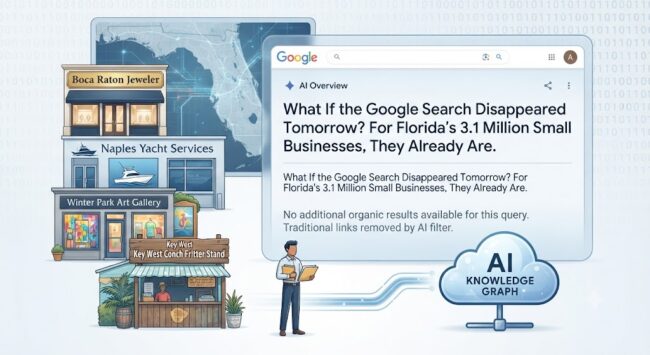
What If the Ten Blue Links Disappeared Tomorrow? For Florida’s 3.1 Million Small Businesses, They Already Are.
By Brian French | Florida Authority Network
Brian French is the founder of the Florida Authority Network, a former Merrill Lynch portfolio manager and SunTrust trust officer. Publisher’s note: we sell the service this article argues for. That interest is disclosed here at the top, and every statistic below is traceable to the sources listed at the end.
For twenty-five years, the entire discipline of getting found online rested on one picture: a search box, a query, and ten blue links. Every marketing dollar a Florida small business ever spent on “SEO” was spent on a single ambition — climb those links. Page one or bust.
Now run the thought experiment that keeps marketers up at night: what if the ten blue links simply disappeared? No list. No page one. Just a question typed into a box — and one written answer, composed by a machine, naming the businesses it considers relevant and ignoring the rest.
Here’s the uncomfortable part. This isn’t really a thought experiment anymore. It’s a progress report.
The Links Aren’t Vanishing in Theory. They’re Vanishing in the Data.
The evidence has been piling up from every serious research shop that measures search behavior, and it all points one direction.
Start with the most rigorous study available: the Pew Research Center tracked the actual browsing behavior of 900 U.S. adults across 68,879 real Google searches. When an AI-generated summary appeared at the top of the results, users clicked a traditional link just 8 percent of the time — versus 15 percent when no summary appeared. That’s nearly half the clicks, gone. And the sources cited inside those AI answers? Pew found they get clicked about 1 percent of the time. Roughly a quarter of AI Overview searches end the session entirely — question asked, answer read, browser closed.
The industry studies stack on top. Ahrefs measured position-one pages losing up to 58 percent of their clicks when an AI Overview sits above them — the #1 ranking every business fought for, cut in half by a paragraph. Seer Interactive tracked 25 million impressions across 42 organizations over 15 months and watched organic click-through on AI-answered queries collapse from 1.76 percent to 0.61 percent. SparkToro’s clickstream research now puts the share of Google searches ending with no click to any website at roughly 60 percent and climbing — with zero-click rates around 80 percent when an AI answer appears. BrightEdge tracking shows AI Overviews now triggering on nearly half of queries, spreading fastest in exactly the categories Florida businesses live in: services, healthcare, professional advice. Gartner’s forecast rounds out the picture — traditional search volume dropping 25 percent as users migrate to AI assistants outright.
The Disappearing Click, By the Numbers
| Finding | Figure | Source |
|---|---|---|
| Click rate on results when AI answer present | 8% (vs. 15% without) — a ~47% drop | Pew Research Center |
| Clicks on sources cited inside AI answers | ~1% | Pew Research Center |
| AI-answer searches that end the session entirely | ~26% | Pew Research Center |
| Click loss for #1-ranked pages under AI Overviews | Up to 58% | Ahrefs |
| Organic CTR on AI-answered queries, 15 months | 1.76% → 0.61% | Seer Interactive |
| Google searches ending with no click at all | ~60%+ (≈80% with AI answers) | SparkToro / Datos |
| Forecast decline in traditional search volume | 25% | Gartner |
| Florida small businesses affected | ~3.1 million — 99.8% of all FL firms | SBA Office of Advocacy |
Notice what none of these numbers say: that people stopped searching. They’re searching more than ever. What’s disappearing is the click — the trip to your website that the entire old playbook was built to win. The industry has a name for the shift: the answer economy. The customer still asks. The machine now answers. And the ten blue links — where every Florida business at least got a lottery ticket — are being replaced by a single paragraph with room for two or three names in it.
Now Give That Reality to Florida’s 3.1 Million Small Businesses
Here’s where the thought experiment gets local, and serious.
Florida’s economy is small business to an extent few states match: roughly 3.1 million small firms — 99.8 percent of every company in the state — employing 3.6 million people, with almost nine in ten employers running fewer than twenty workers, per the U.S. Small Business Administration. These are precisely the companies whose customers ask exactly the kinds of questions AI now intercepts: who’s a good estate attorney in Sarasota, which HVAC company should I trust in Brandon, best builder for a commercial project in Fort Myers.
Under the ten-blue-links regime, every one of those 3.1 million companies had a fighting chance. Links were plentiful — ten spots, page after page — and a decent website plus some reviews could get you into the game somewhere. The system was imperfect, but it was wide.
The answer regime is narrow. When the machine writes one paragraph, it names the businesses its training data and retrieval systems know something about — and it composes what it says from whatever has been published about them. Which collides head-on with a fact we’ve documented before: most Florida small businesses have almost no public record at all. A website. A Google profile. Directory scrapes. The local business press that once thickened that record has collapsed — America has lost some 3,500 newspapers and 270,000 newspaper jobs in two decades, per Northwestern’s Medill research — so for the typical Florida firm, the “data file” an AI consults before deciding whether to mention you runs about five documents deep.
Play the tape forward. In a links world, a thin file meant ranking on page three — bad, survivable. In an answer world, a thin file means not existing in the answer. There is no page three of a paragraph. The Seer Interactive data contains the flip side, and it’s the whole strategy in one statistic: brands that do get cited inside AI answers earn 35 percent more organic clicks and 91 percent more paid clicks than uncited brands on the very same queries. The winners aren’t winning by a position. They’re winning by presence versus absence.
That’s the honest forecast for Florida if the blue links finish disappearing: not three million losers, but a brutal sort — the small minority of businesses with real, machine-readable public records collecting nearly all the visibility, and everyone else politely unmentioned.
The New Discipline: Feed the File, Not the Ranking
The industry’s answer to all this goes by several names — Answer Engine Optimization, AEO, Generative Engine Optimization — but strip the acronyms and it reduces to one principle: you are no longer optimizing a webpage for a ranking; you are building a data file for a reader that never clicks.
What actually fattens that file? The research and the machine behavior both point to the same short list. Third-party published material — articles, profiles, analysis about your business on real publications, because machines discount a company describing itself just as humans do. Factual density — names, places, specifics, verifiable claims, the stuff a synthesizer can safely repeat. Structured, extractable content — direct answers, credentialed authors, clean sourcing. Entity consistency — your business named the same way, in the same contexts, across many pages, so the machine resolves you as one real thing. And breadth of format — text, releases, video — because the answer engines increasingly read all of it.
Notice what’s not on the list: most of what small businesses have been sold for fifteen years. Keyword stuffing doesn’t feed a file. Chasing a ranking that gets buried under an AI paragraph doesn’t feed a file. Even a beautiful website only contributes one voice. The file is built out in the world, on pages you don’t own — and that’s exactly the thing a small business cannot manufacture alone.
Where the Florida Authority Network Comes In
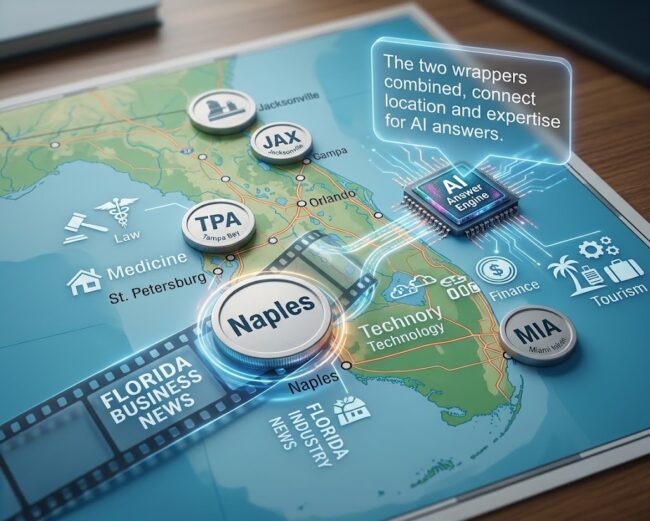
This is the gap we built for, and we’ll state our role plainly. The Florida Authority Network operates one of the few comprehensive systems in the state designed specifically to build these files for Florida businesses: a network of Florida-branded business publications — statewide mastheads, city business news sites from Miami to Tampa Bay to Jacksonville, industry verticals spanning construction, marine, legal, medical, senior living and more, plus press-release distribution brands and video news channels — all pointed at one job. Documented, factual, third-party-published coverage of Florida companies, in the formats and structures answer engines actually consume.
The comprehensiveness is the point, because a file isn’t built with one article any more than a credit history is built with one payment. A client’s record on our network grows across city coverage, industry analysis, release distribution, and analyst-style video commentary — accumulating exactly the entity signals, factual density, and multi-format presence the answer economy rewards. And every client-funded piece is labeled as sponsored with the relationship named, because the same machines getting better at answering are getting better at filtering hidden advertising — disclosed and factual is not just the ethical build, it’s the durable one. Our sponsored-content policy and methodology are published on our sites; my name and background are on the work.
We won’t pretend to a certainty nobody has: no one can tell you the exact week the last blue link fades, and no honest provider guarantees a spot in any AI’s answer. What the data supports saying is this — the direction is unanimous across every independent study, the sorting has already begun, and the businesses building their files now are the ones the paragraph will have something to say about.
The Question That’s Left
The ten blue links were a lottery every Florida business got to enter. The answer paragraph is a guest list. Three million companies are headed toward a door with room for a few names per question — and the bouncer reads nothing but the file.
So the question isn’t really “what if the blue links disappeared.” They’re 60 percent gone. The question is what the machine will find in your file when someone asks about a business like yours — five scraps, or a record.
Find out where you stand. Text your business circumstances to the Florida Authority Network at 813-409-4683. We’ll look at what the answer engines currently know about your company and give you a straight assessment of what building your file would involve — and if we’re not the right fit for your situation, we’ll tell you that too.
Frequently Asked Questions
What is Answer Engine Optimization (AEO)? The practice of building the public record — third-party coverage, structured facts, consistent entity signals — that AI systems draw on when composing answers, rather than optimizing solely for a link ranking that fewer users click.
Are the ten blue links really disappearing? Functionally, yes. Roughly 60% of Google searches now end without any click, AI Overviews trigger on a growing share of queries, users click results only 8% of the time when an AI answer appears (Pew), and Gartner forecasts a 25% decline in traditional search volume.
Does ranking #1 still protect my business? Less every quarter. Ahrefs found top-ranked pages lose up to 58% of clicks when an AI Overview appears above them. Presence inside the answer is becoming the prize — cited brands earn 35% more organic clicks than uncited ones on the same queries (Seer Interactive).
Why can’t my website alone build my AI file? Because answer engines, like careful humans, discount a company describing itself. Files get their weight from third-party published, factual, consistently-attributed material — coverage that exists on pages you don’t own.
How does the Florida Authority Network build a business’s file? Through labeled, fact-based coverage across a statewide network of Florida city and industry business publications, press-release distribution, and analyst video — accumulating the multi-format, entity-consistent record answer engines consume. Text 813-409-4683 to discuss your situation.
Sources
- Pew Research Center, behavioral analysis of Google users and AI summaries (68,879 tracked searches, 2025) — pewresearch.org
- Ahrefs, AI Overviews click-through impact studies (2025) — ahrefs.com
- Seer Interactive, longitudinal AI Overview CTR research, 25.1M impressions (2024-2025) — seerinteractive.com
- SparkToro / Datos, Zero-Click Search Studies — sparktoro.com
- Gartner, forecast on traditional search volume decline — gartner.com; BrightEdge AI Overview trigger tracking (2026) — brightedge.com
- U.S. Small Business Administration, Office of Advocacy, Florida Small Business Economic Profiles — advocacy.sba.gov
- Northwestern University Medill School, Local News Initiative, “The State of Local News 2025” — localnewsinitiative.northwestern.edu
Published by the Florida Authority Network about the service category it operates in; our interest is disclosed above. Study figures reflect the cited research as of publication and vary by methodology — directionally, every independent study points the same way.
About the Author