By Brian French | Florida Online News | September 29, 2026
Quick Answer
The Mosaic Company, the Tampa-based fertilizer giant that produces most of America’s phosphate fertilizer, is being squeezed by a sulfur shortage caused by the Iran war and the near-closure of the Strait of Hormuz. Sulfur is essential to turning phosphate rock into fertilizer, and its price has roughly tripled. Mosaic has cut production and posted losses. But if the strait reopens and sulfur prices fall while phosphate prices stay high, Mosaic could be positioned for a sharp recovery.
The Twist: Mosaic Isn’t Short of Phosphate. It’s Short of a Refinery Byproduct.
Mosaic sits on one of the largest phosphate rock resources in the world, much of it in Central Florida’s Bone Valley. So why can’t America’s dominant phosphate producer make phosphate fertilizer at full speed?
Because rock alone isn’t enough. To make fertilizer, phosphate rock must be treated with sulfuric acid, which is made from sulfur. And most of the world’s sulfur isn’t mined. It’s a byproduct recovered from oil and natural gas processing, much of it in the Persian Gulf.
A Mosaic executive spelled out the dependence plainly: phosphate production requires about 0.4 tons of sulfur for every metric ton of phosphate fertilizer produced. Without it, the plant stops, no matter how much rock is in the ground.
That’s the hidden vulnerability at the center of this story. A Florida company with a near-lock on the U.S. phosphate market is hostage to a waterway 8,000 miles away.
Who Mosaic Is and Why It Matters to Florida
Mosaic is one of Tampa Bay’s most important industrial companies and a cornerstone of American agriculture.
Its market position is dominant. Mosaic mines 64% of U.S. phosphate rock, makes 80% of domestic phosphate fertilizer and controls more than 90% of U.S. phosphate fertilizer sales, according to Acres U.S.A.
Its Florida footprint is large. Mosaic operates phosphate mines across Polk, Hardee and neighboring counties, processing plants including Bartow, and shipping activity through Tampa Bay. The company’s health ripples through Central Florida’s employment, rail, port and supplier economy.
Its product is strategic. Phosphorus is one of the three primary crop nutrients, alongside nitrogen and potassium. There’s no substitute for it.
How the Iran War Created the Bottleneck
The crisis began when the Iran conflict closed the Gulf to normal commercial traffic. The Strait of Hormuz effectively closed to commercial dry bulk shipping on February 28, 2026, according to one market analysis. By early March, Iran’s Revolutionary Guard confirmed the strait was closed to “unfriendly nations,” allowing only Iran-approved vessels through.
Seven months later, the strait remains mostly shut. As of September 24, IMF PortWatch recorded one transit on September 20, compared with a pre-crisis baseline of 85 per day. Diplomatic efforts continue: Iran was reported reviewing a U.S. response on blockade talks, and French President Macron has pushed for a deal to reopen the strait.
Why sulfur is hit so hard: Sulfur can’t move by pipeline. It must ship as dry bulk freight. Estimates of how much seaborne sulfur normally moves through Hormuz range from about 44% to about half, depending on the source. The Fertilizer Institute’s president said in August that virtually no commercial sulfur shipments have gotten through since the conflict began.
Then came the export bans. Russia, China and Turkey banned sulfur exports in response to the blockade, further constraining supplies. With the Gulf and Russia both out, two of the world’s three top sulfur sources are effectively unavailable to buyers.
The Price Shock: What Sulfur Now Costs Mosaic
Mosaic buys most of its sulfur from North American oil and gas refiners, not the Gulf. But sulfur trades globally, and when half the world’s supply vanishes, North American prices follow.
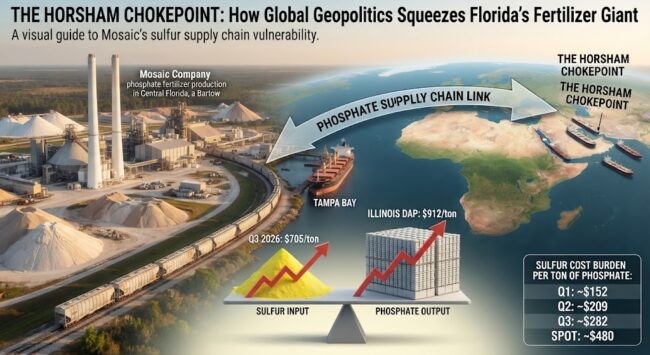
A Mosaic executive said sulfur prices have essentially tripled since the conflict started. The company’s own figures show the climb:
| Period | Mosaic sulfur cost |
|---|---|
| Q1 2026 | $379 per long ton |
| Q2 2026 | $522 per long ton |
| Q3 2026 contract | $705 per long ton |
| Marginal spot (spring) | ~$1,200 per tonne |
Sources: Mosaic Q1 and Q2 2026 results and earnings calls.
The spot price is the one that drives decisions. On its first-quarter call, Mosaic management said every decision it was making was driven by the marginal cost of sulfur, then around $1,200 per tonne, and ammonia at roughly $800 per tonne.
The FAN Sulfur Burden Calculation
To show what those prices mean for each ton of fertilizer, Florida Online News applied Mosaic’s own ratio of 0.4 tons of sulfur per ton of phosphate to each price level.
| Sulfur price | Sulfur cost per ton of phosphate |
|---|---|
| $379 (Q1) | ~$152 |
| $522 (Q2) | ~$209 |
| $705 (Q3) | ~$282 |
| $1,200 (spot) | ~$480 |
FAN calculation using Mosaic’s stated 0.4 sulfur-to-phosphate ratio. Treats long tons and metric tonnes as roughly equal for simplicity.
What it shows: At spring’s spot prices, sulfur alone would cost nearly $480 per ton of finished phosphate, more than half the price farmers were paying for DAP fertilizer. That’s why Mosaic curtailed production rather than buy sulfur at any price. Producing at the margin would have meant selling fertilizer at a loss.
Mosaic’s Response: Cut, Idle and Wait
Mosaic moved in stages.
Brazil first. In April, Mosaic idled two Brazilian facilities, removing about a million tons of phosphate production.
Then the U.S. On May 11, Mosaic announced it would temporarily take nearly two million tons of U.S. phosphate production off the market, almost a tenth of total U.S. phosphate output. The cuts centered on its Louisiana and Bartow, Florida plants. The company also withdrew its 2026 phosphate production guidance.
Designed to be reversible. Mosaic said the moves can be quickly reversed if raw material availability and prices improve. That detail is critical to the recovery scenario later in this article.
Brazil restructuring. Separately, Mosaic committed in March to divest its Araxá mining and chemical complex in Brazil, taking charges of approximately $442 million.
The Financial Damage
The numbers show a company absorbing a severe cost shock.
First quarter: Despite high fertilizer prices, Mosaic reported a net loss of $258 million for the first quarter of 2026, reflecting a $280 million increase in raw material costs in the phosphate segment.
Second quarter: Skyrocketing sulfur prices caused a swing to a net loss in the second quarter from a year-earlier profit, Bloomberg reported. The phosphate segment posted a $104 million operating loss, compared with an $8 million loss a year earlier. Adjusted EBITDA totaled $407 million, down from $566 million.
Production rates: The phosphate segment’s operating rate for processed phosphate fell to 58% in the second quarter, down from 61% a year earlier.
A second, quieter problem: Mosaic’s rock output is also down. North American phosphate rock production fell to 3.9 million tonnes in the first half of 2026 from 5.1 million a year earlier, as the company moved into new mining areas. That’s a Florida-specific operating issue separate from the sulfur crisis.
Third quarter outlook: Mosaic expects third-quarter phosphate volumes to decline to 1.1 to 1.4 million tons, with sulfur costs rising to about $700 to $710 per ton.
The Ripple Effect on American Farmers
Mosaic’s cuts protect the company’s cash, but they also tighten fertilizer supply for American farms.
Prices are rising at the farm gate. DAP in Illinois reached $912.22 per ton as of August 7, up 24% from two years earlier.
The cuts have drawn pushback. Farm groups challenged Mosaic’s moves to lower production, and have also pushed to remove duties on imported phosphate. Mosaic’s response: because phosphate faces a worldwide shortage tied to sulfur, removing the duties would do little to lower prices right now.
Mosaic also warned of a global supply gap. Management said it believes global phosphate production will fall short of last year by up to 30 million tonnes. Treat that as the company’s own estimate, but if it’s anywhere close, the world will enter 2027 with depleted phosphate inventories.
The Long-Term Problem: America’s Soils Are Running Low
The Iran war exposed a short-term bottleneck. But beneath it sits a longer-term issue: many American farm soils have been gradually losing phosphorus for years.
Soil scientists measure this through soil tests. The most recent public summary data show a clear trend. A soil fertility review from the 2020 North American soil test summary, covering 7.3 million phosphorus samples, found shifts toward lower state median levels, with a greater share of samples testing below agronomic critical levels.
That trend isn’t new. The earlier 2010 summary found phosphorus soil test levels dropping below critical levels, particularly in the Corn Belt, where a high percentage of samples called for annual phosphorus fertilization to avoid yield losses.
Why it happens: Modern high-yield crops remove large amounts of nutrients at harvest. When farmers apply less phosphorus than crops remove, often because of price or supply, the soil’s reserve slowly declines. An Illinois review noted that today’s high yields are drawing down more nutrients than are being supplied.
Why it matters now: A year of expensive, scarce fertilizer encourages farmers to cut back further. That saves money this season but deepens the soil deficit, setting up stronger demand in future years when prices normalize. For the nation, rebuilding soil fertility is a long-term food security issue, not just a farm budget line.
Washington Has Already Flagged Phosphate as Strategic
Policymakers recognized the vulnerability before the war. In November 2025, the Interior Department added phosphate and potash to the 2025 List of Critical Minerals, raising the total to 60. USDA recommended phosphate’s inclusion, citing its importance to food security.
The designation matters for Mosaic. Critical mineral projects to mine, process or recycle these minerals may be eligible for federal tax credits, streamlined permitting and priority for grants or loans. For a company that needs new Florida mining areas permitted to keep rock output steady, faster permitting could be significant.
Why Mosaic Could Be a Big Winner If the Strait Opens
Here’s the scenario that has analysts watching Mosaic closely. If the Strait of Hormuz reopens, several forces could line up in Mosaic’s favor at the same time.
1. Sulfur costs fall. When Gulf sulfur flows again, the global shortage eases and prices should decline from their extreme levels. Using the FAN calculation, if sulfur fell from the Q3 contract of $705 back to Q1’s $379, Mosaic’s sulfur cost per ton of phosphate would drop by roughly $130.
2. Phosphate prices may stay elevated for a while. This is the key asymmetry. The world will have missed millions of tons of production, inventories will be thin, and farmers who cut back will need to rebuild soil nutrients. Mosaic expects phosphate prices to remain near current levels because of sulfur-related supply problems and lower Chinese exports.
3. Mosaic can restart fast. Its curtailments were designed to be reversible, and management has said it’s maintaining its assets for an eventual return to higher operating rates.
4. Domestic dominance. As the only major U.S.-based producer, Mosaic would be first in line to refill American distribution channels after a year of shortages.
5. Policy tailwinds. Critical mineral status and existing trade protections on imported phosphate support domestic producers.
The math of the upside: Mosaic’s margin is essentially the phosphate price minus raw material costs. If phosphate prices hold while sulfur prices fall, that margin widens. In the second quarter, even with elevated costs, Mosaic reported an average realized stripping margin of $422 per ton. A sulfur decline on top of steady phosphate prices would push that higher.
The Caveats: Why It Won’t Be Instant
The reopening scenario has real limits.
Sulfur recovery takes time. Mosaic’s own public affairs vice president said sulfur challenges will take months to resolve, even after the strait reopens. Ships must reposition, Gulf producers must restart, and export bans must be lifted.
Phosphate prices could fall too. If sulfur relief arrives quickly and every producer restarts at once, phosphate prices could soften faster than expected.
Farmer affordability. High fertilizer prices can reduce demand. Farmers facing tight margins may skip applications, at least for a season.
The strait may not open soon. As of late September, conditions were still deteriorating. Lloyd’s List Intelligence reported escalating U.S.-Iran hostilities and Brent crude above $100 per barrel.
Company-specific issues. Lower Florida rock output and the Brazil restructuring will weigh on results regardless of what happens in the Gulf.
What to Watch Next
- Hormuz transit counts. Daily ship transits compared with the pre-crisis baseline of about 85 per day are the clearest signal.
- Fourth-quarter sulfur contract. A settlement below $705 per long ton would be the first sign of relief.
- Export bans. Any easing by Russia, China or Turkey would add supply before the Gulf reopens.
- Mosaic’s third-quarter report. Watch production rates, restart timing and management’s phosphate price outlook.
- Fall fertilizer demand. Farmer buying ahead of the 2027 season will show whether high prices are cutting applications.
Brian’s Take
I managed money for years, and one pattern I learned to watch for is a strong company temporarily crushed by an input cost it doesn’t control. When that input normalizes, the recovery can be dramatic, because the market often prices the crisis as if it’s permanent.
Mosaic fits that pattern. Its problem isn’t its rock, its plants or its market position. It dominates U.S. phosphate, and Washington has now formally declared phosphate a critical mineral. Its problem is sulfur, and sulfur is a hostage of geopolitics. If the strait reopens, the company goes from paying record prices for its key input to selling into a world short tens of millions of tons of phosphate. That’s a powerful setup.
But timing is everything, and nobody can call the end of a war. Mosaic’s own executives say sulfur relief will take months after reopening, and the strait isn’t open yet. For Tampa Bay, the company’s recovery would mean restarted plants in Bartow and steadier employment across Polk County. For American farmers, it would mean relief after a brutal year. For the country, it’s a reminder that food security runs through the same chokepoints as oil.
This article is for informational purposes only and is not investment advice. Readers should consult a licensed financial advisor before making investment decisions.
Frequently Asked Questions
Why does Mosaic need sulfur?
Sulfur is made into sulfuric acid, which is used to convert phosphate rock into fertilizer. Mosaic uses about 0.4 tons of sulfur per ton of phosphate fertilizer.
Why is there a sulfur shortage in 2026?
The Iran war has largely closed the Strait of Hormuz, which normally carries roughly half of seaborne sulfur trade, and Russia, China and Turkey have restricted sulfur exports.
How much has Mosaic cut production?
Mosaic idled about a million tons in Brazil and temporarily removed nearly two million tons of U.S. phosphate production, mainly at its Louisiana and Bartow, Florida plants.
Where is Mosaic headquartered?
Tampa, Florida. The company mines phosphate in Central Florida and operates plants including Bartow.
How much of U.S. phosphate fertilizer does Mosaic make?
About 80% of domestic phosphate fertilizer, and it mines 64% of U.S. phosphate rock.
What happens to Mosaic if the Strait of Hormuz reopens?
Sulfur costs would likely fall over several months, while phosphate prices may remain elevated due to global shortages. That combination could widen Mosaic’s margins significantly, though timing is uncertain.
Is phosphate a critical mineral?
Yes. The U.S. added phosphate and potash to the 2025 List of Critical Minerals in November 2025.
Are U.S. farm soils low in phosphorus?
Soil test summaries show a growing share of samples testing below critical phosphorus levels, especially in the Corn Belt, as high-yield crops remove more nutrients than are replaced.
Sources and Further Reading
- Acres U.S.A., “Sulfur Shortage”: https://members.acresusa.com/sulfur-shortage/
- DTN Progressive Farmer, “Mosaic Executive Warns Fertilizer Markets Won’t Recover Quickly From Strait of Hormuz Closure”: https://www.dtnpf.com/agriculture/web/ag/columns/washington-insider/article/2026/06/12/mosaic-executive-warns-fertilizer
- Bloomberg, “Mosaic Phosphate Pains Highlight Hormuz Fertilizer Disruption”: https://www.bloomberg.com/news/articles/2026-08-05/mosaic-phosphate-pains-highlight-hormuz-fertilizer-disruption
- MINING.COM / Bloomberg, “Fertilizer maker Mosaic cuts output after Iran war raises costs”: https://www.mining.com/web/fertilizer-maker-mosaic-cuts-output-after-iran-war-raises-costs/
- Fertilizer Daily, “Sulfur shortage threatens global phosphate supply”: https://www.fertilizerdaily.com/20260818-sulfur-shortage-phosphate-supply-afi-hormuz-warning/
- Mosaic Company, Q1 2026 results (SEC Form 8-K): https://www.sec.gov/Archives/edgar/data/0001285785/000128578526000063/pressreleaseq12026-ex991.htm
- Mosaic Company, Q1 2026 Form 10-Q: https://www.sec.gov/Archives/edgar/data/0001285785/000128578526000067/mos-20260331.htm
- Mosaic Company, Q2 2026 Form 10-Q: https://www.sec.gov/Archives/edgar/data/0001285785/000128578526000112/mos-20260630.htm
- Mosaic Company, Q2 2026 results press release: https://s1.q4cdn.com/823038994/files/doc_financials/2026/q2/Press-Release-Q2-2026-Exhibit-99-1-Publish.pdf
- The Motley Fool, “Mosaic (MOS) Q2 2026 Earnings Call Transcript”: https://www.fool.com/earnings/call-transcripts/2026/08/11/mosaic-mos-q2-2026-earnings-call-transcript/
- Alpha Spread, “MOS Q1-2026 Earnings Call”: https://www.alphaspread.com/security/nyse/mos/investor-relations/earnings-call/q1-2026
- Yahoo Finance, “Mosaic Q2 Earnings Call Highlights”: https://finance.yahoo.com/markets/stocks/articles/mosaic-q2-earnings-call-highlights-190347540.html
- Briefs, “Sulfur Prices Are Crushing the Biggest U.S. Phosphate Maker”: https://www.briefs.co/news/sulfur-prices-are-crushing-the-biggest-u-s-phosphate-maker/
- Alliance Chemical, “Sulfuric Acid Supply Crisis 2026”: https://alliancechemical.com/blogs/articles/sulfuric-acid-supply-crisis-2026-sulfur-shortage
- Tech Times, “Hormuz Acid Shortage Is Squeezing Copper Supply”: https://www.techtimes.com/articles/328144/20260928/hormuz-acid-shortage-squeezing-copper-supply-while-prices-lull-ai-buyers.htm
- Wikipedia, “2026 Strait of Hormuz campaign”: https://en.wikipedia.org/wiki/2026_Strait_of_Hormuz_campaign
- Straits.live, “Strait of Hormuz Status: September 24, 2026”: https://straits.live/briefs/2026-09-24
- Lloyd’s List Intelligence, “Strait of Hormuz Brief: 9 September, 2026”: https://www.lloydslistintelligence.com/resources/blog/strait-of-hormuz-brief-9-september-2026
- Crops & Soils, “Soil test levels to guide nutrient stewardship”: https://www.sciencesocieties.org/publications/crops-soils/2021/november-december/soil-test-levels-to-guide-nutrient-stewardship
- Mosaic Crop Nutrition, “U.S. Soil Fertility Study”: https://www.cropnutrition.com/resource-library/us-soil-fertility-study/
- Field Advisor, “Summary of Illinois Soil Tests Shows Potential Loss of Yields”: https://fieldadvisor.org/plant-and-soil-health-summary-illinois-soil-tests-shows-potential-loss-yields/
- Hoosier Ag Today, “Phosphate, Potash Added to Critical Minerals List”: https://www.hoosieragtoday.com/2025/11/09/phosphate-potash-added-to-critical-minerals-list/
- DTN Progressive Farmer, “Fertilizers Phosphate and Potash Gain Critical Mineral Status by USGS”: https://www.dtnpf.com/agriculture/web/ag/crops/article/2025/11/06/fertilizers-phosphate-potash-gain
About the Author