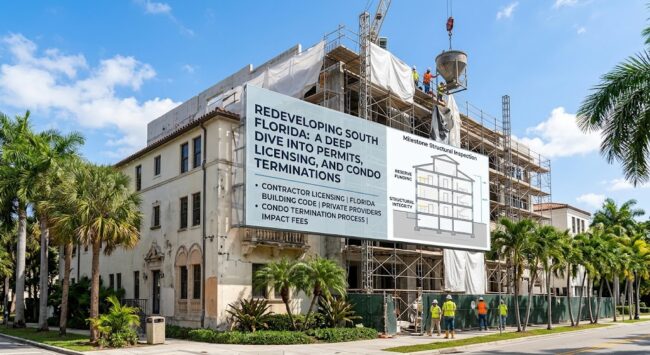
Quick Answer: Building in South Florida requires properly licensed contractors, permits issued under the Florida Building Code, and inspections that confirm compliance. Miami-Dade and Broward counties sit in the High-Velocity Hurricane Zone, which imposes stricter wind standards and product approvals. Unlicensed contractors generally cannot enforce their contracts or liens, open permits can delay sales and financing, and Florida law now offers tools such as private provider plan review and inspections and deadlines for local permit decisions.
Permitting and code compliance are where many South Florida development projects gain or lose months. A missing product approval, an incomplete plan submittal, a contractor whose license does not cover the work, or an open permit from a prior owner can stall construction, block a closing, or delay a certificate of occupancy that tenants and buyers are waiting on. For developers, contractors, and property owners, understanding the rules is as important as understanding the budget.
McArdle Franco PLLC, a Coral Gables law firm established in 2002, represents developers, property owners, contractors, subcontractors, architects, engineers, commercial tenants, and lenders in land development and construction matters. As a Florida land development attorney team whose senior partners have built real estate and construction businesses themselves, the firm understands how permitting and licensing problems affect real projects. This article explains the key rules.
Contractor Licensing in Florida
Certified and Registered Contractors
Chapter 489 of the Florida Statutes governs construction contracting. The Construction Industry Licensing Board (CILB), within the Department of Business and Professional Regulation, regulates contractors.
| License Type | Scope |
|---|---|
| Certified contractor | Licensed by the state; may work anywhere in Florida |
| Registered contractor | Licensed for specific local jurisdictions where it holds competency |
| Specialty contractors | Roofing, plumbing, mechanical, pool, and other trades |
| Electrical contractors | Licensed separately under Part II of Chapter 489 |
General, building, and residential contractor licenses carry different limits on the type and height of structures the contractor may build. A residential contractor, for example, cannot build a commercial mid-rise.
Qualifying Agents
A business entity engaged in contracting must have a licensed qualifying agent. The qualifier is responsible for supervising the entity’s construction operations and can face discipline for the entity’s violations. Owners should confirm that the entity they contract with is properly qualified, not just that an individual associated with it holds a license.
Consequences of Unlicensed Contracting
Florida treats unlicensed contracting seriously:
- Contracts unenforceable: Under Section 489.128, a contract entered into by an unlicensed contractor is generally unenforceable in law or equity by the unlicensed contractor.
- No lien rights: Unlicensed contractors generally cannot enforce construction liens.
- Criminal penalties: Unlicensed contracting is a crime, and penalties increase during a declared state of emergency, such as after a hurricane.
- Owner remedies: Owners may have claims against unlicensed contractors, and licensed contractors who aid unlicensed activity face discipline.
A Coral Gables construction lawyer reviewing a contract will verify the license of every contractor and key subcontractor before work begins.
Owner-Builder Exemption
Florida allows property owners to act as their own contractor for certain work on their own property under an owner-builder exemption, subject to disclosure and occupancy requirements. The exemption is narrow and is generally not available for property built for sale or lease.
The Florida Building Code
Florida adopts a single statewide building code, the Florida Building Code, updated on a three-year cycle by the Florida Building Commission. The 8th Edition (2023) took effect at the end of 2023, and the next edition is in development. Local governments enforce the code and may adopt limited local amendments.
The High-Velocity Hurricane Zone
Miami-Dade and Broward counties are designated as the High-Velocity Hurricane Zone (HVHZ), which carries the code’s most stringent wind design and construction requirements. Products used in the building envelope, such as windows, doors, shutters, roofing, and skylights, must have approval demonstrating compliance with HVHZ standards. Miami-Dade County’s product control program issues Notices of Acceptance (NOAs) that are widely recognized in the industry. Using products without proper approval can result in failed inspections, removal of installed work, and delays.
Flood Zones and Coastal Construction
Much of South Florida lies within FEMA special flood hazard areas. Construction must meet flood-resistant design requirements, including minimum elevations and substantial improvement rules that can require existing buildings to be brought into compliance when renovations exceed 50 percent of market value. Construction seaward of the Coastal Construction Control Line requires state permits under Chapter 161.
The Permitting Process
Building Permits
Under Section 553.79 of the Florida Statutes, building permits are generally required before construction, alteration, or demolition. Permit applications typically require signed and sealed plans, product approvals, energy calculations, and other documentation. Larger projects may require separate permits for structural, mechanical, electrical, plumbing, fire, and site work.
Deadlines for Local Permit Decisions
Section 553.792 requires local governments to approve, approve with conditions, or deny certain building permit applications within statutory timeframes after receiving a complete application. Recent amendments added consequences, including fee reductions when local governments miss deadlines, and limited the number of requests for additional information. Applicants should track submission and response dates carefully to preserve these rights.
Private Provider Plan Review and Inspections
Section 553.791 allows owners or contractors to hire licensed private providers, such as engineers, architects, or certified building code inspectors, to perform plan review and inspections in place of the local building department. Legislative amendments in recent years expanded the program, required local governments to accept private provider work within set timeframes, and addressed fees. For time-sensitive projects, private providers can significantly shorten approval timelines.
| Permitting Tool | Benefit |
|---|---|
| Complete initial submittal | Starts statutory review clock |
| Private provider plan review | Faster review by licensed professionals |
| Private provider inspections | Reduces scheduling delays |
| Phased permits | Allows foundation work before full approval |
| Pre-application meetings | Identifies issues early |
Threshold Buildings
Buildings that exceed specified height, occupancy, or area thresholds require a special inspector, known as a threshold inspector, under Section 553.79 to inspect structural components during construction. Developers of mid-rise and high-rise projects must budget for this requirement.
Inspections and Certificates of Occupancy
Each phase of permitted work requires inspection before it is covered or completed. Failed inspections require corrections and re-inspection. At completion, the building official issues a certificate of occupancy or certificate of completion. Temporary certificates of occupancy may allow partial occupancy before all work is finished.
Certificates of occupancy are important beyond construction. They often trigger rent commencement under leases, closings for condominium units, conversion of construction loans to permanent financing, and the start of the statute of repose for construction defect claims.
Open Permits and Code Violations
Open and Expired Permits
Permits left open or expired without final inspection can create problems years later. Buyers, lenders, and title insurers increasingly require permit searches. Open permits may need to be closed by the original contractor, a new contractor, or the owner, sometimes after opening walls to verify work. Florida law has provided some relief by allowing local governments to close older permits in certain circumstances, but owners should not assume old permits will be ignored.
Code Enforcement Liens
Under Chapter 162 of the Florida Statutes, local code enforcement boards and special magistrates may impose daily fines for code violations, which can become liens on the property. Fines can accumulate to large amounts. Negotiating reductions or releases often requires correcting the violation and applying for mitigation.
Unpermitted Work
Unpermitted work can create insurance problems, lender objections, and liability when a property is sold. Legalizing unpermitted work usually requires after-the-fact permits, plans, inspections, and sometimes demolition and reconstruction.
Building Safety Inspections for Existing Buildings
Following the 2021 Champlain Towers South collapse, Florida adopted Section 553.899, requiring milestone structural inspections for condominium and cooperative buildings three stories or taller, generally by 30 years after initial occupancy and every 10 years thereafter, with local option for earlier inspections in some cases. Miami-Dade and Broward counties also maintain building safety recertification programs for older buildings. Developers acquiring older buildings for renovation or redevelopment must account for these requirements and any repairs they reveal.
Impact Fees and Development Approvals
Building permits are only one layer of approval. Before vertical construction, many projects need site plan approval, platting, utility capacity commitments, and payment of impact fees for roads, schools, parks, water, and sewer. Florida’s Impact Fee Act, Section 163.31801, requires impact fees to be proportional and reasonably connected to the impacts of new development and limits how quickly local governments can raise them. Developers should confirm fee amounts and timing early, because impact fees are often due before a building permit or certificate of occupancy is issued and can materially affect a project budget. Credits may be available for infrastructure the developer builds itself.
Contract Provisions That Allocate Permitting Risk
Permitting and licensing risks should be allocated clearly in development and construction contracts. A Miami construction law firm drafting those contracts will address:
- Who obtains which permits, including building, site, utility, and environmental permits
- Who pays permit and impact fees
- Licensing representations by contractors and subcontractors
- Product approval requirements for HVHZ compliance
- Time extensions for permit delays outside the contractor’s control
- Responsibility for failed inspections and corrective work
- Closeout obligations, including final inspections and certificates of occupancy
- Private provider use and cost allocation
Purchase and Lease Due Diligence
Buyers of existing buildings and tenants leasing space for build-out should investigate permit and code history before committing. Key steps include ordering municipal lien and permit searches, reviewing certificates of occupancy for the intended use, confirming zoning compliance, and identifying open violations. A South Florida real estate development attorney can build these investigations and related remedies into purchase contracts and leases.
When Permitting and Code Issues Become Disputes
Permit delays, failed inspections, and code violations frequently lead to disputes over who caused the problem and who pays. Owners may claim the contractor’s work failed inspection. Contractors may claim the design was deficient or the owner delayed approvals. Purchasers may claim sellers concealed open permits or violations. A South Florida construction defect attorney can evaluate whether code violations support claims under Section 553.84, which provides a civil cause of action for damages caused by building code violations.
Frequently Asked Questions
Can an unlicensed contractor sue to get paid in Florida?
Generally no. Under Section 489.128, contracts entered into by unlicensed contractors are unenforceable by the unlicensed contractor, and lien rights are generally unavailable.
What is the High-Velocity Hurricane Zone?
It is the designation for Miami-Dade and Broward counties under the Florida Building Code, requiring the most stringent wind design standards and product approvals for building envelope components.
What is a private provider?
A licensed engineer, architect, or certified building code inspector hired by the owner or contractor to perform plan review and inspections in place of the local building department under Section 553.791.
How long does a local government have to act on a permit?
Section 553.792 sets statutory timeframes for local governments to approve, approve with conditions, or deny certain complete permit applications, with consequences for missing them.
Can open permits stop a property sale?
They can. Buyers, lenders, and title insurers often require open permits to be closed or addressed before closing.
What is a milestone inspection?
It is a structural inspection required by Section 553.899 for condominium and cooperative buildings three stories or taller, generally at 30 years after initial occupancy and every 10 years after that.
Key Takeaways
- Verify contractor and qualifier licensing before signing any contract.
- Unlicensed contractors generally cannot enforce contracts or liens.
- Miami-Dade and Broward projects must meet HVHZ standards and product approvals.
- Private providers and statutory deadlines can accelerate permitting.
- Open permits and code liens should be addressed in due diligence.
About McArdle Franco PLLC
McArdle Franco PLLC is a Coral Gables law firm established in 2002 that counsels and represents businesses throughout Florida, across the nation, and internationally in land development and construction, real estate, business structuring, transaction structuring, and business litigation. The firm represents developers, property owners, contractors, subcontractors, commercial tenants, architects, engineering firms, mortgage lenders, and commercial lenders. The firm was named a Tier 2 firm in Miami for Litigation – Construction in the 2026 edition of Best Law Firms® and was ranked in Chambers USA 2025 for Litigation: General Commercial in Florida.
Contact McArdle Franco PLLC
Address: 255 Alhambra Circle, Suite 925, Coral Gables, FL 33134
Phone: (305) 442-2214
Website: mcardlefranco.com
This article provides general information and is not legal advice. Consult a qualified attorney about your specific situation.
Sources and Further Reading
- Contracting, Chapter 489, Florida Statutes – Florida Legislature
- Florida Building Code, 8th Edition (2023) – Florida Building Commission
- Building Permits, Section 553.79, Florida Statutes – Florida Legislature
- Alternative Plans Review and Inspection (Private Providers), Section 553.791, Florida Statutes – Florida Legislature
- Building Permit Application to Local Government, Section 553.792, Florida Statutes – Florida Legislature
- Milestone Inspections, Section 553.899, Florida Statutes – Florida Legislature
- Local Government Code Enforcement Boards Act, Chapter 162, Florida Statutes – Florida Legislature
- Product Control Division and Notices of Acceptance – Miami-Dade County
- Construction Industry Licensing Board – Florida Department of Business and Professional Regulation
- Land Development and Construction Practice – McArdle Franco PLLC
Condo Terminations and Redevelopment in South Florida
Quick Answer: Aging condominium buildings along South Florida’s coast are increasingly being sold to developers for redevelopment. The process usually involves assembling unit owner support, negotiating a bulk purchase or plan of termination under Section 718.117 of the Florida Statutes, appraising units, addressing mortgages and holdouts, and then securing land use approvals, demolition permits, and financing for the new project. Florida law requires supermajority approval and provides specific protections for unit owners, so careful legal planning is essential for developers and associations alike.
Drive along Collins Avenue, Brickell Bay Drive, A1A in Broward, or the waterfront in Coral Gables and North Miami, and you will see many condominium buildings constructed in the 1960s, 1970s, and 1980s. After the 2021 collapse of Champlain Towers South in Surfside, Florida adopted milestone structural inspections, structural integrity reserve studies, and stricter reserve funding requirements. For many older buildings, those requirements revealed expensive repairs and led to large special assessments and higher monthly fees.
At the same time, the land beneath these buildings, often on the water and zoned for significant density, has become extremely valuable. The result is a wave of condominium terminations and bulk sales in which owners sell their units collectively to developers who demolish the building and construct new projects.
McArdle Franco PLLC, a Coral Gables law firm established in 2002, represents developers, property owners, lenders, contractors, and other participants in land development and construction. The firm’s senior partners have developed single-family and condominium communities, retail space, and mixed-use projects themselves. As a South Florida real estate development attorney team, McArdle Franco helps clients structure condominium redevelopment transactions and the new construction that follows. This article explains the process.
Why Older Condominiums Are Being Redeveloped
| Pressure | Effect on Owners |
|---|---|
| Milestone inspections | Identify structural repairs that must be made |
| Structural integrity reserve studies | Require funding of reserves for major components |
| Reserve funding rules | Limit associations’ ability to waive reserves |
| Rising insurance costs | Increase monthly fees |
| Special assessments | Require large lump-sum payments |
| Land value | Developers offer prices above individual unit market values |
For many owners, a collective sale at a premium is more attractive than paying large assessments to repair an aging building. For developers, buying an existing condominium can provide a waterfront site that would otherwise be unavailable.
Two Paths to Redevelopment
Bulk Purchase of Units
A developer may buy units one by one or under a coordinated purchase program until it controls enough of the building to pursue termination. Purchase contracts often include price escalators, closing deadlines, leaseback rights for sellers, and contingencies tied to reaching a target percentage of units.
Plan of Termination
Florida law allows a condominium to be terminated through a plan of termination, after which the property is owned by a termination trustee or sold, and the proceeds are distributed among unit owners and lienholders. Termination is governed primarily by Section 718.117 of the Florida Statutes.
How Condominium Termination Works
Grounds for Termination
Section 718.117 provides for termination in several circumstances, including:
- Economic waste or impossibility, such as when the total cost of required repairs exceeds the value of the units after completion or when repairs are not legally possible
- Optional termination approved by the required supermajority of voting interests
- Termination after casualty in certain circumstances
Optional termination generally requires approval by at least 80 percent of the total voting interests, and the plan can be defeated if a statutorily specified minority of voting interests rejects it. The statute has been amended repeatedly, including to add protections for unit owners, so the current version must be reviewed for every transaction.
The Plan of Termination
A plan of termination must include, among other things:
- The name of the termination trustee
- The date the plan becomes effective
- Each unit owner’s share of the proceeds and how it is calculated
- The method for allocating proceeds among unit owners and lienholders
- Provisions for selling the property, if applicable
- Any interests to be retained by the developer or bulk owner
Allocation and Appraisal
Proceeds are generally allocated based on the fair market value of each unit as determined by an independent appraiser, or on another method specified in the declaration or plan. Florida law includes protections intended to ensure that unit owners receive fair compensation, including additional protections for certain owners, such as those who use their units as homestead and those who originally purchased from the developer. Developers who control a large share of units face additional scrutiny and requirements.
Notice and Objections
Unit owners must receive notice of the plan and its terms. Unit owners who believe the plan is unfair may contest it in court within a short statutory period. The Division of Florida Condominiums, Timeshares, and Mobile Homes also has oversight responsibilities.
Mortgages and Liens
Lienholders’ interests transfer to the termination proceeds. Unit owners’ mortgages are paid from their share of the proceeds. Planning for mortgage payoffs, tax liens, and judgment liens helps avoid closing delays.
Holdouts and Disputes
Even when most owners support a sale, some may object. Common sources of conflict include:
- Disagreement over appraised values
- Owners who want to stay for personal or financial reasons
- Long-time residents on fixed incomes
- Concerns about tax consequences of the sale
- Claims that the board or developer acted improperly
Associations and developers should anticipate holdouts and structure the plan, communications, and compensation to minimize challenges. Transparency, independent appraisals, and compliance with statutory procedures reduce litigation risk.
Representing the Association and Unit Owners
Associations considering a sale often hire counsel to evaluate offers, negotiate with multiple developers, and protect owners’ interests. Key negotiation points include price, allocation method, deposit amounts, timeline, leaseback rights, relocation assistance, treatment of association reserves and debts, and conditions to closing. Competitive processes that solicit multiple offers often produce higher prices.
Representing the Developer
Developers acquiring a terminated condominium must consider not only the termination process but also whether the site can support the intended new project.
Zoning and Entitlements
Older buildings may have been built under different zoning rules. In some cases, the existing building contains more units or greater height than current zoning would allow, creating a nonconforming structure that may not be rebuilt at the same density. In other cases, current zoning allows significantly more. Developers must analyze the applicable zoning code, comprehensive plan, coastal regulations, and any available incentives before committing. A Florida land development attorney will evaluate entitlement risk as part of due diligence.
Coastal and Environmental Regulation
Waterfront redevelopment may require Coastal Construction Control Line permits, environmental resource permits, compliance with flood elevation requirements, and sea turtle lighting rules. Demolition near the shoreline requires careful planning.
Financing
Acquisition and termination costs can be substantial, and lenders require clear evidence that the termination will succeed and that the new project is feasible. Financing structures often involve land loans, mezzanine debt, and equity partners. Joint venture agreements must address the risk that termination is delayed or challenged.
Tenants and Occupants
Some units may be occupied by tenants under leases that survive the sale. Developers should review leases, plan for termination of occupancy, and comply with notice requirements.
Demolition and New Construction
After termination and closing, the developer typically demolishes the existing building and constructs a new project, often a luxury condominium. The new development must comply with:
- Demolition permits and safety requirements
- The current Florida Building Code and High-Velocity Hurricane Zone standards
- Condominium formation and disclosure requirements under Chapter 718
- Pre-construction sales rules, including escrow of deposits
- Post-Surfside inspection and reserve requirements for the new building over time
A Miami construction law firm can structure demolition, design, and construction contracts that align with the project’s financing and sales timeline. A Coral Gables construction lawyer can also address surety bonds and contractor qualifications for the new project.
Managing Construction Risk on the New Project
The new condominium will eventually be turned over to a new association, which may investigate construction quality. Developers should plan from the start to manage future defect exposure by requiring strong contractor warranties, indemnities, and insurance; maintaining complete construction records; and coordinating condominium documents with construction contracts. A South Florida construction defect attorney can help developers anticipate turnover issues that often arise years after completion.
Governance Duties of the Association Board
Condominium boards considering a sale must act in the interests of the association and its members. Directors owe fiduciary duties, must comply with open meeting and notice requirements, and must disclose conflicts of interest. Board members who own units, have relationships with prospective buyers, or would receive different treatment under a plan should disclose those interests and, where appropriate, abstain. Accurate communication with owners about building conditions, repair costs, and the terms of any offer reduces the risk of later claims that the board breached its duties or misled owners. Many boards form a sale committee and retain independent counsel, appraisers, and brokers to run a fair process.
Tax and Personal Considerations for Owners
Unit owners selling through a termination should consult tax advisers. Owners who used their units as primary residences may qualify for the federal home sale gain exclusion, subject to ownership and use requirements. Investors may consider Section 1031 exchanges to defer gain. Owners who lose homestead status should also consider the effect on property taxes and Save Our Homes benefits at their next residence, including the ability to transfer, or port, accumulated assessment savings under Florida law.
A Timeline Overview
| Phase | Typical Activities |
|---|---|
| Exploration | Board evaluates building condition, costs, and interest |
| Marketing | Association solicits developer proposals |
| Negotiation | Price, allocation, deposits, and conditions agreed |
| Owner approval | Vote on plan of termination or bulk sale |
| Contest period | Owners may challenge plan within statutory deadline |
| Closing | Proceeds distributed; property transferred |
| Entitlements | Developer secures approvals for new project |
| Demolition and construction | New building designed, permitted, and built |
Frequently Asked Questions
How many owners must approve a condominium termination in Florida?
Optional termination generally requires approval by at least 80 percent of total voting interests, and the plan can be defeated if a specified minority rejects it. Requirements depend on the current version of Section 718.117 and the condominium’s declaration.
Can a unit owner be forced to sell?
If a valid plan of termination is approved and survives any challenge, the condominium can be terminated even if some owners object. Florida law provides protections and a process to contest plans that are unfair.
How is each owner’s share of proceeds determined?
Usually based on independent appraisals of each unit’s fair market value or another method in the declaration or plan, subject to statutory protections for certain owners.
Why are so many older condominiums selling to developers?
Post-Surfside inspection and reserve requirements, rising insurance costs, and large special assessments have increased the cost of keeping older buildings, while waterfront land values have made developer offers attractive.
What happens to my mortgage if the condominium is terminated?
The mortgage is generally paid from your share of the termination proceeds at closing.
Can a developer always rebuild at a higher density?
No. Current zoning, comprehensive plan policies, coastal regulations, and nonconforming structure rules determine what can be built. Entitlement analysis is essential before acquisition.
Key Takeaways
- Post-Surfside requirements are driving condominium terminations along the coast.
- Section 718.117 governs termination and requires supermajority approval.
- Unit owners have statutory protections and the right to contest unfair plans.
- Developers must analyze zoning and coastal rules before acquiring.
- Construction contracts for the new building should anticipate future turnover issues.
About McArdle Franco PLLC
McArdle Franco PLLC is a Coral Gables law firm established in 2002 that counsels and represents businesses throughout Florida, across the nation, and internationally in land development and construction, real estate, business structuring, transaction structuring, and business litigation. The firm represents developers, property owners, contractors, subcontractors, commercial tenants, architects, engineering firms, mortgage lenders, and commercial lenders. The firm was named a Tier 2 firm in Miami for Litigation – Construction in the 2026 edition of Best Law Firms® and was ranked in Chambers USA 2025 for Litigation: General Commercial in Florida.
Contact McArdle Franco PLLC
Address: 255 Alhambra Circle, Suite 925, Coral Gables, FL 33134
Phone: (305) 442-2214
Website: mcardlefranco.com
This article provides general information and is not legal advice. Consult a qualified attorney about your specific situation.
Sources and Further Reading
- Termination of Condominium, Section 718.117, Florida Statutes – Florida Legislature
- Condominiums, Chapter 718, Florida Statutes – Florida Legislature
- Milestone Inspections, Section 553.899, Florida Statutes – Florida Legislature
- Condominium Reserves and Structural Integrity Reserve Studies, Section 718.112, Florida Statutes – Florida Legislature
- Division of Florida Condominiums, Timeshares, and Mobile Homes – Florida Department of Business and Professional Regulation
- Coastal Construction Control Line Program, Chapter 161, Florida Statutes – Florida Department of Environmental Protection
- Exclusion of Gain From Sale of Principal Residence, Internal Revenue Code Section 121 – Internal Revenue Service
- Save Our Homes Portability – Florida Department of Revenue
- Land Development and Construction Practice – McArdle Franco PLLC
- Best Law Firms 2026 Rankings – McArdle Franco PLLC Press Release
About the Author