America’s transport billions belong on the rails — 1,200 words on why
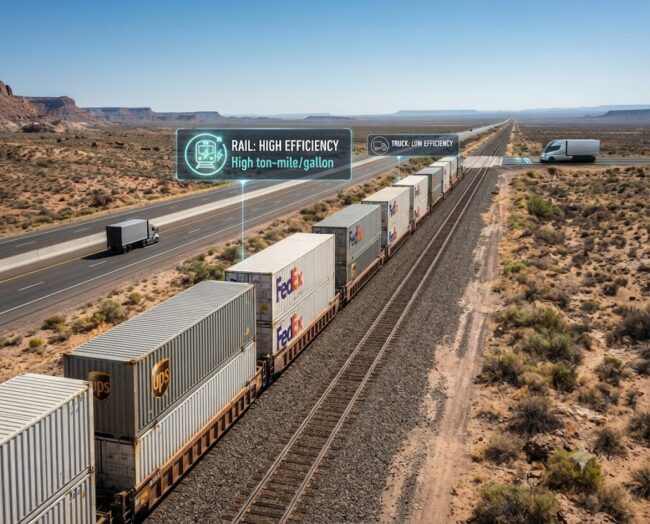
Here’s a secret hiding in plain sight: when you track that two-day UPS or FedEx package across the country, there’s a good chance it’s not on a truck at all. It’s riding a train. By some industry estimates, up to 30 percent of UPS and FedEx ground packages spend the long-haul portion of their journey in a double-stacked container on a freight railroad — and almost nobody knows. UPS is one of the largest intermodal rail customers in America. The parcel giants figured out decades ago what Silicon Valley is spending billions trying to rediscover: the cheapest, safest, most efficient way to move cargo across a continent is steel wheels on steel rails.
Meanwhile, the money flows the other way. Investors have poured billions into autonomous trucking startups and electric semis, chasing the dream of driverless freight. But autonomous freight isn’t a dream. It’s a 190-year-old fact. A freight train is a land vehicle that steers itself along a fixed guideway, hauls the load of several hundred trucks with a crew of two, and does it through blizzards that would ground any camera-and-lidar rig. Rio Tinto already runs fully driverless heavy-haul trains across hundreds of miles of the Australian outback — routinely, profitably, today. We are spending a fortune to invent a worse train.
The Physics Is Not Negotiable
No battery breakthrough will ever change the core math. Steel-on-steel rolling resistance is a small fraction of rubber-on-asphalt, and a train moves as one aerodynamic unit instead of hundreds of individual boxes each punching its own hole in the air. That’s why American railroads move a ton of freight roughly 470–500 miles on a single gallon of diesel — several times the efficiency of any truck, electric or otherwise.
The electric semi doesn’t escape this; it just relocates the problem. It must haul tons of battery that displace paying cargo, and it demands a coast-to-coast network of megawatt charging plazas that doesn’t exist. Rail electrification, by contrast, is boring, proven, century-old technology: string a wire, run the trains on it. Europe, China, India, Japan, and Russia did it long ago. No range anxiety, no payload penalty, no charging stops — and where wires don’t reach, a locomotive can carry a battery the size of a garage without anyone caring, because trains aren’t weight-limited the way trucks are. Every electrified rail corridor converts freight from imported diesel to domestic wind, solar, nuclear, and hydro on day one.
The Safety Problem Trucks Can’t Solve — and Trains Never Had
Roughly 40,000 Americans die on the roads every year, thousands of them in crashes involving large trucks. The autonomous trucking industry’s grand challenge is teaching an 80,000-pound vehicle to handle the most chaotic environment in transportation: merging traffic, construction zones, cyclists, school buses, rain-slicked off-ramps, infinite edge cases.
Railroads solved that problem in the 1830s by not sharing the road. A train’s path is known to the meter. It cannot swerve, drift, or rear-end a minivan. Its contact with the public is limited to a finite, mappable list of grade crossings — each one fixable with gates, sensors, or a bridge.
Yes, rail has its own safety debts — East Palestine made that brutally clear. But look at what kind of problem a derailment is: a monitoring problem. Overheating bearings, cracked rail, worn wheels — exactly the things modern sensors, machine vision, and predictive AI are spectacularly good at catching. A billion dollars spent on wayside detectors, drone track inspection, and full positive train control buys orders of magnitude more safety than a billion spent teaching a truck to interpret a hand signal from a flagger. One problem is tractable engineering. The other may never be certifiable.
Climate Math That Embarrasses Everything Else
Transportation is America’s largest source of greenhouse emissions, and heavy trucks are a huge slice of it. The official plan — swap millions of diesel tractors for battery ones over decades — is the slow, expensive path. Mode shift is the fast one: because rail is several times more efficient per ton-mile, freight moved from highway to rail cuts its emissions massively the moment it switches, even behind today’s diesel locomotives. Electrify the main lines and the cut approaches total. As a bonus, every intermodal train pulls hundreds of trucks off the interstate — less congestion, less pavement destruction (heavy trucks cause exponentially more road wear than cars), fewer highway expansions nobody wants to pay for.
Why hasn’t it happened? Partly narrative — trucks feel like the future because software companies build them. Partly policy — taxpayers build and maintain the highways trucks run on, while railroads must fund every crosstie themselves. Nobody asks a trucking firm to pay for I-80. Level that field and the freight flows differently. And partly the railroads’ own fault: decades of cost-cutting made service slow and opaque, driving away every customer who wasn’t shipping coal or containers by the trainload.
That last failure is exactly what technology money fixes.
What a High-Tech Railroad Could Actually Do
Give rail the digital nervous system we’ve given everything else — app-based booking, real-time tracking, automated terminals, self-routing smart railcars — and whole new industries appear.
Move your entire house by rail. A secure, climate-controlled residential container is dropped in your driveway. You load it. A local truck shuttles it five miles to the railhead, and it crosses the country for a fraction of a moving van’s fuel and cost — tracked on your phone, with shock and humidity sensors standing guard over the piano. Cross-country relocation becomes as routine as ordering a parcel pickup.
White-glove freight for the antique dealer. Fragile, valuable, non-urgent cargo is the worst fit for trucking and the best fit for rail. Picture a shared “fine goods car”: vibration-damped mounts, individual crate telemetry, automatic chain-of-custody logs. An antiques dealer buys an estate in Vermont and sells it in Santa Fe; galleries, auction houses, and museums subscribe to the same network — a market that simply doesn’t exist today.
Parcel-style rail for small business. A furniture maker books six pallets to Chicago the way you book airline seats; automated yards sort them Amazon-warehouse style; electric trucks handle the last five miles. The technology already exists — it’s just pointed at warehouses instead of railroads.
Rolling warehouses, rolling power. Scheduled, tracked trains become inventory in motion for just-in-time manufacturers. Battery-tender railcars move gigawatt-hours to disaster zones or stressed grids overnight. Modern reefer cars rebuild overnight farm-to-city produce networks. No truck fleet can match any of it.
Finish the Revolution
None of this banishes trucks — they’ll always own the first and last mile, and electric trucks make perfect railhead shuttles. But the backbone belongs on rails, and the parcel carriers quietly proved it years ago while the rest of us watched robot-truck demos.
America built the transcontinental railroad in six years with hand tools and black powder. Electrifying, automating, and digitizing the 140,000-mile network we already own is a smaller feat with a bigger prize: less oil, cleaner air, safer roads, cheaper goods. The autonomous freight revolution doesn’t need inventing. It needs finishing. Your packages already know the way — follow them to the rails.
About the Author