By Brian French | October 27, 2026
Quick Answer
AI is improving at an exponential pace, not a steady one. The length of tasks AI can complete on its own has been doubling every four to seven months, and the computing power behind frontier models has grown about fivefold a year. Human intuition is built for straight lines, which is why this pace is so hard to grasp. The United States leads this shift, and the next five years are likely to bring more progress than any period in human history.
Key Takeaways
- In early 2025, top AI models could reliably handle tasks that take a human expert about 50 minutes. By early 2026, that had grown to roughly 14 hours.
- Training compute for frontier AI models has grown about 5 times per year since 2020.
- The cost of running AI at a fixed level of performance has fallen by roughly 40 times per year.
- The U.S. attracted $285.9 billion in private AI investment in 2025, about 23 times China’s total, and hosts more than 10 times as many data centers as any other country.
- America’s four largest tech companies plan to spend about $725 billion on infrastructure in 2026, much of it for AI.
- Research shows people consistently underestimate exponential growth, and are overconfident that they understand it.
The Numbers Behind the Quickening
| Measure | Growth Rate | Source |
|---|---|---|
| AI task length | Doubles every 4–7 months | METR |
| Frontier training compute | About 5x per year | Epoch AI |
| AI cost at fixed performance | Falls about 40x per year | Epoch AI |
| AI chip value per dollar | Up 37% per year | Epoch AI |
| Big Tech 2026 capex | Up 77% year over year | Company guidance |
The Brain Was Built for Straight Lines
For nearly all of human history, life changed in a straight line. A farmer who planted one more acre got roughly one more acre of crops. A hunter who walked twice as far covered twice the ground. Our brains evolved to predict the future by extending the recent past forward at the same speed, and for hundreds of thousands of years, that worked.
Exponential change breaks that instinct. When something doubles at a steady pace, it looks unimpressive for a long time and then suddenly overwhelms everything around it.
Economists have a name for this blind spot: exponential growth bias. Researchers Victor Stango and Jonathan Zinman documented in 2009 that people systematically underestimate how fast compounding grows, which leads to costly mistakes with loans and savings. Later work by Matthew Levy and Joshua Tasoff found something even more revealing. People are not only wrong about exponential growth, they are confident they are right. During the early months of COVID-19, a study published in the Proceedings of the National Academy of Sciences found that Americans viewed the virus’s spread in linear terms and underestimated how quickly case counts would climb.
Researchers have also found one simple fix. When growth is described in doubling times instead of percentages, people understand it much better. So that is how this article will describe AI.
The Old Story of the Chessboard
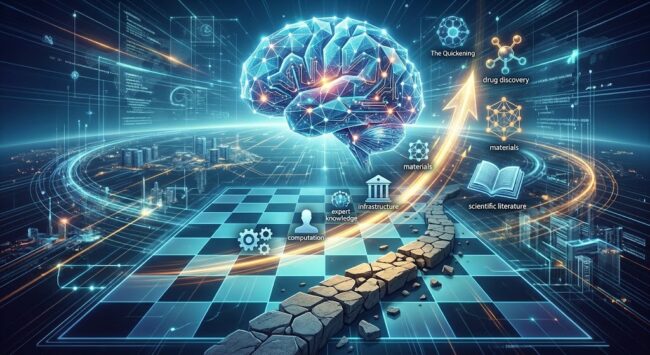
There is an ancient legend about the inventor of chess. When the king offered him any reward, he asked for a single grain of rice on the first square of the chessboard, two on the second, four on the third, and so on, doubling each time across all 64 squares.
The king laughed at the modest request. Through the first half of the board, the numbers stayed manageable. By the 32nd square, the pile was about four billion grains, a large amount but still imaginable. Then came the second half of the board. By the final square, the total exceeded all the rice that has ever been grown on Earth.
Futurist Ray Kurzweil used this story to describe what he called the law of accelerating returns: technologies that improve themselves eventually enter the second half of the chessboard, where each doubling adds more than all previous doublings combined.
AI has entered the second half of the chessboard.
How Fast AI Is Actually Doubling
The clearest measure of AI’s progress comes from METR, an independent research group that tracks how long a task an AI system can complete on its own. METR measures this by how long the same task takes a skilled human expert.
When METR published its method in March 2025, the best AI models could reliably succeed at tasks that took a human expert about 50 minutes. METR found that this “time horizon” had been doubling about every seven months since 2019.
Then the curve steepened. In January 2026, METR released an updated benchmark with longer, harder tasks. It estimated that Anthropic’s Claude Opus 4.6 could succeed at tasks taking a human expert roughly 14 hours, about half the time. For the period since 2023, METR’s data shows the doubling time shrinking to about four months.
In plain terms: in about a year, AI went from handling a task that fills one meeting to one that fills nearly two full workdays.
The hardware and economics behind AI are compounding at the same time. Epoch AI, a research group that tracks the field, estimates that the computing power used to train frontier language models has grown about five times per year since 2020. Over the same period, the cost of running AI at a given level of performance has dropped by roughly 40 times per year. AI is getting more powerful and cheaper at the same time, and each improvement feeds the next.
What the Next Five Years Could Look Like
Here is where the linear brain struggles most. Ask most people how much better AI will be in five years, and they will picture today’s tools with a few improvements, perhaps twice as good or five times as good.
The math points somewhere very different. If the time horizon keeps doubling every seven months, five years brings about eight or nine more doublings, a gain of roughly 400 times. If it keeps doubling every four months, five years brings 15 doublings, a gain of more than 30,000 times.
Applied to today’s 14-hour figure, even the slower path would mean AI systems that can carry out projects equal to years of skilled human work. The faster path goes well beyond that.
No trend continues forever, and these figures are projections, not promises. Benchmarks can saturate, and real-world bottlenecks such as power, chips, and clinical trial timelines will matter. But the direction is clear, and history shows that people underestimate compounding far more often than they overestimate it.
Why the Next Five Will Dwarf Everything Before
Every great technology of the past amplified one kind of human ability. The steam engine multiplied muscle. The telephone and internet multiplied communication. The computer multiplied calculation.
AI is different because it amplifies reasoning itself, the ability that produced every other invention. When the tool that creates tools gets exponentially better, progress accelerates across every field at once.
That is already visible. In 2026, AI systems designed a drug that reached Phase III trials, discovered new heat-resistant alloys in weeks, ran chemistry experiments around the clock in self-driving labs, and produced a claimed proof on one of mathematics’ most famous unsolved problems. Each of these would have been a career-defining achievement a decade ago. Now they are arriving in clusters.
The profound solutions in the works include:
- Medicine. Faster drug discovery, earlier disease detection, and treatments designed for individual patients.
- Energy. New battery chemistries, better solar materials, and AI-assisted fusion research.
- Materials. Stronger, lighter, and more heat-resistant metals for aircraft, rockets, and medical implants.
- Science. AI agents that can read the entire scientific literature, form hypotheses, and run experiments without fatigue.
- Productivity. Expert-level help available to every small business, clinic, and classroom.
Anthropic CEO Dario Amodei has predicted that AI could compress 50 to 100 years of progress in biology and medicine into 5 to 10 years. When he made that prediction in 2024, many considered it far-fetched. The results of 2026 have made it look more like a roadmap.
America at the Center
The United States is the engine of this transformation, and the numbers make that clear.
According to Stanford University’s 2026 AI Index, U.S. private AI investment reached $285.9 billion in 2025, roughly 23 times China’s $12.4 billion. American organizations produced 50 notable AI models in 2025, compared with 30 from China. The U.S. hosts 5,427 data centers, more than 10 times any other country. Global corporate AI investment more than doubled in 2025 to about $581.7 billion, and the largest share flowed to America.
The infrastructure buildout is historic. Microsoft, Alphabet, Amazon, and Meta are on track to spend roughly $725 billion on capital expenditures in 2026, up about 77% from $410 billion in 2025, with much of it going to AI chips and data centers. Apollo chief economist Torsten Slok estimated that 2026 capital spending by these firms and Oracle would equal about 2% of U.S. GDP and exceed the combined military budgets of Germany, France, the United Kingdom, Japan, Italy, and Canada. Alphabet CEO Sundar Pichai has explained the logic simply: the risk of investing too little is far greater than the risk of investing too much.
This leadership rests on uniquely American strengths: deep capital markets, world-class universities, a culture that rewards risk-taking, and the ability to attract talent from around the world. Every leading frontier AI lab that has shaped this era was founded in the United States.
The lead must be earned every year. Stanford found that the top U.S. model led its nearest Chinese rival by only 2.7% on a basket of benchmarks in March 2026. That narrow margin is a reason to keep investing, building, and innovating at full speed, and America is doing exactly that.
Florida’s Place in the Quickening
Florida is positioned to benefit. The University of Florida operates HiPerGator, the fastest university-owned and operated AI supercomputer in the nation, and makes it available to researchers across the State University System. Moffitt Cancer Center in Tampa is applying AI to cancer treatment planning. The Space Coast, Tampa Bay’s defense sector, and South Florida’s financial firms all run on the kind of complex analysis that AI is rapidly absorbing.
For Florida’s hospitals, physician groups, life sciences companies, and medical device makers, the opportunity is enormous. AI can shorten research timelines, reduce administrative burden, and help clinicians spend more time with patients. The organizations that start building with these tools now will be the ones that define healthcare in the state for the next generation.
How to Think Exponentially
Because the human brain defaults to straight lines, thinking clearly about AI takes deliberate effort. A few practical habits help:
- Think in doublings. Ask how many times something will double over a period, not how much it will grow by a percentage.
- Plan for the tools of next year. Whatever AI cannot do well today may be routine within 12 months.
- Revisit assumptions often. A strategy built on 2025’s AI capabilities is already out of date.
- Start small, but start now. Early experience compounds, just like the technology.
- Keep people in charge of judgment. AI multiplies output. Human expertise ensures that output is accurate and useful.
Brian’s Take
When I was a money manager, the most important lesson I learned was that compounding is the most powerful force in finance and the most underestimated. Investors who understood it built wealth quietly for years and then watched it accelerate. Investors who did not kept waiting for a straight line that never came.
AI is compounding the same way, except the asset is human knowledge itself. Every doubling builds on all the ones before it. That is why the next five years will not look like a slightly better version of the last five. They will look like a different era.
I am deeply optimistic about where this leads. Diseases that have resisted every treatment, materials that seemed impossible, and scientific questions that stood for centuries are all now within reach. The United States is leading this leap, and Florida has the universities, medical centers, and business climate to be one of its strongest players.
We are living through the steepest part of the most important curve in history. The best thing any of us can do is learn to see it clearly, and start building on it today.
FAQ
What does “exponential” growth in AI mean?
It means AI’s abilities double at regular intervals rather than improving by a fixed amount. METR estimates the length of tasks AI can complete on its own has doubled every four to seven months.
Why is exponential change so hard to understand?
Human intuition expects steady, linear change. Researchers call this exponential growth bias, and studies show people underestimate compounding and are overconfident in their estimates.
How fast is AI improving right now?
Frontier models went from handling tasks of about 50 minutes in early 2025 to about 14 hours in early 2026. Training compute is growing about 5 times a year, while costs at a fixed performance level are falling sharply.
Is the United States leading in AI?
Yes. Stanford’s 2026 AI Index reports $285.9 billion in U.S. private AI investment in 2025, about 23 times China’s, along with more notable models and far more data centers than any other country.
How much will AI change in the next five years?
If current doubling trends continue, AI could handle tasks hundreds or even thousands of times longer than today’s. Exact outcomes are uncertain, but the trend points to more change than in any previous five-year period.
What does this mean for Florida healthcare?
Faster research, earlier diagnosis, more personalized treatment, and less administrative work. Florida institutions such as UF and Moffitt are already putting AI to work.
Sources and Further Reading
- METR — Measuring AI Ability to Complete Long Tasks (March 2025)
- METR — Time Horizon 1.1 (January 2026)
- Epoch AI — Training Compute of Frontier AI Models Grows by 4-5x Per Year
- Epoch AI — AI Trends and Statistics Dashboard
- Stanford HAI — The 2026 AI Index Report
- ScienceBlog — U.S. private AI investment far exceeded China’s in 2025
- Yahoo Finance — Magnificent 7 earnings rush reveals AI spending surge, with hyperscaler capex set to reach $725 billion in 2026
- Silicon Canals — Four U.S. tech giants steering toward roughly $725 billion in 2026 capital spending
- Stango and Zinman — Exponential Growth Bias and Household Finance, Journal of Finance (2009)
- Levy and Tasoff — Exponential-Growth Bias and Overconfidence, Journal of Economic Psychology
- Lammers, Crusius, and Gast — Correcting misperceptions of exponential coronavirus growth increases support for social distancing, PNAS (2020)
- ETH Zurich via ScienceDaily — Grasping exponential growth (Schonger and Sele)
- Ray Kurzweil — The Law of Accelerating Returns (2001)
- Dario Amodei — Machines of Loving Grace (October 2024)
- University of Florida — HiPerGator and AI initiative materials
- Moffitt Cancer Center — Moffitt Study Shows AI Boosts Efficacy of Cancer Treatment, But Doctors Remain Key
About the Author