Commentary | By Brian French |October 21, 2026
Quick Answer: Local TV news websites are running syndicated stories such as “how to keep Halloween safe for people with epilepsy” while under-covering the local business, property insurance, jobs and government stories Floridians actually need. The problem is not the safety tip itself. It is a newsroom culture that fills airtime with recycled feel-good advisories instead of hard local reporting, and viewers have noticed.
Every October, like clockwork, it arrives. Somewhere between the weather segment and the sports highlights, a local TV anchor turns to the camera with a concerned look and tells you how to make Halloween safe. This year’s entry, “Flashing lights and late nights: How to keep Halloween safe for people with epilepsy,” is a syndicated health story now making the rounds on local station websites. It warns homeowners about strobe-light decorations and offers tips from a hospital epilepsy specialist.
Let me be clear about what this column is not saying. Photosensitive epilepsy is real. Flashing lights can trigger seizures in a small share of people with epilepsy, and families dealing with it deserve good information. The Epilepsy Foundation and medical centers publish that information every year, and they should.
My problem is not with epilepsy awareness. My problem is with what local TV news has become.
A Newsroom Full of Advisories, Short on News
Look at a typical local TV website in Florida this month. You will find Halloween safety tips. Candy safety tips. Costume safety tips. Driving-in-the-dark safety tips. Pet safety tips. Pumpkin-carving safety tips. Many of them are syndicated packages produced once and pushed out to dozens of stations owned by the same media company, with the local logo slapped on top.
Now look for what is missing:
| What Floridians Need Covered | How Often It Gets Real Coverage |
|---|---|
| Property insurance premiums and carrier exits | Occasional, usually after a crisis |
| Condo assessments after post-Surfside laws | Sporadic |
| Local jobs and layoffs | Rarely beyond a headline |
| County budgets and property taxes | Mostly at election time |
| Small business conditions | Almost never |
| Local development and zoning decisions | Rarely, unless protesters show up |
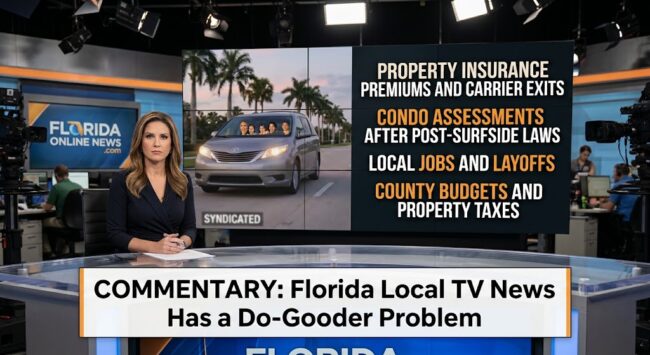
Florida’s unemployment rate is 4.4%, above the national rate for the first time in years. Finance and insurance employers have cut nearly 16,000 jobs in the past year. Condominium owners are facing special assessments that run into five and six figures. Homeowners are watching insurance bills consume a larger share of their budgets. Those are the stories that change lives in Florida households. They take reporters, sources, documents and time. A syndicated safety tip takes none of those things.
The Do-Gooder Complex
There is a particular tone that local TV news has adopted over the past decade. It is earnest, cautious and slightly parental. Every holiday becomes a hazard. Every season becomes a checklist. Viewers are treated less like adults who want to understand their community and more like children who need to be reminded to look both ways.
I call it the do-gooder complex. It feels virtuous to produce. It is safe, it offends no advertiser, it requires no confrontation with a public official, and it lets a station say it is “serving the community.” But it substitutes the appearance of public service for the real thing.
The real thing is accountability reporting. It is asking a county commission why a contract went to a donor. It is explaining why a local insurer stopped writing policies. It is telling a small business owner what a new state law means for payroll. That work is harder, and it occasionally makes people uncomfortable. That is exactly why it matters.
Why Viewers Are Tuning Out
The audience has already voted. Local TV news viewership, especially among people under 50, has declined for years. Trust in news media sits near historic lows in national surveys. Younger Floridians get local information from social media, newsletters, neighborhood apps and independent digital outlets.
When viewers see a newsroom spend its limited resources on a recycled Halloween advisory while their insurance bill doubles, they draw a conclusion: this station is not talking to me. It is talking at me.
That gap is not partisan. Viewers across the political spectrum want the same thing from local news: tell me what is happening in my town, tell me why, and tell me what it means for my family and my business.
The Business Model Behind the Fluff
To be fair to the people working in local newsrooms, many of them are talented journalists stretched thin. Station groups have consolidated. Newsrooms have shrunk. Producers must fill hours of newscasts and endless web pages with fewer reporters. Syndicated content is cheap, available and safe.
But that is an explanation, not an excuse. Stations still choose what to put in front of viewers. When the choice is between a borrowed safety package and one more local story with real reporting behind it, the borrowed package keeps winning, and the audience keeps leaving.
What Local News Should Do Instead
| Instead of This | Do This |
|---|---|
| Syndicated holiday safety tips | Local investigations with documents and data |
| Generic “experts say” segments | Interviews with Florida business owners and officials |
| Seasonal checklists | Explain how state and local laws affect households |
| Viral feel-good clips | Track promises made by local governments and employers |
| Talking down to viewers | Trust viewers with complexity |
A safety tip can live in a 30-second tag at the end of a newscast or a link on a website. It should not be presented as journalism, and it should not crowd out the reporting a community depends on.
Where This Leaves Florida
Florida is one of the fastest-growing, most economically complex states in the country. Its residents are dealing with rapid development, rising insurance costs, a changing job market, new state laws every year and a constant stream of corporate relocations. The demand for serious, local, explanatory news has never been higher.
That demand is why independent and digital publishers are filling the gap with long-form local business coverage, data-driven reporting and answers to the questions Floridians actually ask. Local TV news can compete for that audience. But it will not win it back with another reminder to check the candy.
Frequently Asked Questions
Is the Halloween epilepsy safety advice wrong?
No. Flashing and strobe lights can trigger seizures in some people with photosensitive epilepsy, and medical organizations recommend caution with strobe decorations. The criticism here is about news priorities, not the medical advice.
Why does local TV run so many safety stories?
They are inexpensive to produce, often syndicated across station groups, low-risk with advertisers and easy to fill into newscasts and websites with shrinking staffs.
What local news do Floridians need more of?
Coverage of property insurance, condo assessments, jobs, local government spending, development decisions and small business conditions.
Is local TV viewership declining?
Yes. Viewership of local TV news has declined for years, particularly among younger adults, as audiences shift to digital and social platforms.
Key Takeaways
- The problem is not safety advice but what it replaces.
- Syndicated advisories fill airtime that could go to local accountability reporting.
- Floridians face major insurance, housing and jobs issues that deserve deeper coverage.
- Viewers are leaving local TV news for sources that speak to their real concerns.
- Local newsrooms can win back trust by treating viewers like adults.
Sources and Further Reading
- “Flashing Lights and Late Nights: How to Keep Halloween Safe for People With Epilepsy” – WBNS-10TV and WTOL (TEGNA syndicated health story)
- “Celebrating Halloween While Managing Seizures” – Epilepsy Foundation
- “Common Halloween Concerns for Children With Epilepsy” – Epilepsy Foundation
- “Florida’s Unemployment Rate Dips for the Fourth Consecutive Month” – WUSF, October 16, 2026
- “Florida Jobless Rate Dips in September” – WLRN, October 16, 2026
- State of Local News Reports – Medill School of Journalism, Northwestern University
- Americans’ Trust in Media – Gallup
About the Author