By Brian French | September 29, 2026
Quick Answer
Medical office buildings, ambulatory surgery centers and outpatient clinics are among Florida’s strongest commercial real estate assets in 2026. The sharpest scarcity isn’t at hospital campuses. It’s in off-campus, neighborhood-level medical space in Jacksonville and Orlando, where vacancy has fallen close to zero, and in retail centers where healthcare tenants are taking over storefronts.
The Twist: Healthcare Isn’t Beating Retail. It’s Becoming Retail.
The usual story frames healthcare real estate and retail real estate as competitors, with medical buildings winning. In Florida in 2026, that framing misses what’s actually happening.
In Tampa Bay, retail isn’t weak at all. Cushman & Wakefield reported a 3.8% Tampa Bay retail vacancy rate in the first quarter of 2026, well below the 5.9% national rate, with South Tampa and Westshore below 2%. That’s tighter than the metro’s medical office market.
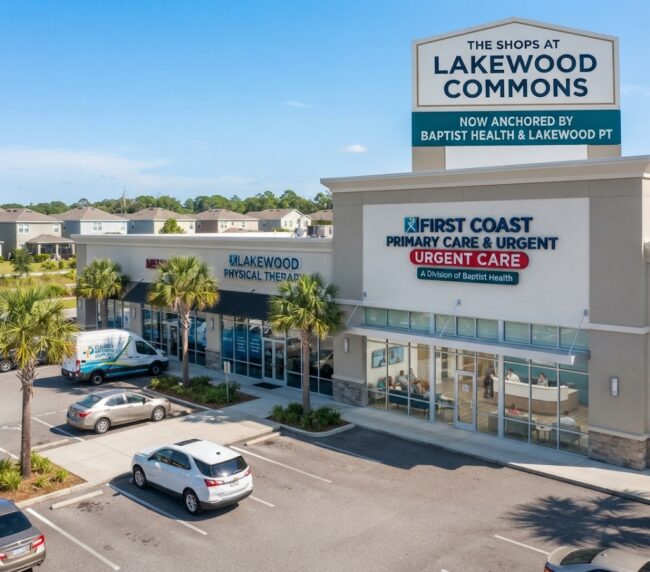
So why do healthcare providers keep winning the good corners? Because they increasingly compete for the same buildings. According to CoStar data cited by JLL’s Florida team, about 20% of leased medical space now sits in retail buildings, up 20% from 2010. The industry calls it “medtail,” and it’s quietly rewriting Florida’s strip centers.
The second half of the twist shows up in the data FAN pulled for this article. When you split medical office vacancy into on-campus buildings (on or attached to a hospital campus) and off-campus buildings (in neighborhoods, suburbs and retail corridors), Florida’s two fastest-growing inland markets look nothing like the rest of the country. Off-campus space in Jacksonville and Orlando is nearly sold out.
That combination (healthcare moving into retail, and off-campus space running out) is where capital should be looking.
The National Backdrop: Full Waiting Rooms, Empty Suites Elsewhere
Healthcare real estate’s outperformance starts with a simple comparison. National medical outpatient building vacancy was 9.8% in Q4 2025, against 18.6% to 21.0% for traditional office, according to MMCG Invest’s 2026 outlook. That analysis also noted that office loan delinquency peaked at a record 12.34% in January 2026, driven by towers, not clinics.
Transwestern’s Q1 2026 medical outpatient report shows the same resilience using a narrower measure. National direct vacancy held at 5.8%, stable for three quarters, with net asking rents of $27.55 per square foot and 1.5% year-over-year rent growth.
The demand engine is employment. Transwestern reported that healthcare accounted for 68% of all jobs created in 2026, and that medical office-using jobs (physicians, dentists and ambulatory practitioners) are forecast to grow 5.5% in 2026.
Supply isn’t flooding the market either. 88.1% of space currently under construction is pre-leased, which means future deliveries will boost absorption but do little to relieve vacancy in tight markets.
The Florida Scorecard: Tampa, Orlando and Jacksonville
Here’s how the three I-4 and North Florida markets stack up, with Miami as a benchmark.
| Market | Vacancy | NNN rent | Under const. |
|---|---|---|---|
| Jacksonville | 4.3% | $25.54 | 442,990 sf |
| Orlando | 6.0% | $27.04 | 519,840 sf |
| Tampa/St. Pete | 4.7% | $24.71 | 485,000 sf |
| Miami | 4.1% | $39.71 | 875,000 sf |
| U.S. total | 5.8% | $27.55 | 16.4M sf |
Source: Transwestern, U.S. Medical Outpatient Buildings Q1 2026 (CoStar data; buildings 10,000 sf+). Direct vacancy; triple-net asking rents.
Three quick observations:
- All three inland Florida markets sit at or below the national vacancy rate, with Jacksonville and Tampa well below it.
- Rents are moderate, not spiking. Tampa, Orlando and Jacksonville all posted rent growth of about 2% year over year, based on Transwestern’s current and prior-year asking rents.
- Tampa is the value market. At $24.71 triple net, Tampa/St. Petersburg had the lowest asking rent of the Florida markets in the survey, below both Jacksonville and Orlando.
The FAN Off-Campus Scarcity Gap
This is the composite measure at the heart of this article. FAN calculated it from Transwestern’s on-campus and off-campus vacancy figures for each market. The Off-Campus Scarcity Gap is simply on-campus vacancy minus off-campus vacancy.
A positive number means neighborhood and suburban medical space is tighter than hospital-campus space. A negative number means the reverse.
| Market | On-campus | Off-campus | Gap |
|---|---|---|---|
| Jacksonville | 7.0% | 0.7% | +6.3 |
| Orlando | 7.3% | 1.5% | +5.8 |
| Palm Beach | 5.5% | 4.0% | +1.5 |
| Tampa/St. Pete | 4.5% | 5.0% | −0.5 |
| U.S. total | 4.9% | 6.1% | −1.2 |
| Fort Lauderdale | 7.6% | 9.3% | −1.7 |
| Miami | 3.0% | 6.5% | −3.5 |
FAN calculation from Transwestern Q1 2026 market summaries. Gap shown in percentage points.
What it tells us: Nationally, off-campus buildings have more vacancy than on-campus ones. Jacksonville and Orlando flip that pattern hard. With off-campus vacancy under 2% in both markets, a physician group or specialty clinic looking for a suburban location in those metros has almost nothing to lease. That’s a development and conversion signal.
Transwestern’s own notes point to part of the explanation: on-campus vacancy has ticked up for two straight quarters, and markets where on-campus vacancy exceeds the average often reflect new buildings in lease-up. In other words, some of the on-campus vacancy is new product still filling, while the off-campus shortage is structural.
Two more FAN calculations sharpen the picture:
- Pipeline as a share of existing stock: Miami 7.3%, Jacksonville 5.7%, Orlando 3.9%, Tampa 2.6%.
- 12-month net absorption as a share of stock: Miami 3.1%, Jacksonville 2.4%, Orlando 1.4%, Tampa 0.8%.
Jacksonville is absorbing space fastest relative to its size among the three inland markets, and it has the largest pipeline relative to stock. Tampa has the thinnest pipeline, which supports rents even with slower absorption.
Tampa: Institutional Money Follows the Suburbs
Tampa’s healthcare real estate story in 2026 is about where the population is moving: south and east along I-75.
The clearest capital signal came in May. BGO, a global real estate investment manager, acquired 6606 Simmons Loop Road, a Class A medical office building totaling 41,810 square feet in Riverview. The building was completed in 2025 and sits in the Southeast Hillsborough County submarket, which BGO described as one of Tampa’s fastest-growing healthcare corridors with connectivity via I-75.
That deal fits a pattern: institutional buyers want new, suburban, fully leased medical buildings near growing rooftops and hospital systems. The Riverview corridor already includes BayCare’s St. Joseph’s Hospital South and HCA Florida South Shore Hospital, per BGO’s announcement.
Tampa Bay’s system landscape supports the thesis. BayCare operates 14 hospitals and hundreds of additional outpatient and ambulatory locations across Hillsborough, Pinellas, Pasco and Polk counties, according to FloridaMedicalNews.com’s 2026 review of the state’s largest healthcare organizations.
Where Tampa stands: Vacancy is low at 4.7%, rents are the most affordable of the three markets, and the construction pipeline is thin. Q1 absorption was slightly negative, so Tampa’s story is steady value rather than scarcity. For investors, that can mean better entry pricing than Orlando or Jacksonville.
Orlando: Sold-Out Suburbs and the Office Conversion Play
Orlando is the market where the Off-Campus Scarcity Gap has the most practical consequences. With off-campus vacancy at 1.5%, suburban medical tenants are competing for a sliver of available space.
At the same time, Orlando’s traditional office market has the opposite problem. One local investment analysis puts metro office vacancy at 17.6% and argues that the most compelling opportunity is buying distressed Class B/C office and converting it to medical office, which commands 5.5% to 6.5% cap rates. The same analysis points to AdventHealth-adjacent corridors, noting University/436 sits within three miles of AdventHealth Orlando’s main campus.
Treat that underwriting as one firm’s view, not a market consensus. Conversions require heavier mechanical systems, plumbing, parking and accessibility upgrades than ordinary office. But the logic is sound: when one property type is starved and a nearby one is oversupplied, conversion capital will find the spread.
Health systems are building their own outpatient networks too. AdventHealth has been moving into ambulatory surgery for years; when it opened its Mills Park surgery center near downtown Orlando, its Central Florida leadership described ambulatory surgery as a lower-cost venue for surgeries than a hospital setting. Florida’s state facility database now lists AdventHealth surgery centers in Maitland, Mills Park, Innovation Tower, Blue Springs, Davenport and Tampa’s Wellswood area, among others.
One caution for Orlando: MMCG Invest flagged that Sunbelt pipeline concentration means 2026–27 deliveries hit Houston, Dallas, Phoenix and Orlando specifically. Orlando’s on-campus vacancy of 7.3% may reflect some of that new product. Investors should underwrite suburban and on-campus assets very differently in this market.
Jacksonville: The Tightest Neighborhood Market in Florida
Jacksonville posts the most extreme reading in FAN’s composite. Off-campus medical vacancy of just 0.7% means neighborhood medical space is effectively full.
Jacksonville also combines that scarcity with real momentum:
- Absorption: 187,469 square feet of 12-month net absorption on a 7.7 million square foot base, according to Transwestern.
- Pipeline: 442,990 square feet under construction, about 5.7% of stock (FAN calculation), the largest relative pipeline of the three inland markets.
- Rent: $25.54 triple net, up from $25.03 a year earlier.
Pricing context matters for Jacksonville investors. A June 2026 Florida cap rate guide from a Central Florida developer puts primary markets like Orlando and Tampa 50 to 100 basis points tighter than secondary markets such as Jacksonville. If Jacksonville’s off-campus shortage persists, that yield spread is the opportunity: better going-in cap rates for assets in a tighter market.
The South Florida Benchmark
South Florida is the most expensive and most heavily built medical office market in the state, and it offers a preview of where Tampa, Orlando and Jacksonville could head.
Blanca Commercial Real Estate reported that South Florida has about 24.6 million square feet of medical office inventory and the largest medical office construction pipeline of any U.S. metro, while occupancy remains near 92.8%. The firm also counted nearly $491 million in medical office transactions over the trailing 12 months.
Miami’s triple-net asking rent of $39.71 per square foot is roughly 55% to 60% higher than the inland Florida markets (FAN calculation from Transwestern data). Notice, though, that Miami’s scarcity sits on campus (3.0% vacancy), while its off-campus vacancy is 6.5%. South Florida’s heavy suburban building program has loosened neighborhood supply. The inland markets haven’t reached that point yet.
Why Healthcare Real Estate Keeps Outperforming
Five forces explain why this asset class has held up while conventional office struggled.
1. The outpatient shift. Procedures that once required hospital admission now happen in surgery centers, imaging centers and clinics. Health systems want those services closer to patients and at lower cost.
2. Healthcare employment. Every new physician, therapist or technician needs a place to work. Healthcare’s share of national job creation makes it the most reliable driver of occupied space in commercial real estate right now.
3. Demographics. Florida’s older population uses more outpatient care per person, and in-migration keeps adding patients in suburban growth corridors.
4. Regulatory change. PwC and the Urban Land Institute noted that Florida metros have outperformed most markets on occupancy growth, absorption and completions in recent years, and that significant portions of Florida’s certificate of need laws were repealed in 2019. Fewer approval hurdles made it easier for systems to expand.
5. Tenant stickiness. Medical tenants invest heavily in their build-outs, including plumbing, specialized electrical, imaging shielding and accessibility features. Once installed, they rarely move, which produces long leases and high renewal rates for landlords.
Ambulatory Surgery Centers: The High-Value Niche
Ambulatory surgery centers deserve special attention because they combine the highest build-out costs with the strongest tenant commitment. An ASC can cost several times more per square foot to build out than a standard medical suite, which is exactly why operators sign long leases and stay.
Florida’s health systems are expanding ASC networks through joint ventures with specialized operators. AdventHealth’s partnership with United Surgical Partners International is one example. The joint venture acquired Tampa Outpatient Surgical Center in 2021, which now operates as AdventHealth Surgery Center Wellswood, offering orthopedics, gastroenterology, spine, ophthalmology and other specialties.
The hospital-campus model is evolving as well. In Daytona Beach, AdventHealth opened a $45.7 million, 60,000-square-foot medical office building and ambulatory surgery center on its hospital campus, with a 20,000-square-foot surgery center on the third floor.
For investors, ASCs typically trade at a premium when the operator has strong system backing. For developers, the lesson is to design flexible floor plates and heavy infrastructure that can serve surgical tenants, not just exam rooms.
Medtail and Wellness: Clinics in the Shopping Center
Specialized wellness facilities and outpatient clinics are the fastest-changing corner of the market, and they’re increasingly found in retail centers.
The National Association of Realtors described medtail as one of the hottest sub-sectors in healthcare real estate, including urgent care, imaging and physical therapy, and sometimes spa, alternative care and veterinary services. The draw for providers is simple: parking, visibility, and customers who are already running errands nearby.
The draw for landlords is lease stability. But conversions aren’t simple. The same NAR report noted that medical build-outs take much longer than ordinary retail because of complex needs such as gas and oxygen lines and specialized drainage. Some developers now build medtail space on spec, investing up to 30% more in underground infrastructure while betting a medical tenant will arrive.
In Florida’s tight retail markets, that dynamic cuts both ways. Medical tenants compete with restaurants and service retailers for scarce storefronts, which supports rents. But landlords who pre-install medical infrastructure can command a premium and fill space faster when the right provider comes along.
Where to look: Aging strip centers near growing suburbs, especially in corridors where FAN’s Off-Campus Scarcity Gap shows medical office is sold out. In Jacksonville and Orlando, the retail center may be the only realistic place for a new clinic to open in 2027.
Where the Capital Is Coming From
The buyer pool for medical office has shifted decisively toward private capital. According to Transwestern, private equity bought 45% of medical office buildings, followed by REITs at 21%, institutional investors at 18% and hospital systems at 14%.
Hospital systems are pulling back as buyers. Transwestern noted hospital transactions are down 20% year over year, largely because of uncertainty over reimbursement policy. That gives private buyers more room in the market, but it also means fewer systems anchoring new development with their own balance sheets.
National deal flow remains steady. First-quarter 2026 medical office transactions totaled $1.79 billion across more than 210 deals, with a national average price of $380 per square foot.
Portfolio pricing matters. PwC and ULI reported that as of 2Q 2025, the average medical office portfolio cap rate was 6.5%, compared with 7.2% for a single-asset sale. That spread rewards aggregators: an investor who assembles smaller Florida medical buildings into a portfolio can potentially sell the package at a lower cap rate, and a higher value, than the pieces were worth alone.
Florida-specific pricing guidance from the June 2026 cap rate guide places stabilized medical and dental office at 6.0% to 7.0% in primary markets, 6.5% to 7.5% in secondary markets and 7.0% to 8.0% in tertiary markets. Long-term leases to health systems or physicians compress toward the low end.
The Risks Investors Shouldn’t Ignore
Healthcare real estate is resilient, not risk-free. Four risks stand out for Florida in 2026:
- Tenant credit: A lease is only as strong as the operator behind it. MMCG Invest pointed to the collapse of hospital operator Steward as a lesson that rent coverage and sponsor strength matter more than the healthcare label.
- Local oversupply: Orlando’s pipeline exposure and rising on-campus vacancy deserve careful underwriting.
- Reimbursement policy: Changes to Medicare or commercial reimbursement can slow system expansion plans, which is already visible in fewer hospital acquisitions.
- Insurance and operating costs: Florida property insurance remains a major expense line, and triple-net leases pass it to tenants only up to a point before it affects renewal decisions.
What This Means for Investors, Providers and Landlords
For investors: The best risk-adjusted opportunities are off-campus, suburban medical buildings in Jacksonville and Orlando, where scarcity is extreme, and value-priced assets in Tampa’s southeast growth corridor. Consider portfolio strategies to capture the aggregation premium.
For physician groups and specialty providers: If you plan to expand in Jacksonville or Orlando in the next two years, start your site search now. With off-campus vacancy under 2%, waiting until a lease expires leaves almost nothing to choose from. Build-to-suit and retail conversions may be your realistic options.
For retail landlords: A medical tenant can stabilize a center for a decade. Understand what infrastructure a clinic needs before you negotiate, and consider pre-building it in centers near growing suburbs.
For office owners with vacancy: Study the medical conversion math, especially near hospital campuses. The zoning, parking ratios and mechanical upgrades will decide whether it works, not the concept.
Brian’s Take
When I managed money, the best opportunities usually hid inside a sector everyone already agreed was good. “Healthcare real estate outperforms” is consensus. It’s priced into the trophy buildings and the hospital-campus towers.
What isn’t fully priced, in my view, is the split inside the sector. Jacksonville’s off-campus medical space is under 1% vacant. Orlando’s is 1.5%. Nationally, off-campus space is actually looser than on-campus. Those two Florida markets are running against the national trend, and the people who notice first are the ones who’ll build or convert the next generation of neighborhood clinics.
My watch list for 2027: aging strip centers along Jacksonville’s suburban arteries, Class B office buildings within a few miles of Orlando’s major hospital campuses, and small medical buildings in Southeast Hillsborough that can be bundled into portfolios. The retail-versus-healthcare debate is over. In Florida’s growth corridors, the clinic is the new anchor tenant.
Frequently Asked Questions
Is medical office real estate a good investment in Florida in 2026?
Fundamentals are strong. Tampa, Orlando and Jacksonville all report medical office vacancy at or below the national rate of 5.8%, with steady rent growth and mostly pre-leased construction pipelines.
Which Florida city has the tightest medical office market?
By FAN’s analysis, Jacksonville. Its off-campus medical office vacancy was just 0.7% in Q1 2026, the lowest among major Florida markets tracked by Transwestern.
What is the Off-Campus Scarcity Gap?
A FAN composite measure: on-campus medical office vacancy minus off-campus vacancy. A high positive number means neighborhood medical space is much scarcer than hospital-campus space.
How much does medical office space cost in Tampa?
Tampa/St. Petersburg’s average triple-net asking rent was $24.71 per square foot in Q1 2026, the lowest among the Florida markets in Transwestern’s survey.
What is medtail?
Healthcare services located in retail buildings, such as urgent care, imaging, physical therapy and dental clinics. About 20% of leased U.S. medical space is now in retail properties.
Who is buying medical office buildings?
Private equity is the largest buyer group at 45% of purchases, followed by REITs, institutional investors and hospital systems.
What cap rates do Florida medical office buildings trade at?
Roughly 6.0% to 7.0% in primary markets like Tampa and Orlando, and 6.5% to 7.5% in secondary markets such as Jacksonville, according to one 2026 Florida cap rate guide.
Why are ambulatory surgery centers growing in Florida?
They offer a lower-cost setting than hospitals for many outpatient procedures, and major systems like AdventHealth are expanding ASC networks through joint ventures with surgical operators.
Sources and Further Reading
- Transwestern, U.S. Market Medical Outpatient Buildings Q1 2026: https://transwestern.com/Upload/MarketResearchFactsheet_PDF/639126330898364613.pdf
- MMCG Invest, “US Medical Office Market Outlook 2026: Full Waiting Rooms, Empty Pipelines”: https://www.mmcginvest.com/post/us-medical-office-market-outlook-2026-full-waiting-rooms-empty-pipelines
- Blanca Commercial Real Estate, “Why Healthcare Continues to Lead: The Real Estate Advantage in South Florida”: https://blancacre.com/insights/south-florida-healthcare-real-estate-continues-to-outperform
- BGO, “BGO expands healthcare portfolio with acquisition of Tampa medical office property”: https://bgo.com/press-release/bgo-expands-healthcare-portfolio-with-acquisition-of-tampa-medical-office-property
- PwC and ULI, Emerging Trends in Real Estate, Medical Office: https://www.pwc.com/us/en/industries/financial-services/asset-wealth-management/real-estate/emerging-trends-in-real-estate-pwc-uli/property-type-outlook/medical-office.html
- Bisnow, “Is Medtail The Cure For What Ails Retail? That’s The Prognosis In Florida, According To JLL”: https://www.bisnow.com/studio-b/south-florida/retail/medtail-florida-jll-studiob120449-120449
- National Association of Realtors, “Prescription for Profit: How ‘Medtail’ Is Shaping the Retail Market”: https://www.nar.realtor/commercial/create/prescription-for-profit-how-medtail-is-shaping-the-retail-market
- Trinity CRE, “Tampa Commercial Real Estate Market Outlook: Key Trends for 2026”: https://trinitycre.com/insights/tampa-commercial-real-estate-market-outlook-key-trends-for-2026/
- The List Orlando, “Orlando Office Real Estate Market 2025–2026”: https://thelistorlando.com/orlando-office-real-estate/
- MaxLife Development, “Florida Commercial Real Estate Cap Rates 2026”: https://maxlifedevelopment.com/florida-cap-rates
- AdventHealth, “AdventHealth and USPI form joint venture to expand outpatient surgical services in Tampa Bay region”: https://www.adventhealth.com/news/adventhealth-and-uspi-form-joint-venture-expand-outpatient-surgical-services-tampa-bay-region
- AdventHealth, “AdventHealth and USPI expand partnership with opening of AdventHealth Surgery Center Mills Park”: https://www.adventhealth.com/news/adventhealth-and-uspi-expand-partnership-opening-adventhealth-surgery-center-mills-park
- AdventHealth, “New surgery center and medical office building at AdventHealth Daytona Beach”: https://www.adventhealth.com/news/new-surgery-center-and-medical-office-building-adventhealth-daytona-beach
- FloridaHealthFinder, Ambulatory Surgery Center directory: https://quality.healthfinder.fl.gov/Facility-Provider/ASC?amp=&type=0
- FloridaMedicalNews.com, “The 10 Largest Healthcare Organizations in Florida: A 2026 Report”: https://floridamedicalnews.com/the-10-largest-healthcare-organizations-in-florida-a-2026-report/
About the Author