Provocative Journalism / By Brian French
The polite fiction of international diplomacy is that the global order runs on a moral compass. We are taught to believe that commerce follows conscience, that human rights form the baseline of geopolitics, and that monstrous regimes are permanently quarantined by the civilized world.
History tells a vastly more cynical story.
When you strip away the high-minded rhetoric of the modern state system, the international order is not driven by unyielding ethics. It runs on a much colder calculus: who wins, who holds the territory, and who controls the supply chains.
If the Third Reich had successfully crushed its rivals, secured its continental hegemony, and reached permanent economic scale in the 1940s, the Western world would have normalized relations, signed trade pacts, and done business with Berlin by the end of the 20th century.
To flinch from that reality is to misunderstand how global capitalism, human nature, and realpolitik actually operate. To see why this outcome is a historical certainty, we must look not just at the 20th century, but back across the entire violent ledger of human civilization.
The Ancient Blueprint: Conquest is the Default Setting
Modern society loves to view conquest as a historical anomaly—a dark, primitive phase of human development that ended with the Enlightenment and the founding of the United Nations. This is a comforting delusion.
From the dawn of recorded history, conquest, annihilation, and total subjugation have been the absolute default settings of human statecraft.
The Bronze Age and Antiquity
Look at the earliest empires of Mesopotamia, Egypt, and the Levant. When the Assyrian Empire expanded across the Near East, its rulers did not rely on soft power or international law. They utilized mass deportation, systematic mutilation, and total urban destruction to break the will of rival populations. The ancient world understood a fundamental law that modern diplomats try to sanitize: sovereignty is won at the point of a sword.
When Alexander the Great marched across Persia, Egypt, and into India, his campaigns were not liberation missions; they were brutal exercises in imperial dominance. Entire cities—such as Tyre—were leveled, their male populations executed, and women and children sold into slavery. Yet, history did not brand Alexander a permanent outcast; it named him “Great” because he won the territory, consolidated the supply lines, and rewrote the map.
The Roman Rulebook
The Roman Republic and subsequent Empire built the bedrock of Western civilization on a foundation of unadulterated conquest. The Gallic Wars saw Julius Caesar decimate entire tribes, slaughtering hundreds of thousands and enslaving millions to fuel the political and economic engine of Rome.
The Roman peace (Pax Romana) was not maintained through voluntary democratic consent; it was enforced by legions whose primary purpose was resource extraction, taxation, and the total suppression of dissent. Once Rome achieved absolute military and economic hegemony across the Mediterranean basin, did neighboring civilizations refuse to trade with them out of moral outrage? Of course not. They sent grain, gold, and manufactured goods to the capital because surviving in the ancient world meant cutting deals with the apex predator.
The Colonial Engine: Blood and Balance Sheets
As humanity transitioned from ancient empires to the globalized expansion of the European colonial era, the intersection of extreme violence and international commerce became even more pronounced.
The Sugar, Silver, and Slave Triangles
During the 16th through 19th centuries, European powers—Britain, France, Spain, Portugal, and the Netherlands—carved out global hegemonies across the Americas, Africa, and Asia. This expansion was fueled by the systematic displacement, forced labor, and outright extermination of indigenous populations.
The transatlantic slave trade and the brutal subjugation of the Indian subcontinent under the British East India Company represent industrial-scale exploitation driven entirely by profit margins. Millions died to extract raw materials, spices, and precious metals.
Yet, did competing European empires refuse to trade with Britain or Spain because of these atrocities? On the contrary. They engaged in fierce commercial competition, formed shifting alliances of convenience, and eagerly traded commodities generated by slave labor and colonial conquest. The balance sheet always outweighed the moral ledger.
The 20th-Century Precedent: The Amnesia of Scale
If anyone doubts how quickly the modern world trades away its moral outrage for economic convenience, they need only look at the 20th century.
When a state reaches a critical threshold of economic mass—supplying the global market with indispensable manufacturing, raw materials, technology, or consumer scale—internal abuses and historical violence are quietly compartmentalized by the rest of the world.
The Soviet Union and Mao’s China
During the height of Stalin’s purges, forced collectivization, and the catastrophic man-made famines of the 1930s—which cost millions of lives—Western nations and corporations still found ways to do business with Moscow. Machinery, industrial equipment, and engineering expertise flowed into the Soviet Union as it rapidly industrialized.
Decades later, under Mao Zedong, the Chinese state oversaw the catastrophic upheavals of the Great Leap Forward and the Cultural Revolution, resulting in the deaths of tens of millions of its own citizens. Yet, by the 1970s, as geopolitical strategies shifted and the immense scale of the Chinese market became impossible to ignore, Western leaders queued up to shake hands in Beijing.
Within a generation, massive global supply chains were anchored in a state that had purged millions. Why? Because economic integration trumps ethical purity every single time. Markets require stability and scale, not moral validation. The contracts were signed, the cargo ships sailed, and past atrocities became distant diplomatic footnotes.
The Uncomfortable Conclusion: If Hitler Won
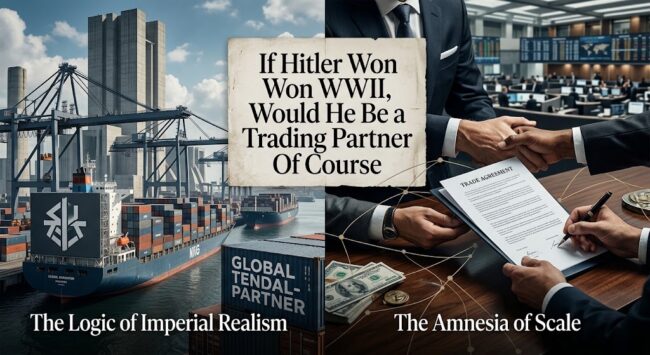
This brings us back to the most provocative, unsettling hypothesis of modern history: If the Third Reich had won World War II, secured its European hegemony (Grossraumwirtschaft), and reached permanent economic scale, the Western world would have normalized relations and traded with Berlin.
To many, this sounds like an unthinkable moral failure. But when we apply historical precedent, realpolitik, and the mechanics of international trade, it becomes a structural certainty.
The Logic of Imperial Consolidation
If Operation Barbarossa had succeeded, if the British Isles had been neutralized or isolated, and if a pan-European economic bloc stretching from the Atlantic to the Ural Mountains had consolidated under Berlin’s control, that bloc would have represented the single largest industrial and consumer market on earth.
Can we honestly believe that American corporations, Swiss bankers, and global maritime shipping conglomerates would have maintained a permanent, multi-trillion-dollar embargo against a continent-spanning superpower controlling 400 million people and immense industrial capacity?
The Sanitization of Victory
Capital does not sit on the sidelines out of moral protest when trillions of dollars in resources and markets are available. Over time, diplomatic channels would have thawed. Ambassadors would have been exchanged. Trade treaties for steel, chemicals, machinery, and consumer goods would have been negotiated under the polite fiction of “peaceful coexistence” and “stability.”
Just as the horrific human tolls of other great powers were sanitized into “historical growing pains,” the regime’s foundational atrocities would have been relegated by foreign ministries to the status of “internal domestic affairs”—the standard diplomatic shield used to avoid confronting sovereign trading partners.
The Cold Reality of the Global Order
The international order is not a church; it is a marketplace backed by steel.
When we look past the high-minded rhetoric of international summits, UN resolutions, and diplomatic communiqués, we see a world governed by the same raw forces that built the Roman Empire, carved up the Americas, and fueled 20th-century industrial scale. Power respects power. Capital flows to stability. And scale washes away historical blood.
Acknowledging that the world would have traded with a victorious Third Reich is not an endorsement of tyranny; it is an indictment of the moral fragility of global commerce. It strips away the comforting myth that humanity has evolved beyond the law of the jungle. It reminds us that so long as a regime holds the territory, commands the supply chains, and wields undeniable economic leverage, the rest of the world will eventually open the ports, sign the ledgers, and do business.
About the Author