By Brian French
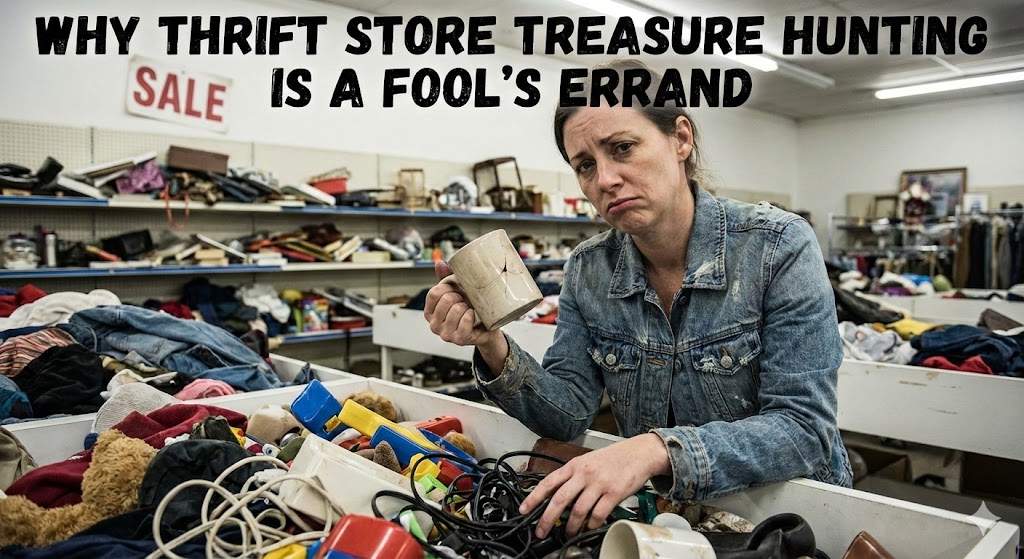
The internet loves a good thrift store success story. Someone finds a signed Picasso print for $7, a rare Mid-Century Modern lamp for $12, or a vintage Rolex buried in the watch case. The post goes viral, the finder becomes a folk hero, and thousands of wannabe pickers descend on their local Goodwill with visions of retirement funds dancing in their heads.
Here’s the truth nobody wants to hear: chasing thrift store scores is one of the worst uses of your time if you’re serious about finding valuable items.
The Lottery Ticket Fallacy
When someone brags about their $7 thrift store find that appraised for $2,000, they’re not telling you about the 300 fruitless hours they spent digging through chipped ceramic figurines and stained polyester blazers to get there. Those viral success stories represent statistical outliers, not a viable business model.
The odds of finding something genuinely valuable at a thrift store are roughly one in ten thousand. Yes, it happens. So does winning at roulette. Neither is a sustainable wealth-building strategy.
Think about what those odds really mean. If you spend an hour carefully examining merchandise at a thrift store and find nothing (the most likely outcome), that’s an hour you’ll never get back. String together enough of those hours and you’ve wasted weeks of your life on what amounts to gambling with your most precious resource: time.
Fishing in a Puddle During a Drought
Here’s an analogy that should clarify the absurdity of thrift store hunting: imagine you’re a serious fisherman. You could fish in a small, heavily-picked-over pond where dozens of other anglers show up daily to compete for the same handful of fish. Or you could fish in the ocean.
Thrift stores are that picked-over pond. Yes, occasionally a fish swims in during the “flood”—when someone donates their grandmother’s estate without knowing what they have. But the flood is rare, unpredictable, and even when it happens, you’re competing with a dozen other people who got the same tip from an employee or who happened to be there when the items hit the floor.
The phrase “fishing in a lake that has a few fish” is generous. During exceptional circumstances, unusual opportunities appear—like fish in the street during a flood. But you still wouldn’t waste your time fishing on the street. You’d go where the fish actually are, consistently and in abundance.
Where the Real Opportunities Live
If you’re serious about finding valuable antiques at bargain prices, you need to fish where the quality fish actually swim: online auction houses.
Platforms like Invaluable and LiveAuctioneers host millions of listings every single month from thousands of auction houses worldwide. This isn’t a trickle of donations filtered through disinterested retail staff. This is a constant, massive flow of cataloged, photographed inventory from estate sales, gallery closures, and private collections.
The mathematics work in your favor here. With millions of items cycling through the system monthly, genuine bargains appear every single day. Not once in a blue moon when the thrift store gods smile upon you, but daily and predictably.
Why do these bargains exist at reputable auction houses? Several reasons:
- Timing: Auctions end at specific times. If a quality item’s auction concludes at 2 PM on a Tuesday, you might face minimal competition from buyers who are at work.
- Misattribution: Even professional auction houses occasionally mislabel or undervalue items, especially in mixed lots or less popular categories.
- Market inefficiencies: Regional auction houses may not attract international bidders for items that would command premium prices in different markets.
- Volume: Auction houses move inventory constantly. They can’t obsessively research every single piece the way a specialized dealer might.
The Research Revolution
Here’s where thrift store hunting becomes even more absurd in 2025: the research gap has vanished.
Thrift stores provide virtually no information about their merchandise. You’re left holding a mystery object, hoping your gut instinct is correct. Even if you have a smartphone, you’re still trying to research items in a fluorescent-lit warehouse while other shoppers hover nearby, waiting to snatch anything you show interest in.
Online auctions provide high-resolution photographs from multiple angles. You can examine items from your home, use Google Lens for instant visual identification, and employ AI tools like Google Gemini to analyze potential purchases.
Want to know the retail market price for an item? Ask Gemini. Trying to decide between fifteen different lots you’re watching? Feed them to an AI and ask which has the highest profit potential based on current market trends. The technology analyzes sold comparables, condition reports, provenance, and market demand in seconds.
Try doing that while fighting off other bargain hunters in the housewares aisle at Goodwill.
The Time Thief
Every hour you spend at a thrift store is an hour you’re not spending on higher-value activities. This isn’t just about antiques—it’s about understanding your personal economics.
Let’s say you earn $50 per hour in your regular work. You spend three hours on a Saturday morning hitting four different thrift stores. You find nothing. You’ve just donated $150 worth of your time to the universe in exchange for… nothing.
Even if you do find something valuable once every twenty trips, ask yourself: could you have made more money spending those same sixty hours learning to better research online auctions, building relationships with estate sale companies, or developing expertise in a specific collecting category?
Your time is your only non-renewable asset. Spend it where the return on investment is highest.
The Bottom Line
Thrift store treasure hunting appeals to our love of serendipity and our desire to feel cleverer than everyone else. It’s lottery-ticket thinking dressed up as entrepreneurship.
If you enjoy thrift shopping as a hobby, by all means, continue. But if you’re serious about finding valuable antiques at bargain prices—if you want to build actual wealth or a sustainable business—stop wasting your time fishing in puddles.
Fish where the fish are: the vast, constantly refreshed waters of online auction houses where millions of items, professional photography, AI research tools, and simple mathematics all work in your favor.
The treasure is out there. It’s just not hiding under piles of donated t-shirts.
About the Author