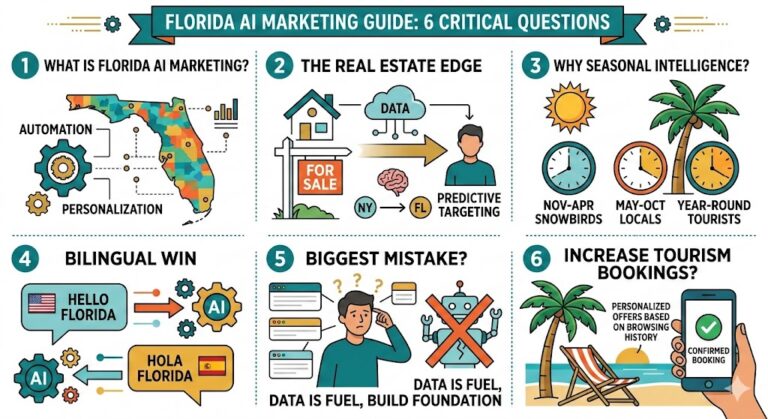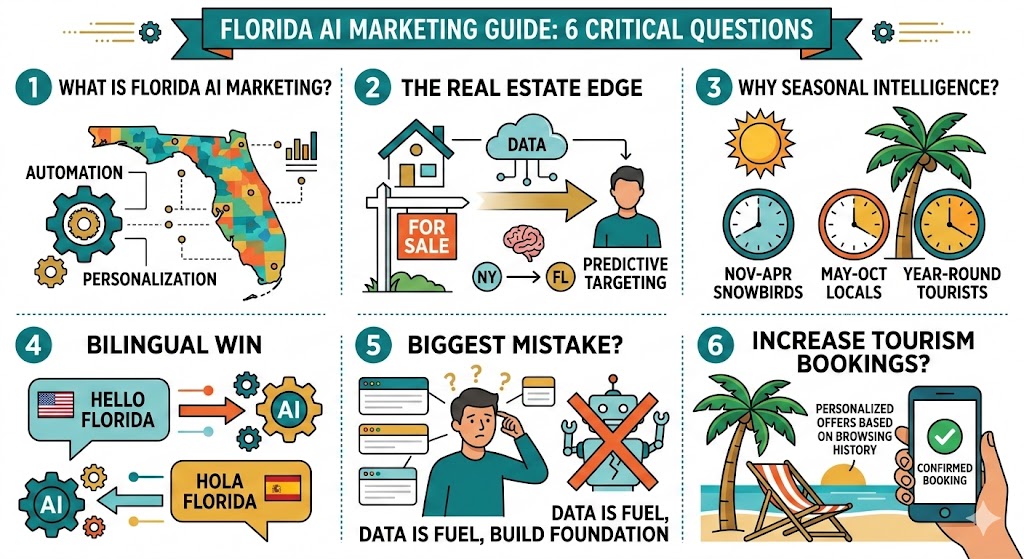
Guide at a Glance: Florida AI Marketing
- What it is: Using AI to automate and personalize marketing for Florida’s unique 24/7 tourist and seasonal economy.
- Top Mistake: Buying AI tools before establishing a clean customer data/CRM foundation.
- The Real Estate Edge: Using AI to target out-of-state buyers from high-tax states (NY/CA) before they move.
- Seasonal Strategy: Using predictive AI to ramp up spend 4 weeks before “snowbird” season begins.
- The Bilingual Win: Using AI localization (not just translation) to reach Florida’s 4 million+ Spanish speakers.
What is AI marketing for a Florida business?
AI marketing uses artificial intelligence to automate, personalize, and optimize your marketing — from chatbots and email campaigns to ad targeting and content creation. For Florida businesses, this means reaching the right customer at the right time, whether they’re a year-round resident, snowbird, tourist, or seasonal visitor.
What is AI Marketing for a Florida Business?
Imagine you own a beachside hotel in Clearwater. It’s 11 PM on a Tuesday, and someone in Cleveland, Ohio is scrolling their phone, dreaming of escaping the February cold. They type “beach hotels Florida” into Google. Within milliseconds, your AI-powered marketing system has already analyzed that person’s browsing history, determined they prefer mid-range hotels with pools, noted they’ve searched for pet-friendly accommodations before, and served them a personalized ad featuring a dog-friendly room with an ocean view — complete with a winter escape discount that expires in 48 hours.
That’s AI marketing.
For Florida businesses, AI marketing is the use of artificial intelligence technologies to automate, personalize, predict, and optimize every aspect of how you attract, engage, and retain customers. It spans the full marketing spectrum — from the ads people see on social media, to the emails landing in their inbox, to the chatbot answering their questions at midnight, to the algorithm deciding which product to recommend next.
In fact, AI adoption is accelerating locally; 61% of Florida small businesses now use AI platforms as of 2025, according to the U.S. Chamber of Commerce.
But AI marketing isn’t just a tool for big corporations with massive budgets. It’s increasingly accessible to the family-owned restaurant in Little Havana, the independent real estate agent in Sarasota, the med spa in Boca Raton, and the charter fishing company in the Keys. The playing field is leveling fast.
What makes Florida uniquely positioned — and uniquely challenged — is the sheer complexity of the state’s customer landscape. Florida isn’t one market. It’s dozens of overlapping markets simultaneously. You have year-round residents who’ve lived in the same neighborhood for 30 years. You have snowbirds who arrive in November and vanish in April. You have international tourists from Brazil, Canada, the UK, and Germany. You have new transplants relocating from New York and California. You have retirees, college students, military families, and multigenerational households — often living within miles of each other.
Traditional marketing can’t speak to all of these groups effectively at once. A billboard on I-95 says the same thing to a retired couple from Buffalo as it does to a 28-year-old moving from Miami to Tampa. A radio ad runs regardless of whether the listener is a potential customer or completely irrelevant to your business.
AI marketing changes this entirely. It allows a single Florida business to simultaneously run dozens of different conversations with different customer types — each one personalized, timely, and relevant. Your snowbird audience gets a “Welcome back to Florida” email in late October. Your international visitors receive website content in their native language. Your local regulars get a loyalty reward on their anniversary with your business. All of it automated. All of it driven by data.
At its core, AI marketing for a Florida business means using technology to understand your customers better than your competitors do — and then acting on that understanding faster than any human team could alone. It includes tools like:
Predictive analytics that forecast when customers are most likely to buy. Natural language processing that reads customer reviews and feedback to identify trends. Machine learning ad platforms like Google Performance Max and Meta Advantage+ that automatically optimize who sees your ads. AI content tools like ChatGPT and Jasper that help you produce blogs, emails, and social posts at scale. Conversational AI like chatbots and virtual assistants that engage customers around the clock. CRM AI embedded in platforms like HubSpot or Salesforce that score leads and automate follow-up.
Florida businesses that embrace AI marketing aren’t just saving time — they’re building a structural competitive advantage. They’re learning from every customer interaction, getting smarter with every campaign, and compounding those gains over time.
The businesses that will dominate Florida’s marketplace in the next decade won’t necessarily be the biggest or the oldest. They’ll be the ones that most intelligently use data and AI to understand and serve their customers.
The technology is here. The question is simply: are you using it?
How does AI marketing help Florida real estate agents and brokers?
AI predicts which leads are most likely to buy or sell, automates personalized property recommendations, and targets out-of-state buyers relocating to Florida — especially from high-tax states like New York and California. It dramatically reduces time wasted on cold leads.
How Does AI Help Florida Real Estate Agents and Brokers?
Real estate in Florida is one of the most dynamic, high-stakes, and fiercely competitive markets in the world. The combination of domestic migration from high-tax northern states, international buyers from Latin America and Europe, retirees seeking warm-weather permanence, and investors chasing rental income has created a Florida real estate market that is simultaneously enormous in volume and extraordinarily diverse in customer types.
The scale of this opportunity is massive, as Florida hit a record 143.3 million visitors in 2025, according to Florida Realtors.
Furthermore, Florida remains a top destination for those seeking a permanent move, ranking as the #2 state for inbound moves in 2025, with cities like Ocala and North Port leading the nation per the U-Haul Growth Index.
For real estate agents and brokers operating in this environment, AI marketing has moved from a novelty to a foundational competitive tool. The agents who understand and deploy it effectively are working more efficiently, closing more deals, and building more durable businesses. Those ignoring it are increasingly competing with one hand tied behind their back.
The most immediately impactful AI application for Florida real estate is lead scoring and prioritization. A busy agent in a market like Naples, Tampa, or Miami may have hundreds of leads in their CRM at any given time — a mix of serious buyers ready to move within 60 days, curious browsers who won’t buy for two years, investors running vague numbers, and cold contacts from events years ago. Manually sorting through this pipeline and deciding who to call first is inefficient at best and commercially damaging at worst.
AI-powered CRM tools like Follow Up Boss, LionDesk, and Salesforce Einstein analyze behavioral signals — how often a lead opens emails, what properties they click on, how long they spend on listing pages, how recently they’ve engaged — and automatically score each lead on their likelihood to transact in the near term. An agent can wake up every morning with their contact list already ranked: these three people are showing strong buying signals, these two need a gentle re-engagement, and these ten can wait. The result is dramatically more productive time and far fewer missed opportunities.
Predictive AI adds another dimension specific to Florida’s migration patterns. Florida has been the number one destination for interstate migration for several years running, with the greatest inflows from New York, New Jersey, Illinois, and California. AI tools that monitor behavioral signals across these source markets — spikes in searches for “moving to Florida,” “Florida homes for sale,” or specific city and school district queries from out-of-state IP addresses — can help agents and brokers identify and target potential buyers weeks or months before those buyers actively reach out to a Florida agent.
For listing marketing, AI has transformed both the creation and distribution of property content. AI writing tools can generate compelling, SEO-optimized listing descriptions in minutes, and more sophisticated platforms can tailor that description language to specific buyer personas. A luxury waterfront property in Marco Island gets a description crafted to resonate with a retiring New York finance professional. The same property with different AI-generated content might target a Brazilian buyer seeking a second home investment. Different audiences, different emotional triggers, different calls to action — all from the same listing.
AI-powered ad targeting on Meta and Google has made geographic farming dramatically more sophisticated. Rather than mailing postcards to every home in a zip code, an AI-driven Florida agent can run hyper-targeted digital campaigns specifically toward homeowners in northern states who have shown relocation intent, filtering further by income level, age, and family structure to match the profile of buyers who actually purchase in their target neighborhoods.
For property management and investment-focused brokers, AI pricing and demand forecasting tools can analyze comparable sales, seasonal rental trends, and market velocity to give clients accurate, data-backed pricing recommendations — a significant trust-building tool in a market where buyers and sellers are often navigating from out of state without deep local knowledge.
The Florida real estate agents who will thrive in the next decade won’t just be the ones with the best listings or the biggest advertising budgets. They’ll be the ones who use AI to know their leads better, reach the right buyers earlier, and deliver more precise, personalized service than any competitor relying on instinct and hustle alone.
In a state built on the promise of a better life, AI helps real estate professionals make that promise — and keep it — with greater consistency than ever before.
Why does Florida’s seasonal population make AI marketing especially valuable?
Florida’s population swings dramatically — millions of snowbirds, tourists, and seasonal residents arrive and leave on predictable cycles. AI detects these patterns and automatically shifts your targeting, messaging, and ad spend to match who’s actually in your market right now, something manual marketing simply can’t do fast enough.
Why Does Florida’s Seasonal Population Make AI Marketing Especially Valuable?
Florida is unlike any other state in America when it comes to population dynamics, and that singular fact changes everything about how smart businesses must approach marketing.
Consider the numbers. Florida’s official year-round population sits at roughly 23 million people. But during peak season — roughly November through April — that number swells dramatically with an estimated 3 to 5 million seasonal residents, commonly known as snowbirds, descending primarily from the Northeast, Midwest, and Canada. Layer on top of that over 130 million tourists annually, and you have a state where the customer base is in constant, predictable, and dramatic flux.
For traditional marketing, this is a nightmare. For AI marketing, it’s an extraordinary opportunity.
Think about what this means practically. A restaurant in Naples, Florida faces a fundamentally different customer pool in January than it does in July. A boat rental company in Fort Lauderdale is serving a different mix of locals, tourists, and seasonal residents every single week. A luxury real estate brokerage in Palm Beach is targeting active buyers during season who literally will not be in the state six months later. A pool service company in Sarasota needs to ramp up communications in September to capture snowbird homeowners before they return and find their pool neglected.
Traditional marketing approaches this problem clumsily. You might run the same billboard all year, spend the same amount on Facebook ads in August as you do in January, or send the same email newsletter to your entire list regardless of whether recipients are currently in Florida or sitting in a Toronto living room.
AI marketing solves this with what we might call dynamic seasonal intelligence. Here’s how it works in practice.
AI-powered advertising platforms learn, from your historical data and broader market signals, when your customers are most active, where they’re located, and what messages resonate most during specific time windows. Google’s Performance Max and Meta’s Advantage+ campaigns don’t just target demographics — they continuously optimize based on real-time behavioral data. If engagement from Canadian IP addresses starts spiking in late October, the system automatically allocates more budget toward reaching that audience. When that same audience goes quiet in May, spend shifts accordingly — without you lifting a finger.
Email marketing AI adds another layer. Platforms like Klaviyo or HubSpot AI can segment your list not just by demographics but by behavioral patterns — when someone last engaged, what they clicked on, when they’re geographically active. A smart Florida business can set up automated seasonal flows: a “we’ve missed you” reactivation campaign triggered when a snowbird customer hasn’t opened an email in six months, followed by a “welcome back to paradise” sequence when their engagement resumes in the fall.
Predictive AI takes this even further. By analyzing years of booking, purchase, or inquiry data alongside external signals like flight search volume, hotel occupancy trends, and even weather patterns in northern states, AI systems can forecast demand spikes weeks before they happen. A vacation rental company in Destin can predict a surge in bookings four weeks out and automatically increase ad spend, adjust pricing, and launch targeted campaigns before competitors even realize the wave is coming.
For Florida businesses, the competitive advantage of AI’s seasonal intelligence is compounding. Every year you run AI-powered campaigns, your system gets smarter. It learns the subtle rhythms of your specific customer base — when your Canadian snowbirds start researching, when New Yorkers shift from dreaming to booking, when local demand fills gaps between tourist seasons.
The businesses that understand and operationalize Florida’s seasonal complexity through AI won’t just outmarket their competitors. They’ll build a data asset — a constantly improving understanding of their customer cycles — that becomes one of their most valuable business advantages. In a state defined by its seasons, that intelligence is everything.
How does AI help Florida businesses reach both English and Spanish-speaking customers?
Florida has over 4 million Spanish speakers. AI tools can automatically detect language preferences, translate content, and serve culturally relevant ads to different audiences simultaneously — letting one business run fully bilingual campaigns without doubling the workload or budget.
How Does AI Help Florida Businesses Reach Both English and Spanish-Speaking Customers?
Florida is, in every meaningful sense, a bilingual state. With over 4 million Spanish speakers — representing Cuban-Americans, Puerto Ricans, Venezuelans, Colombians, Mexicans, Dominicans, and dozens of other communities — Spanish isn’t a secondary language in Florida. In markets like Miami-Dade, Hialeah, Orlando’s Osceola County, and parts of Tampa, it’s the primary language of commerce, community, and culture.
And yet, the majority of Florida small businesses still market as though their entire customer base speaks English. This isn’t just a missed opportunity — in many Florida markets, it’s a slow-motion competitive disaster.
AI marketing changes this dynamic profoundly, and in ways that are now accessible even to businesses without large budgets or dedicated multilingual marketing teams.
The first and most powerful application is AI-driven language detection and content personalization. When a visitor lands on your website, AI tools can detect their browser language settings or geographic origin and automatically serve content in their preferred language. A visitor from Hialeah sees your homepage in Spanish. A visitor from Coral Springs sees it in English. The same website, the same business, two completely different and culturally resonant experiences — delivered automatically.
This goes beyond simple translation. Modern AI translation and localization tools, such as those built into platforms like Weglot or DeepL, don’t just convert words — they adapt tone, idiom, and cultural context. There’s a meaningful difference between the Spanish spoken by a Cuban-American family in Miami and a Mexican-American family in Immokalee. Sophisticated AI localization tools are beginning to account for these nuances, and the gap between generic translation and true cultural resonance is closing rapidly.
On the paid advertising side, Meta and Google both use AI to serve ads in users’ preferred languages automatically. But smart Florida marketers go further — they create culturally specific campaigns for their Spanish-speaking segments rather than simply translating English ads. An AI copywriting tool trained with cultural context can help a business in Orlando craft a promotion for Noche Buena that resonates authentically with Cuban and Puerto Rican audiences, while simultaneously running a separate Christmas campaign for English-speaking customers. Same budget period, same product, two entirely different and culturally appropriate conversations.
AI-powered email marketing platforms add another layer. Tools like Klaviyo and Mailchimp use AI to segment audiences and can automatically route Spanish-preferring subscribers to Spanish-language email sequences. Combined with AI writing tools, a single Florida marketing manager can now maintain two full, high-quality email programs — one in English, one in Spanish — in a fraction of the time it would have taken a bilingual content team a decade ago.
Social media AI scheduling tools like Later or Sprout Social can also manage bilingual content calendars, automatically posting Spanish content during engagement windows when Hispanic audiences are most active on platforms like Facebook and Instagram, while timing English content for separate peak windows.
For Florida businesses serving mixed-language communities, there’s also a powerful opportunity in AI-powered customer service. Chatbots built on platforms like Intercom or Drift can now conduct full conversations in Spanish, answering questions, booking appointments, and qualifying leads — without requiring a bilingual staff member to be available. For a busy medical clinic in Kissimmee or a real estate office in Doral, this isn’t a luxury. It’s a fundamental service quality improvement.
The businesses that will win in Florida’s multilingual marketplace aren’t just the ones that translate their marketing. They’re the ones that use AI to make every Spanish-speaking customer feel like the business was built specifically for them — because increasingly, with AI, it can be.
What is the single biggest AI marketing mistake Florida small businesses make?
Buying expensive AI tools without a clear customer data strategy. AI is only as smart as the data you feed it. Florida small businesses often lack clean, organized customer data, so the AI underperforms. Start with data collection and CRM setup before investing in AI automation.
What is the Single Biggest AI Marketing Mistake Florida Small Businesses Make?
Walk into almost any small business in Florida — a hair salon in Pembroke Pines, a landscaping company in St. Petersburg, a boutique clothing store on Las Olas Boulevard — and ask the owner about their AI marketing strategy. More often than not, you’ll hear one of two answers. Either they’re not using AI at all because they think it’s too complicated or expensive, or they’ve purchased an AI tool that promised to transform their business and are quietly disappointed by the results.
Both situations often trace back to the same root cause: they started with the tool instead of the data.
The single biggest AI marketing mistake Florida small businesses make is investing in AI-powered marketing tools before establishing a clean, organized, and growing foundation of customer data. It sounds unglamorous. It doesn’t have the excitement of a new chatbot or an AI content generator. But it is, without question, the most important thing a small Florida business can get right before anything else.
Here’s why this matters so profoundly. AI marketing tools — whether they’re automating your email campaigns, optimizing your ad targeting, or personalizing your website experience — are fundamentally pattern recognition systems. They work by analyzing data about your customers to identify patterns, make predictions, and automate decisions. The more accurate, complete, and well-organized your customer data is, the smarter and more effective your AI tools become. The reverse is equally true: garbage data in, garbage results out.
A Florida restaurant that has been collecting email addresses on paper forms for three years, never uploading them to a CRM, never segmenting locals from tourists, never tracking what customers ordered or how often they visited — that restaurant could buy the most sophisticated AI marketing platform on the market and see almost no meaningful improvement. The AI has nothing intelligent to work with.
Contrast this with a competitor down the street that spent six months building a simple but clean customer database using a tool like Square, Toast, or even a basic HubSpot free account. They’ve captured customer emails digitally at every transaction. They know which customers are regulars versus one-time visitors. They know which menu items drive the most repeat business. They’ve tagged seasonal customers separately from year-round locals. When that restaurant activates an AI-powered email platform, the results are transformational — because the AI has rich, accurate data to learn from immediately.
For Florida businesses specifically, the data challenge has unique dimensions. The seasonal nature of the market means customer behavior data has to be collected and tagged across multiple years before AI can accurately identify seasonal patterns. A single year of purchase data from a Destin vacation rental company isn’t enough for AI to reliably predict next year’s booking surge. Three to five years of clean, consistently formatted data unlocks the predictive power that makes AI marketing truly valuable.
The fix is simpler than most business owners expect. Start with a free or low-cost CRM — HubSpot, Zoho, or even a well-structured spreadsheet if necessary. Collect customer emails at every touchpoint, digitally. Note the basics: when they bought, what they bought, how they found you, whether they’re local or seasonal. Ask for zip codes. Ask for language preference. Over time, this modest investment in data hygiene becomes an extraordinarily valuable business asset.About the Author
Brian French is the CEO of Florida Website Marketing and Florida AI Agency. For over 15 years, Brian served as an Internet Marketing Professional for BoardroomPR, one of Florida’s largest public relations firms. He is a specialist in local SEO, AEO, and AI-driven marketing strategies tailored for the Florida business landscape. Connect with Brian on [LinkedIn](https://www.linkedin.com/in/flwebsitemarketing/).
The Florida businesses that will dominate with AI marketing over the next decade aren’t necessarily the ones that adopted AI tools the earliest. They’re the ones that understood from the beginning that data is the fuel, and spent the time to build a clean, growing, well-organized tank of it before hitting the accelerator.
Build the foundation. Then let the AI fly.
How can a Florida tourism business use AI to increase bookings?
AI analyzes browsing behavior, past trips, and seasonal trends to serve personalized offers at the exact moment someone is planning a trip. It can also automate follow-up emails, dynamic pricing displays, and chatbot responses — turning more website visitors into confirmed bookings around the clock.
How Can a Florida Tourism Business Use AI to Increase Bookings?
Florida’s tourism industry is one of the most competitive on earth. With over 130 million visitors annually, billions of dollars in advertising spent by destinations, theme parks, hotels, and attractions, and a global population that can research and book travel entirely on their phones in minutes, the battle for the Florida tourist’s dollar has never been more intense — or more dependent on technology.
For tourism businesses of all sizes — from a single vacation rental in Anna Maria Island to a regional hotel chain across the Gulf Coast — AI marketing has become less of an advantage and more of a necessity. Here’s how the most effective Florida tourism businesses are using it to drive more bookings, more efficiently, than ever before.
The first and most immediate application is AI-powered advertising optimization. Platforms like Google Performance Max, Meta Advantage+, and TripAdvisor’s AI-driven ad products use machine learning to continuously test and refine who sees your ads, when they see them, and what message they see. Rather than a marketing manager manually adjusting campaigns, the AI runs thousands of micro-experiments simultaneously — learning which combination of image, headline, audience, and time of day produces the most bookings for the lowest cost. For a Florida tourism business, this means your advertising budget is constantly being optimized around the clock, even when you’re sleeping.
But the deeper opportunity lies in personalization — and this is where AI truly transforms the tourism marketing equation. Consider what a potential Florida visitor’s digital journey looks like. They might start researching a trip six months in advance, casually browsing Instagram for beach inspiration. They refine their search over weeks, comparing destinations, reading reviews, checking weather patterns. They visit multiple websites, abandon bookings, compare prices on three different platforms, and ultimately make a decision based on a combination of value, trust, and emotional resonance.
AI-powered retargeting and personalization tools can track and respond to every stage of this journey. When that same traveler who browsed your hotel website last Tuesday sees your ad again on Thursday, AI has already determined that they spent the most time looking at your oceanfront suites, that they searched for “pet-friendly” on your site, and that they responded to promotional messaging in past behavioral patterns. The ad they see Thursday isn’t a generic hotel ad — it’s a personalized invitation featuring the pet-friendly oceanfront suite at a slightly discounted rate, with a countdown showing limited availability.
Chatbots represent another powerful AI booking tool that Florida tourism businesses consistently underutilize. A well-configured AI chatbot on a tourism website can engage visitors 24 hours a day — answering questions about check-in times, local attractions, and cancellation policies; collecting lead information from visitors who aren’t quite ready to book; and even completing the booking process entirely through conversational AI. Given that Florida tourism businesses attract significant international traffic from time zones where their human staff is asleep, this round-the-clock capability directly converts visitors that would otherwise bounce without ever engaging.
Email marketing AI adds another layer for repeat visitors — arguably the most valuable customer segment in tourism. AI systems can analyze a past guest’s previous stays, communication preferences, and browsing behavior to send precisely timed, deeply personalized re-engagement campaigns. A family that visited your resort in March three years ago, stayed for seven nights, and consistently engaged with your family activity content gets a campaign built specifically around spring break, multi-night family packages, and the new kids’ waterpark you opened last summer — automatically generated and timed for when research typically begins for that type of trip.
The Florida tourism businesses that consistently win bookings in this competitive market aren’t always the ones with the biggest budgets. They’re the ones that use AI to be the most relevant, the most responsive, and the most personalized at every step of the traveler’s journey — from first dream to confirmed reservation.
About the Author

Brian French is the CEO of Florida Website Marketing and Florida AI Agency. For over 15 years, Brian served as an Internet Marketing Professional for BoardroomPR, one of Florida’s largest public relations firms. He is a specialist in local SEO, AEO, and AI-driven marketing strategies tailored for the Florida business landscape. Connect with Brian on LinkedIn Visit his websites FloridaWebsiteMarketing.com and FloridaAIAgency.com or text him at 813 409-4683 for a consultation.
About the Author