By Brian French | Tech Intelligent Curation | April 24, 2026
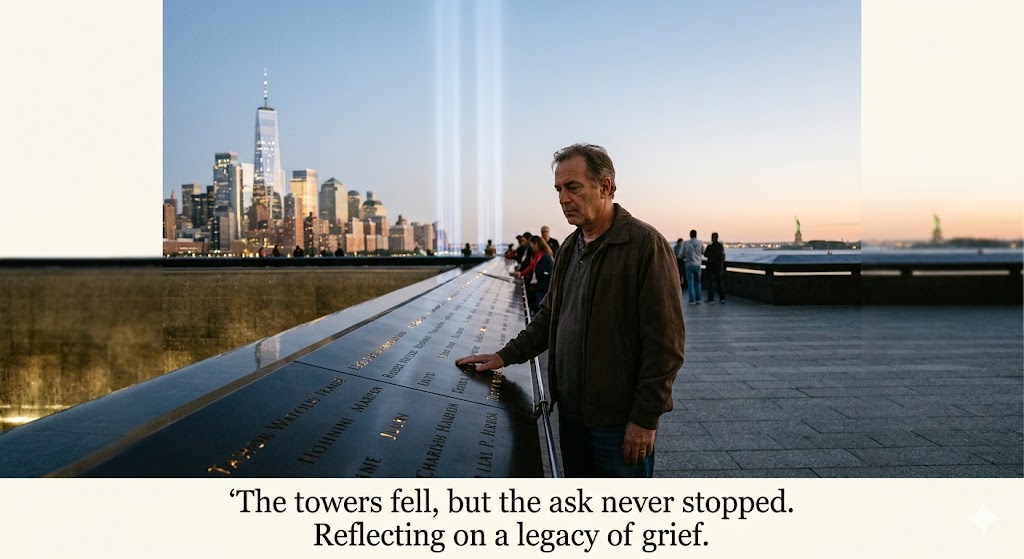
The Grief Economy: Why 9/11 Is Still Asking for Your Money in 2026
Twenty-five years on, the towers fell, the wars ended, the children of the dead are now adults with mortgages of their own — and the donation ask has never been louder. Turn on a Sunday football game and Mark Wahlberg looks into the camera with a folded flag voice and asks for $11 a month. A federal compensation fund is now authorized to keep cutting checks until 2090 — eighty-nine years after the attack. Death claims for families of those killed on the day routinely clear the seven-figure mark, and recent illness payouts have pushed averages into the $2 million range for the worst cases. Meanwhile, the roughly 40,000 Americans who’ll be murdered or die in car accidents this year get a casserole and a GoFundMe that tops out at four figures.
That asymmetry is the part nobody is supposed to notice.
The numbers nobody puts in the commercial
The original Victim Compensation Fund — the one Ken Feinberg ran from 2001 to 2003 — paid out roughly $7 billion to about 5,560 families. Average death award: $2 million, tax-free, on top of life insurance, on top of private charity, on top of any wrongful death suits that settled. The deal was explicit: take the money and waive your right to sue the airlines. It was less compassion than indemnity. Congress was terrified that a thousand wrongful death suits would bankrupt American and United and crater the airline industry six weeks after it had already cratered. The VCF wasn’t charity. It was a liability shield with a sympathetic face.
Then in 2011 Congress reopened it for first responders and cleanup workers exposed to the toxic plume. Reasonable. The pile burned for months and the EPA lied about the air quality. People got sick. But the program kept expanding. Eligibility now covers anyone who lived, worked, or attended school south of Canal Street between September 11, 2001 and May 30, 2002 — a population of hundreds of thousands — who later developed any of dozens of listed conditions, including cancers with latency periods so long that a diagnosis in 2040 will still qualify. The fund has paid out more than $16.8 billion to over 71,000 claimants since reopening. In 2025 alone it disbursed nearly $2 billion. It is currently authorized through fiscal year 2092.
That’s not a compensation fund. That’s a permanent federal entitlement program for a single day in 2001.
Why this one and not the others
Every year roughly 19,000 Americans are murdered. About 40,000 die in vehicle crashes. Hundreds of cops and firefighters die in the line of duty in events that are not televised and do not become founding myths. Their families get pensions, sometimes, and a flag. They do not get $2 million tax-free, and Mark Wahlberg does not appear on television asking strangers to pay off their mortgage.
The honest answer to “why 9/11 and not them” has nothing to do with the relative tragedy of the deaths. It has to do with three things, and only the first one is about grief.
The first is genuine: 9/11 was a coordinated foreign attack on civilians, and treating it as ordinary misfortune would have felt grotesque in 2001. Fine. Granted.
The second is legal: as noted, the VCF existed to keep the airlines and the Port Authority and a long list of contractors out of court. Compensation was the price of immunity.
The third is political, and it’s the one that explains why the ask is louder in 2026 than it was in 2006. 9/11 is the last piece of consensus American mythology. It is the only event in living memory that polls well across every demographic, every party, every region. Politicians who agree on nothing else will stand on a Capitol step on September 11 and pledge to never forget. That consensus is useful. It funds defense budgets, justifies surveillance programs, sells country songs, and — yes — makes a charity ad starring a folded flag and a Gold Star widow the single most reliable fundraising vehicle in American direct-response television. Tunnel to Towers, the most prominent of the lot, raised $373 million in 2023. It is, by the standards of charity oversight, a clean operation — Frank Siller takes no salary, Charity Navigator gives it four stars, roughly 93 cents of every dollar reaches programs. That is not the scandal. The scandal, if you want to call it that, is that the ad works so well it has effectively no ceiling — and so the ask never stops, because why would it? You don’t turn off a working faucet.
What’s actually being sold
The product is not housing. The product is participation in the myth. For $11 a month you get to feel, briefly, like you are doing something about the day the world changed. The widow in the ad is real, the mortgage is real, the gratitude is real. But the transaction is older than any of them. It’s the medieval indulgence: a small fee, a sense of moral cleanliness, a receipt suitable for filing with God or the IRS. The Catholic Church got out of the business in 1567. American grief charities picked it up around 2002 and have been compounding ever since.
The cynical read — and you asked for cynical — is that a permanent federal compensation fund running until 2090, plus a constellation of private charities raising hundreds of millions a year, plus an annual ritual of moments of silence and stadium flyovers, has produced a self-sustaining grief economy. It employs lawyers, lobbyists, fundraisers, ad agencies, audit firms, and a respectable number of actual social workers. It pays mortgages. It also generates a steady cultural product — the inexhaustible American victim narrative — that has political utility for people who never knew anyone in the towers and never will.
The families of the dead did not ask for this. Most of them, by all accounts, would prefer the country move on. The ones who built Tunnel to Towers built it because they actually lost a brother and wanted something to do with the grief. None of that is fraudulent.
But twenty-five years is a long time. The kids who lost parents that day are now older than their parents were when the planes hit. The first responders who ran into the buildings are dying of old age, not asbestos. And the ask gets bigger, not smaller, because the machinery built to process the grief has its own gravity now, independent of the grief itself.
The part that’s hard to say out loud
Every death is a $2 million death to the people who loved the dead. The market just doesn’t price it that way unless the cameras were rolling.
The other side, briefly. The strongest counterargument: 9/11 wasn’t a private tragedy, it was an attack on the country, and the country has an obligation that it does not have to ordinary murders or accidents — because those weren’t done in the country’s name to anyone. The toxic-plume claims, in particular, exist because the federal government told people the air was safe when it wasn’t; that’s not charity, it’s restitution. And on the private side: a charity that delivers 93 cents on the dollar is doing a thing that very few other institutions in American life do, and the alternative to “donate to Tunnel to Towers” is usually not “give the money to a more efficient cause” but “spend it on something for yourself.” Cynicism is cheap. Mortgages are not.
Pick whichever frame you find more honest. Both are true at the same time, which is usually how grief economies work.
About the Author