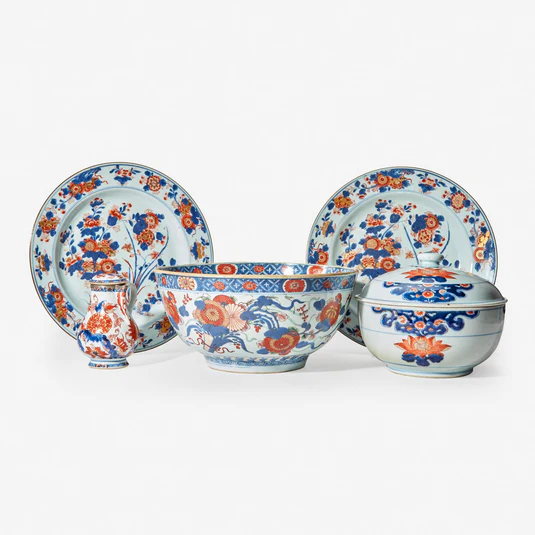
18th-Century Chinese Imari: A Unique, Highly Collectible Art Form
For more than three centuries, collectors have been captivated by the rich color, technical sophistication, and global history embodied in 18th-century Chinese Imari porcelain. Made primarily at the great Jingdezhen kilns for export to Europe, these wares combine Chinese craftsmanship with a bold palette inspired by Japanese Imari and European taste.
Today, 18th-century Chinese Imari remains one of the most sought-after areas of Chinese export porcelain collecting—especially when pieces survive in good condition, with strong enamels and gilding, and in interesting forms such as covered bowls, jars, tureens, and spice boxes.
From Japanese Imari to Chinese Imari
“Imari” originally refers to Japanese export porcelain shipped from the port of Imari, decorated with underglaze cobalt blue and overglaze iron-red and gilt, often with dense floral and textile-inspired designs.
In the late 17th century, political turmoil in China temporarily disrupted porcelain exports, and Japanese kilns at Arita stepped in to supply European demand. When Chinese production resumed in earnest, Chinese potters began copying the highly popular Japanese Imari style, adapting its color scheme and motifs into their own repertoire and producing it on a massive scale for Western markets.
Key visual traits of Chinese Imari include:
- Underglaze cobalt blue designs in the biscuit
- Overglaze iron-red and rich gilding, sometimes with black and other enamel colors
- Bold radial or panelled designs, often with peonies, chrysanthemum, rockwork, stylized scrolls, and patterned borders
By the early 18th century, Chinese Imari was so abundant and successful that it even prompted European factories—Meissen, Chelsea, Worcester, and others—to produce their own “Imari-palette” porcelain to compete with the imports. (The Holburne Museum)
Collected for Centuries
Chinese export porcelain has been a staple of Western collecting since the 1600s. Imari-palette pieces, with their flamboyant enamels and association with aristocratic taste, were particularly admired in European palaces and great houses. (Asian Art Newspaper)
By the 18th century:
- Chinese Imari was produced in dinner services, garnitures, chargers, jars, bowls, and specialized forms such as shaving basins and spice boxes.
- Pieces traveled via the great trading companies to Britain, the Netherlands, Portugal, Spain, and the Americas, furnishing dining rooms, cabinets of curiosities, and later, museum collections.
In the 19th and 20th centuries, major connoisseurs of Chinese ceramics continued to buy Chinese Imari, incorporating it into large export porcelain holdings—and it remains a visible component in private and institutional collections today.
Why 18th-Century Chinese Imari Is Considered Rare Today
Although Chinese Imari was once produced in large quantities, true 18th-century examples have become comparatively scarce for several reasons:
- Fragility and usage – Many service pieces were used at table for generations; breakage, wear, and heavy over-restoration have drastically reduced the number of attractive survivors.
- Changing tastes – Later in the 18th and 19th centuries, other palettes (famille rose, grisaille, armorial services) competed with and eventually overshadowed Imari production, so the peak period is relatively concentrated in time.
- Collector demand – As scholarship and collecting of Chinese export porcelain expanded in the 20th and 21st centuries, high-quality Chinese Imari has been absorbed into long-term collections, reducing the volume of fine pieces that reach the open market. (Christie’s)
As a result, well-preserved 18th-century Chinese Imari—especially in unusual forms or with rare decoration such as grisaille European figures—is now viewed as a relatively scarce, connoisseur’s field.
What Serious Collectors Look For
When evaluating 18th-century Chinese Imari, collectors typically focus on:
- Date and quality of porcelain
- A good, even white body typical of Qing-dynasty Jingdezhen export ware
- Sharp potting and well-finished foot rims
- Strength of the palette
- Deep, clear cobalt blue
- Rich iron-red enamels
- Original gilding still largely intact rather than heavily rubbed or re-gilded
- Design and rarity
- Complex compositions, unusual scenes (European figures, mythological or allegorical scenes), or rare forms (spice boxes, bouquetières, covered jars)
- Condition
- Minor frits, rim nicks, or typical age wear are often acceptable
- Cracks, stained hairlines, and heavy overpainting lower desirability and value
Pieces that combine strong color, rare form, and good condition tend to command the most interest from informed collectors and dealers.
18th-Century Chinese Imari from Wondrous Things (Brian French)
The Wondrous Things eBay store (Wondrous Things with Brian French) offers a focused group of 18th-century Kangxi and early Qing Chinese Imari pieces, each illustrating different aspects of the style and its collecting appeal. (eBay)
Here are four notable examples you can explore directly:
- 18th Century Kangxi Chinese Imari Covered Bowl – 5 1/2 Inches Tall
A compact covered bowl with classic Imari palette, ideal as a reference example of Kangxi-period export Imari in a lidded form.
👉 View on eBay (eBay) - 18th Century Kangxi Chinese Imari RARE Grisaille European Figures – 8 7/8 Inches
This plate combines Chinese Imari coloring with European figures painted in grisaille, a rare and highly sought-after hybrid that speaks to the China-trade’s response to Western tastes.
👉 View on eBay (eBay) - RARE: 18th Century Kangxi Chinese Imari Covered Spice Box
An uncommon covered spice box form, illustrating how Chinese potters adapted functional European shapes while retaining the Imari palette. Rare shapes like this are especially prized by advanced collectors.
👉 View on eBay (eBay) - RARE: 18th Century Kangxi Chinese Imari Covered Jar – 7 Inches
A covered jar with rich Imari enamels, suitable either as a stand-alone collector’s piece or as part of a larger Imari grouping. Covered jars remain a cornerstone shape for Chinese export porcelain displays.
👉 View on eBay (eBay)
All of these pieces come from the same specialist source—Wondrous Things with Brian French, whose store page also shows additional East Asian ceramics and Chinese export examples across related categories. (eBay)
Why Chinese Imari Remains a “Sweet Spot” for Collectors
For today’s collectors, 18th-century Chinese Imari occupies an attractive niche:
- Historically important – It embodies the interaction between Chinese kilns, Japanese design, and European demand in the early global luxury trade.
- Visually impactful – The bold red-blue-gold palette stands out in any cabinet or room, even when mixed with blue-and-white or famille rose porcelain.
- Relatively finite supply – Unlike later factory wares, genuine 18th-century pieces in good condition are limited, and the best examples often settle into long-term collections. (Christie’s)
Whether you’re building a focused collection around Kangxi-period Chinese Imari or adding a few strong examples to a broader Chinese export cabinet, pieces like the covered bowl, spice box, covered jar, and grisaille-decorated plate from Wondrous Things give a tangible, display-ready link to the 18th-century China trade.
More News Articles:
• South Fl Construction Training School | ABC East Coast
• Construction Law Firm Coral Gables / South Florida
• Tampa / Orlando Construction Surety Bond Provider Guignard Company
• Social Security Disability Claim Law Firm in South Fl
About the Author