When Ancient Wisdom Illuminates the Digital Pen
By Brian B. French
Part I: Logos — The Logic of Liberation
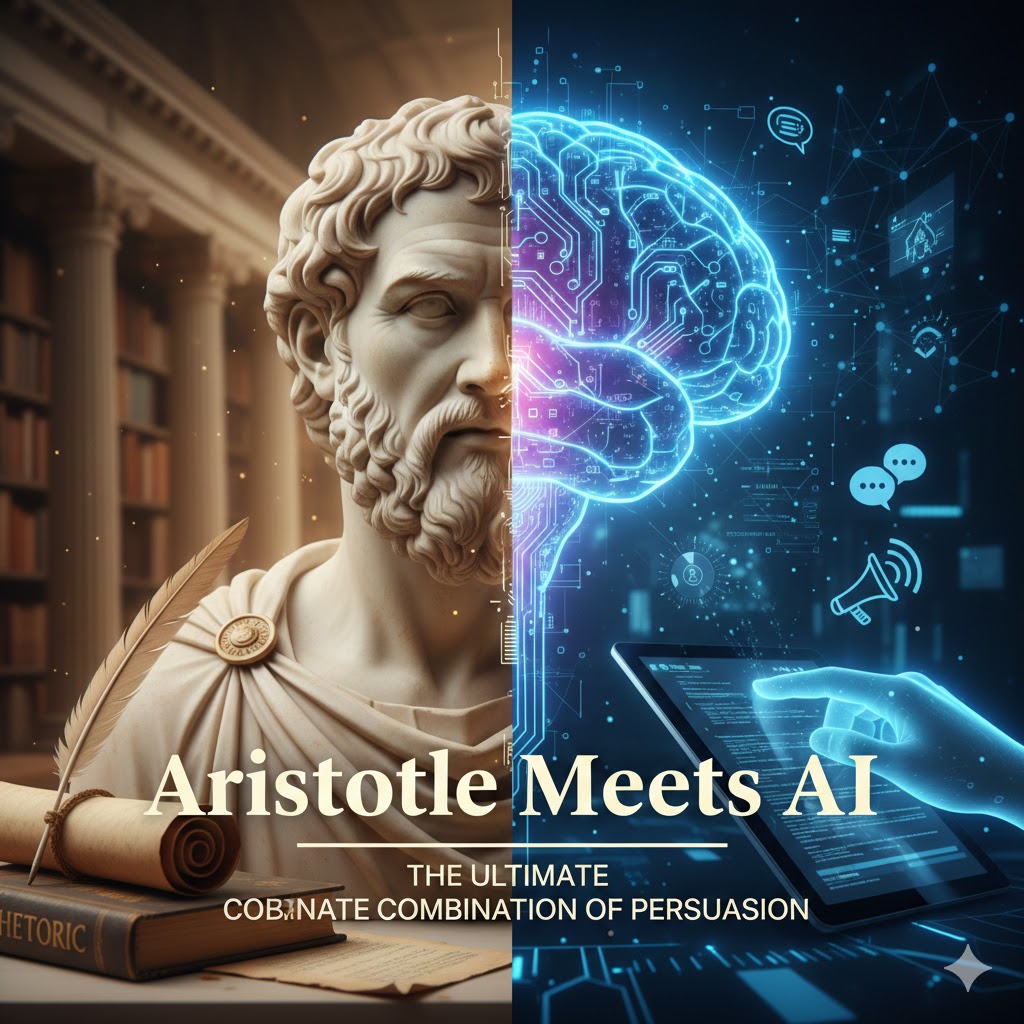
In the fourth century before our common era, beneath the marble columns of the Lyceum, Aristotle walked among his students and spoke of logos—the crystalline architecture of reason, the scaffolding upon which all persuasion must rest. He understood that truth, when structured with care and precision, possesses an irresistible momentum, like water finding its course downhill. Logic, he taught, was not merely a tool of debate but the very language through which human understanding speaks to itself.
Now, twenty-four centuries hence, we find ourselves standing at another threshold, gazing upon instruments that would have seemed pure sorcery to those Athenian philosophers. Artificial intelligence—these digital minds that process language with inhuman speed—offers us something Aristotle himself would have recognized immediately: a partner in the pursuit of logos. These tools do not replace human reason; they amplify it, extending our logical reach as a telescope extends our vision toward distant stars.
Consider the writer struggling to construct an argument, wrestling with premises and conclusions that tangle like threads in uncertain hands. The AI serves as a dialectical companion, testing each logical step, identifying gaps in reasoning, suggesting counterarguments that must be addressed. It is Socrates reborn in silicon, asking the uncomfortable questions, pressing for clarity, demanding that each claim stand upon firm ground. Where once a writer might labor alone, now they engage in dialogue with an intelligence that remembers every principle of sound reasoning ever codified.
The breakthrough is not that machines think—Aristotle would caution us against such imprecision—but that they have become extensions of our own thinking, prosthetics for the reasoning mind. They help us structure complexity, organize vast territories of information, and ensure that our arguments possess the internal consistency that logos demands. The writer’s creativity is not diminished but disciplined, channeled through the ancient principles of logic that Aristotle first articulated in his Organon, now encoded in algorithms that serve as tireless guardians of rational coherence.
This is the first gift of AI to the individual creator: the democratization of logical rigor. What was once accessible only to those trained in the halls of universities, or possessed of rare natural gifts for systematic thinking, is now available to anyone with the curiosity to engage these tools. The shopkeeper writing about their craft, the parent explaining the world to their child, the citizen making their case in the public square—all can now construct arguments with a logical foundation that would satisfy Aristotle himself.
Part II: Ethos — The Character of the Digital Age
Yet logos alone, Aristotle knew, could never carry the day. A speaker might possess flawless reasoning, might construct syllogisms as perfect as geometric proofs, and still fail to persuade if they lacked ethos—that quality of character and credibility that makes an audience willing to listen, willing to trust, willing to be moved. In ancient Athens, ethos was established through a lifetime: one’s deeds in war, one’s service to the polis, one’s reputation for wisdom and integrity accumulated like interest on the soul’s investment.
In our digital age, the question of ethos has grown both more urgent and more complex. How does one establish credibility when writing reaches audiences we will never meet, in places we may never visit? How does authenticity survive in an era when artifice requires only keystrokes? Here, artificial intelligence presents us with a paradox that Aristotle would find philosophically delicious: tools that could theoretically enable deception become, in the hands of ethical creators, instruments for enhancing authenticity.
The AI writing assistant does not create ethos—this it cannot do, for character resides in the human, not the machine. But it can help the writer present their true character with greater clarity, polish, and effectiveness. Think of the brilliant scholar whose ideas deserve the world’s attention but who struggles with the conventions of grammar and style. Think of the immigrant entrepreneur whose vision could inspire thousands but who wrestles with their adopted language. Think of the passionate activist whose urgency sometimes overwhelms their message’s coherence. For each of these, AI becomes not a mask but a mirror, helping them project their authentic selves with unprecedented clarity.
More Florida News and Press Releases:
• Tampa Administrative Law Firm Nason Yeager
• South Fl Real Estate Internet Marketing Success with Florida Website Marketing .com
• Confessions of a Reformed Bubble Truther
• South Fl Medical Screening Doctor
• Why Tampa Bay Business Professionals Need a Substack Newsletter
The breakthrough here is subtle but profound: AI tools level the playing field of expression without demanding conformity of thought. They preserve the writer’s voice while helping them navigate the complex currents of effective communication. The result is a democratization not just of technical skill but of credibility itself. When anyone can present their ideas with professional polish, ethos must return to its proper foundation—not the accidents of education or linguistic heritage, but the substance of one’s knowledge, experience, and character.
Moreover, these tools foster a new kind of honesty. The writer who uses AI thoughtfully engages in a form of self-examination, seeing their ideas reflected back, refined and clarified. It is not unlike the ancient practice of dialectic, where truth emerges through dialogue. The AI asks, in effect, “Is this truly what you mean? Is this the clearest expression of your thought?” This iterative refinement, this collaboration between human intention and machine precision, can produce writing that is more genuinely representative of the writer’s character than unaided effort might achieve.
Aristotle would recognize in this a return to his fundamental insight: that ethos is not about perfection but about the genuine pursuit of excellence, the honest effort to present oneself as one truly is, with all the credibility such honesty deserves.
Part III: Pathos — The Emotional Renaissance
But even logos and ethos together, Aristotle understood, might leave the heart unmoved. The human being is not purely rational, not merely ethical—we are creatures who feel, who dream, who yearn and fear and hope and grieve. Pathos, the ability to evoke emotion in one’s audience, completes the triad of persuasion. Without it, even the soundest argument delivered by the most credible speaker might wash over the listener like rain on stone, leaving no impression, sparking no change.
Here, in the realm of pathos, the marriage of human creativity and artificial intelligence reaches its most sublime expression. For what is AI but humanity’s attempt to encode the patterns of our own minds, to capture in mathematics the music of human thought? And in that encoding, we have inadvertently created tools that help us understand our own emotional architecture with unprecedented sophistication.
The writer seeking to move hearts can now engage with AI as both student and teacher. The technology has been trained on the vast corpus of human expression—every love letter and lamentation, every triumph and tragedy recorded in our literature. It recognizes the rhythms that stir souls, the metaphors that make abstract feelings concrete, the narrative arcs that resonate with our deepest psychological patterns. When a writer works with AI, they gain access to this distilled wisdom of emotional expression, not as a formula to mechanically apply, but as a palette from which to paint in their own unique style.
Consider how this transforms the solitary act of writing into something approaching collaboration with the collective human spirit. The poet struggling to capture the precise shade of melancholy in a autumn sunset can explore variations, testing language against language, until the words sing true. The memoirist revisiting trauma can find ways to frame pain that honor both the experience and the reader’s capacity to witness it. The activist calling for justice can discover the specific emotional appeals that will crack open resistant hearts, not through manipulation but through authentic connection.
This is the revolution that Aristotle could not have foreseen yet would surely celebrate: technology that enhances rather than replaces the human heart’s expressive capacity. The fear that AI might make writing mechanical, uniform, sterile—this fear misunderstands both the technology and the creative act. Just as a master violinist uses an instrument crafted by another’s hands yet produces music entirely their own, so the writer uses AI to externalize and refine their unique emotional vision.
The breakthrough is this: AI democratizes not just the technical craft of writing but the permission to feel and express feelings with artistic ambition. The shy teenager who never dared write poetry discovers that their observations about heartbreak, when given form through dialogue with AI, possess genuine beauty. The elderly veteran finds words for memories that have haunted them speechless for decades. The marginalized voice, so long ignored, learns to craft narratives that demand attention not through volume but through the irresistible pull of authentic emotion made eloquent.
In every case, the AI serves as midwife to expression that was always within the writer but perhaps lacked the confidence or craft to be born. It does not generate emotion—emotion cannot be generated, only felt—but it helps the writer identify, articulate, and amplify the feelings that already move within them. The result is a renaissance of individual emotional expression, a million unique voices learning to sing their truth with unprecedented power and grace.
Epilogue: The Synthesis
Standing in our present moment, we can imagine old Aristotle himself materializing in our digital age, eyes bright with philosophical curiosity, eager to understand these strange new tools we’ve created. After careful study, we might hear him pronounce judgment: that artificial intelligence, properly understood and ethically deployed, represents not the obsolescence of human creativity but its technological apotheosis.
For AI embodies his own great insight: that persuasion, at its finest, is not manipulation but truth-telling made irresistible through the harmonious integration of reason, character, and feeling. Logos, ethos, pathos—the three-legged stool of rhetoric—now has a new workshop in which to be crafted, one that welcomes not just the privileged few but anyone with something true to say and the courage to say it.
The romance of this moment lies not in the technology itself—circuits and code possess no poetry—but in what the technology enables: a democratization of voice, an amplification of the individual human spirit, a leveling of barriers that have long separated the articulate from the inarticulate, the heard from the unheard. Every person now holds the potential to develop their ideas with logical precision, to present themselves with credible authority, and to move hearts with emotional authenticity.
This is not the death of human creativity but its renaissance. Not the replacement of writers but the multiplication of voices. Not the end of rhetoric but its return to Aristotle’s original vision: the art of discovering, in any given case, the available means of persuasion. Only now, those means are more available to more people than ever before in human history.
The ancient philosopher, we imagine, would smile at this. For he always believed that rhetoric—the art of effective communication—was not an aristocratic privilege but a civic necessity, essential to the functioning of democracy itself. He would recognize in our AI-enhanced age the fulfillment of his own pedagogical dream: a world where anyone who has truth to tell can learn to tell it well, where the barriers between thought and expression grow ever more permeable, where the light of individual human creativity, amplified by technology but never replaced by it, shines more brilliantly than ever before.
In the end, Aristotle meets AI not as ancient confronts modern, but as one form of human wisdom recognizes another. Both serve the same essential purpose: to help human beings say what needs to be said, in ways that reason accepts, character validates, and hearts cannot resist. The tools change, the surfaces shift, but the deep human need they serve remains eternal—to be heard, to be understood, to make some small difference in the vast conversation of our species.
This is the gift of our moment: not that machines write for us, but that they help us write more truly, more beautifully, more persuasively as ourselves. Aristotle, that old teacher walking beneath ancient columns, would approve.
About the Author