By Brian French
There is a particular kind of pride that comes from standing in a place that hasn’t changed much in a century. The white clapboard buildings, the harbor smell, the narrow streets that force you to slow down — these things feel precious, even sacred, to people who love them. But beneath that charm lies a set of deliberate choices, and those choices have consequences that are rarely discussed honestly.
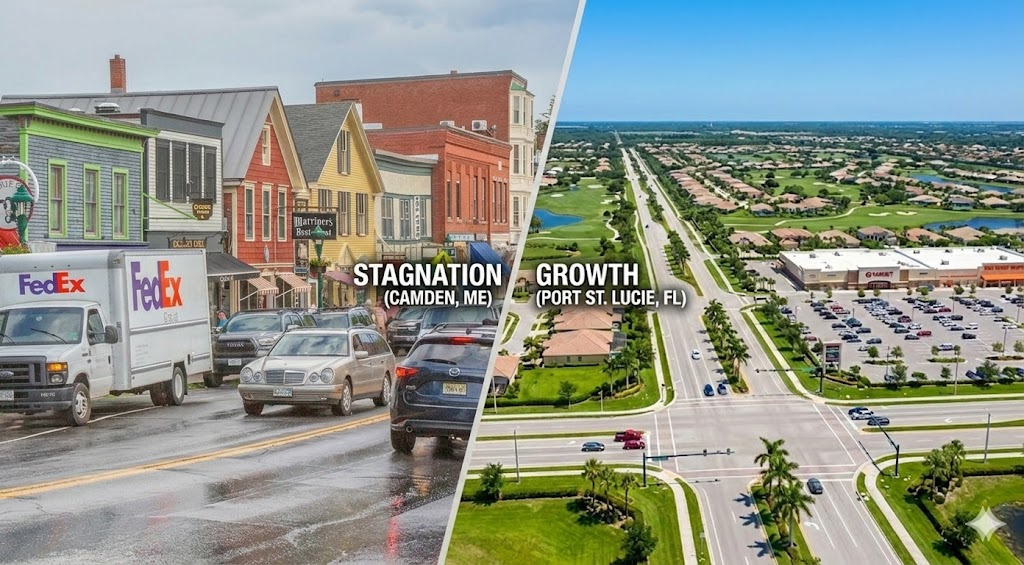
The story of American towns is ultimately a story about two fundamentally different philosophies of place: those that treat growth as a threat to be managed away, and those that treat it as an opportunity to be seized. Camden, Maine and Port St. Lucie, Florida represent these two philosophies in almost perfect opposition, and the contrast reveals something important about how Americans live, how they accumulate wealth, and how the country itself is quietly dividing along lines of ideology disguised as aesthetics.
Camden, Maine: The Museum That People Live In
Camden is, by almost any photographic standard, one of the most beautiful small towns in America. It sits on Penobscot Bay with mountains rising behind it and Windjammer schooners anchored in front. The downtown has kept its nineteenth-century bones. The inns are old and creaky in a way that guests pay a premium for. Million dollar cottages on Lake Megunticook which were called “camps”, by the old timers, have mostly maintained their “minimalist charm” i.e., no granite countertops here, but precarious foundations and frightening outdated electrical wiring that would make a home inspector giggle and a fire marshal faint.
Travel magazines reliably discover Camden every few years and declare it a hidden gem, which it has been for so long that the hiding has become the point.
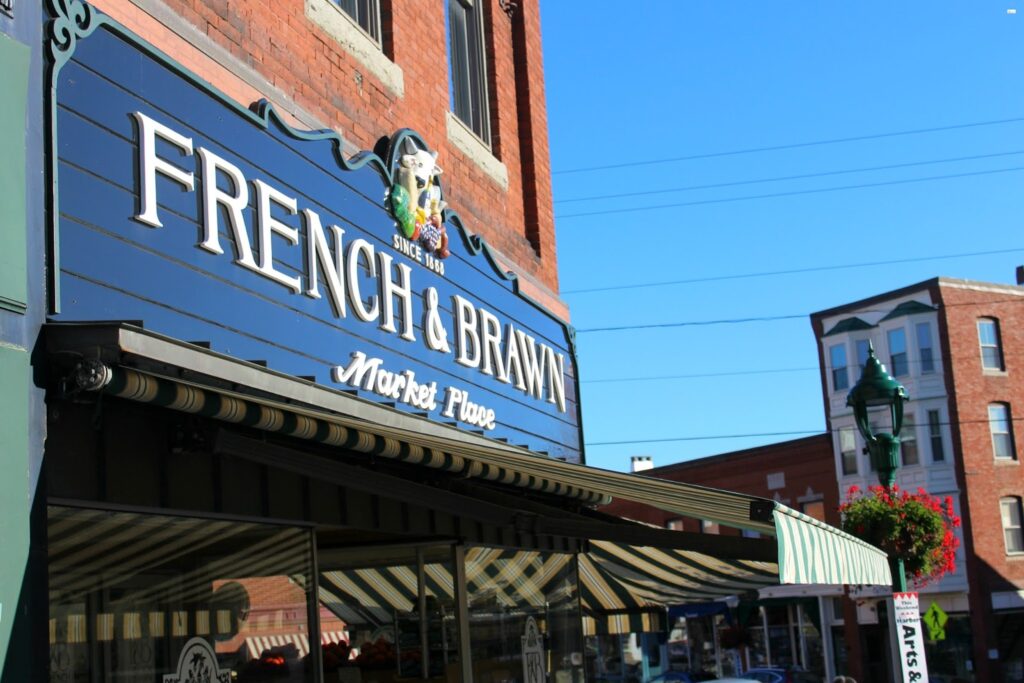
But Camden’s beauty is not an accident of geography alone. It is the product of systematic, decades-long resistance to change. Zoning restrictions, historic preservation ordinances, limits on commercial signage, and a deeply ingrained cultural hostility to anything that might disturb the existing character of the town have all worked in concert to keep Camden exactly as it is. The most visible manifestation of this resistance is something as mundane as a parking lot — or rather, the deliberate absence of adequate ones. In the height of summer, when tourists pour into Camden by the thousands, finding a parking space becomes a genuine ordeal. Streets are narrow and metered, lots are small, and no serious effort has been made to build the infrastructure that would make the town easier to access. This is not an oversight. It is a policy.
The theory, stated or unstated, is that restricting access restricts overcrowding, and restricting overcrowding preserves charm, and preserving charm keeps the right kind of visitor coming. But the small business owner on Bayview Street or Main Street lives and dies not by the right kind of visitor but by volume and frequency. The restaurant that could seat forty more people if the parking lot were larger doesn’t seat forty more people. The retail shop that might have had a second location in a new mixed-use development has no such development to move into. The young entrepreneur who grew up in Camden and wants to open something new finds that there is nowhere new to open it, no affordable commercial space, no growing residential base to serve, no expanding economic ecosystem to join. And so they leave, as young people in Camden have been leaving for generations.
The result is that Camden’s economy is essentially frozen at the same scale it occupied decades ago, just with higher prices attached to everything. The existing property owners — those who got in early, those who inherited, those who had the capital to buy before restrictions made buying nearly impossible — have done very well. Their property values have appreciated handsomely precisely because supply has been so thoroughly constrained. But this appreciation is wealth transfer, not wealth creation. It takes money from buyers and concentrates it among sellers. It does nothing for the person who arrives in Camden with ambition and a good idea but no family land and no inherited equity. For that person, Camden is not charming. It is a closed door.
Port St. Lucie, Florida: The Town That Said Yes
Port St. Lucie barely existed fifty years ago. What is now a city of more than two hundred thousand people was, within living memory, a combination of palmetto scrub, drainage ditches, mosquito-infested wetlands, and a few scattered cattle operations. There was nothing picturesque about it. There was no historic downtown to preserve, no Victorian architecture to protect, no fishing harbor whose silhouette had appeared on a thousand calendars. There was just land — flat, hot, poorly drained, and abundant.
Florida developers looked at that land and saw something different than a postcard. They saw roads and subdivisions and golf course communities and strip malls and medical offices and chain restaurants and the ten thousand daily transactions that constitute an actual functioning regional economy. They built it. The roads came first, then the houses, then the retail, then the employers, then more houses, more retail, more employers in a cycle of accumulation that turned a swamp into a metropolitan area in the span of a single human lifetime.
The small business owner in Port St. Lucie in the 1980s and 1990s was operating in an economy that was expanding beneath their feet. Every new subdivision that went in created new customers. Every new road that was built opened new corridors for commercial development. Every golf course community brought in retirees with disposable income and time to spend it. The person who opened a hardware store, a nail salon, a landscaping company, an urgent care clinic, a sandwich shop — that person could grow because the population around them was growing. They could open a second location because there were new neighborhoods to put it in. They could hire employees because there were people moving to town who needed work. The entire economic ecosystem was expansionist, and in an expansionist ecosystem, ambition has room to run.
The infrastructure investments that made this possible were substantial and deliberate. New roads were not just permitted but actively planned, often ahead of the development they were meant to serve. Interchange improvements on I-95 made Port St. Lucie accessible to the broader regional economy of South Florida. The Treasure Coast became a destination for both retirement and relocation precisely because someone had built the roads, the utilities, and the commercial framework that made everyday life workable at scale. None of this happened by accident, and none of it was pretty in the way that Camden is pretty. But it was real in a way that Camden’s frozen economy is not.
The Ideology of Stasis
The difference between these two places is not merely a matter of local preference. It reflects a deeper cultural and political divide that has become one of the most important fault lines in American economic life, and it runs, with imperfect but unmistakable clarity, along the Mason-Dixon line and beyond.
The Northeast has, over the course of the last half century, developed a powerful cultural consensus around the idea that growth is something to be managed, slowed, contained, and in many cases prevented. This consensus lives in the language of environmental protection, historic preservation, community character, and smart growth — all terms that carry positive connotations but often function, in practice, as mechanisms for restricting development.
The political constituency for these restrictions is largely composed of homeowners who have already arrived, who have already purchased property, and who have a direct financial interest in limiting the supply of new housing and commercial space that might compete with their existing assets. They are joined by people who love a place for what it is and fear what it might become — a fear that is emotionally understandable and culturally coherent but economically consequential.
The South, and to a large extent the Mountain West and Sunbelt, operate from a different default assumption: that growth is good, that more people means more opportunity, that a new subdivision is not a threat to the landscape but a sign of vitality, that roads are not scars on the earth but veins through which economic life flows. This orientation has its own excesses. Sprawl without planning produces congestion without character. Strip mall proliferation can hollow out whatever downtown existed before. But the underlying premise — that an expanding economy creates more opportunity for more people — is correct in ways that the Northeast’s growth skepticism rarely is.
The person who benefits most from a Camden-style policy of deliberate stasis is the person who is already there and already owns something. The person who is harmed is the one who hasn’t arrived yet, who doesn’t own anything yet, who needs an economy in motion to find a place in it. This is not a trivial distinction. It is, in condensed form, a description of how inherited wealth perpetuates itself and why social mobility is so much harder in places where the economy has been deliberately frozen.
Florida News and Business Press Releases:
• 10 Essential Tips for Moving to Florida from New York or New Jersey
• South Florida Charitable Foundation Law Firm Nason Yeager
• The Liability Paradox: Why Self-Driving Cars Face an Impossibly High Bar
• The History of Florida Statehood
• The Business of MLB Spring Training Baseball in Florida
What Gets Lost in the Name of Preservation
There is something genuinely worth preserving in places like Camden. The built environment of the nineteenth century was, in many respects, more humane than what replaced it in the twentieth. Walkable streets, mixed-use buildings, public gathering places, a sense of architectural coherence — these are not nostalgic fantasies but functional qualities that urbanists now spend enormous effort trying to recreate in places that bulldozed their equivalents forty years ago. The instinct to protect what remains of that fabric is not wrong in itself.
But preservation policy in America has rarely been applied with precision. It tends to freeze not just the architecture but the economics, not just the streetscape but the social structure, not just the buildings but the barriers. What gets preserved in Camden is not just the handsome harbor view but the arrangement of power that surrounds it — the arrangement that makes property accessible to those who already have capital and inaccessible to those who don’t, that keeps the business environment comfortable for established operators and hostile to newcomers, that turns a living town into something closer to a theatrical production of itself.
Port St. Lucie has no such production. It has no particular character to protect and no aesthetic coherence to maintain. What it has is an economy that works for people who show up with ambition and without family money, people who need a growing market to grow into, people for whom the absence of history is not a loss but a permission slip. It is not beautiful in the way Camden is beautiful. But for a certain kind of American — the kind America used to celebrate most loudly — it is something more useful than beautiful. It is open.
Growth Is a Choice
The towns that don’t change and the towns that do are not simply the products of different geographies or different histories. They are the products of different choices, made by different coalitions, in service of different interests. Understanding those interests clearly, without the sentimental overlay that tends to accompany discussions of place and character, is essential to an honest reckoning with what American communities actually owe the people who live in them — and the people who might.
Camden is lovely. But lovely is not the same as just, and preservation is not the same as prosperity. Port St. Lucie is not lovely in any postcard sense. But it has given more people more economic footholds in the last fifty years than Camden has given in a century of carefully maintained charm. That is worth saying plainly, even if it complicates the picture. Especially if it complicates the picture.
About the Author