WHEN THE SMARTEST MONEY IN THE WORLD AGREES: CIRCLE, USDC, AND THE COMING COLLAPSE OF FINANCIAL FRICTION
One of Wall Street’s greatest living investors says stablecoins will run the global economy within 15 years. The NYSE is building its future on a digital dollar. A prediction market platform is replacing the sportsbook. And a Florida-based financial system may already be obsolete.
By Brian French | Florida Business News | April 9, 2026
Stanley Druckenmiller has been right about big financial turns more often than almost anyone alive. He ran George Soros’s Quantum Fund when it famously broke the Bank of England in 1992. He called the dot-com collapse. He called the housing bubble. So when Druckenmiller sits down for a Morgan Stanley interview and says — plainly, without hedging — that he expects stablecoins to underpin the entire global payment system within a decade or two, serious people in finance take note.
“I assume our whole payment systems will be stablecoins in 10 or 15 years,” Druckenmiller said in the March 2026 interview. The fiat-pegged tokens are, in his words, “efficient, quicker and cheaper” than anything the traditional financial industry has built to replace them. “Blockchain and the use of stablecoins are incredibly useful in terms of productivity,” he added — a remarkably direct endorsement from a man who has spent most of his career in the same conventional financial structures now being disrupted.
Druckenmiller’s timing is notable. He made these comments precisely as the financial world’s most consequential institutions — the New York Stock Exchange, Visa, BlackRock, Mastercard, Intuit — were quietly lining up behind a single company and its single product: Circle Internet Group (NYSE: CRCL) and its dollar-pegged stablecoin, USDC. Whether Druckenmiller had Circle specifically in mind or not, the infrastructure he described is largely the infrastructure Circle has already built.
THE QUIET COMPANY RUNNING THE PLUMBING
Circle doesn’t advertise much. It doesn’t have a famous founder who drives a provocative car or posts inflammatory things online. It issues a digital dollar, USDC, that is backed one-for-one by actual U.S. dollar assets — reserves held at the Bank of New York Mellon and managed by BlackRock — and it has spent a decade doing the unglamorous work of obtaining regulatory approvals, building institutional relationships, and expanding its infrastructure across 32 blockchain networks.
The numbers that have resulted from this quiet work are, at this point, anything but quiet. USDC circulation hit $75.3 billion at the end of 2025, up 72% in a single year. Quarterly on-chain transaction volume reached $11.9 trillion — a 247% increase year-over-year and a figure that represents roughly half the annual GDP of the United States, flowing through a digital dollar that most Americans still couldn’t identify in a lineup. Circle went public on the New York Stock Exchange in June 2025 under the ticker CRCL. The company that built the payment rails for the internet economy is now listed on the exchange it is helping to transform.
There is an important distinction worth dwelling on: USDC is not a cryptocurrency in the speculative sense that most people understand the word. Druckenmiller himself drew a sharp line between stablecoins and the broader crypto market. Commenting on most digital assets, he repeated a critique he has issued for years: “I said this a long time ago, and I’m going to say it again: it’s a solution looking for a problem.” Stablecoins are something different — a productive application of blockchain technology that addresses the real inefficiencies of the existing financial plumbing. Circle is the regulated issuer that has built the most institutionally trusted version of that tool.
This distinction between “productive” and “speculative” assets is the defining trend of 2026. While the hype-driven markets for alternative collectibles like vintage baseball cards and comics appear to be cooling, the infrastructure for stable, regulated digital capital is just beginning its real growth phase.Circle has demonstrated this in the most literal way possible: the company moved $68 million across its own eight internal entities using USDC, replacing bank wires that typically take one to three days with transfers that completed in under 30 minutes. When the company that issues the digital dollar stops using the traditional banking system for its own treasury operations, it is communicating something meaningful about the product’s maturity.
THE NYSE PARTNERSHIP AND THE END OF THE CLOSING BELL
For generations, the rhythm of global finance has been set by a bell on the floor of the New York Stock Exchange. Markets opened. Markets closed. Pension managers in Tokyo who needed to react to Friday evening news waited until Monday morning. Capital sat locked in settlement systems overnight. The world’s financial infrastructure operated on a schedule designed for an era before smartphones, fiber optics, and round-the-clock global demand.
That schedule is ending.
Intercontinental Exchange — the NYSE’s parent company — has entered an agreement with Circle to explore integrating stablecoins across ICE’s markets, including USDC and USYC (Circle’s tokenized money market fund). The NYSE is developing a platform for continuous trading and on-chain settlement of tokenized securities — a new venue designed for 24/7 operations, instant settlement, and stablecoin-based funding. The proposed platform would allow trading of tokenized shares fungible with traditionally issued securities alongside tokens natively issued as digital securities.
To understand the scale of this, consider what ICE actually controls: the New York Stock Exchange, multiple futures exchanges, bond trading platforms, mortgage technology infrastructure, and settlement systems that process trillions of dollars in transactions daily. When ICE signals that it wants to build its tokenized trading future on a regulated stablecoin infrastructure, that is not a technology experiment. That is the foundational architecture of the next financial system being laid out in plain view.
Nasdaq has separately filed with the SEC to tokenize every listed stock — the first time tokenized securities would trade on a major U.S. exchange. The Depository Trust & Clearing Corporation, which processes the lion’s share of U.S. securities transactions, has articulated an ambition to eventually tokenize its entire $100 trillion asset catalog. “This is no longer driven by FOMO,” said its global head of digital assets. “It’s truly driven by real business cases, client demands.”
The settlement currency in this emerging 24/7 world is USDC. Visa now allows U.S. issuers and acquirers to settle transactions in USDC. Intuit has a multi-year partnership embedding USDC into its platform. Mastercard has brought Circle into its Crypto Partner Program. Roughly 98% of AI-agent payments — the autonomous software transactions that represent an entirely new category of economic activity — already settle in USDC. The architecture Druckenmiller described is not a prediction. It is an installation in progress.
TOKENIZING EVERYTHING: FROM SKYSCRAPERS TO RACEHORSES
The most transformative implication of this infrastructure shift is not faster settlement for institutional traders. It is the democratization of asset classes that have spent generations locked behind walls of capital, connections, and geography.
Consider real estate. Take a $50 million commercial building in downtown Miami. Create a legal entity — a Special Purpose Vehicle — that holds the building. Issue 50,000 tokens, each representing a $1,000 ownership interest. Distribute rental income automatically via smart contract in USDC. Allow tokens to trade on a regulated secondary market, 24 hours a day, seven days a week. The result: a market that previously required six- or seven-figure minimum investments and extensive legal infrastructure becomes accessible to anyone with a smartphone and $1,000. Tokenized real estate assets surpassed $10 billion in value in 2025, with projections for 2026 reaching into the trillions as institutional allocators accelerate their commitments.
The same logic extends outward in every direction. Fine art — a $30 million Basquiat fractionalized into 30,000 tradeable interests, with USDC distributions from licensing revenue. Music royalties — a songwriter tokenizing her entire catalog, raising capital against future streams while investors participate in the upside. Infrastructure — solar farms, toll roads, broadband networks — all generating yield distributed automatically through smart contracts in digital dollars. Rare commodities. Carbon credits. Patent licensing revenue. Private equity fund interests.
Tokenized U.S. Treasury bonds are already the largest on-chain asset category, with over $5.8 billion tracked on blockchain networks led by BlackRock’s BUIDL fund. JPMorgan, Goldman Sachs, and BNY Mellon all operate live tokenized money market products. Circle’s own USYC — a tokenized money market fund backed by Treasury holdings — already holds $1.5 billion in assets under management.
According to Citigroup, tokenized securities could reach $4 to $5 trillion by 2030. Every dollar of that market requires a settlement currency. The infrastructure being assembled around USDC is designed to provide it.
THE PREDICTION MARKET THAT’S EATING THE SPORTSBOOK
While Wall Street has been tokenizing bonds and equities, a quieter revolution has been underway in a market the financial establishment has largely ignored. Prediction markets — led by Polymarket — are building a fundamentally more efficient alternative to one of America’s most profitable consumer industries: sports betting.
Here is how the traditional model works. You want to bet on an NFL game. The sportsbook offers -110 on both sides. You bet $110 to win $100. If two equal and opposite bets are placed, the book collects $220 and pays out $210. The $10 difference — roughly 4.5% — is the vig, the house’s structural margin on every transaction. On less liquid markets, that vig can reach 8-10%. Win consistently, and the sportsbook quietly reduces your maximum bet from $5,000 to $50, then bans you entirely. The industry profits most when its customers lose and penalizes them when they don’t.
Polymarket operates on a fundamentally different model. Instead of fixed-odds wagering, users buy and sell shares tied to specific outcomes. Each contract trades between zero and one dollar, with the price representing the market’s implied probability. Pricing comes from the order book, not from a bookmaker’s internal model. Sports markets charge a taker fee of just 0.75%. There is no vig. There are no bans for winning players.
Circle has struck a partnership with Polymarket that transitions the platform to native USDC for all dollar-denominated settlement — directly tied to Circle’s regulated reserves, rather than bridged versions of dollar-pegged tokens. Every contract, every trade, every payout flows through USDC. Settlement that would take days through traditional banking infrastructure completes in minutes.
Prediction markets processed more than $22 billion in trading volume in 2025, largely settled in USDC. Polymarket, which briefly lost U.S. access to regulatory uncertainty, returned to the American market in late 2025 after acquiring a CFTC-licensed exchange and securing full regulatory approval. The 2026 FIFA World Cup, taking place this summer across the United States, Canada, and Mexico, is expected to mark the moment Polymarket fully announces itself to the mass market. The platform already hosts more than 110 active 2026 prediction markets. When hundreds of millions of soccer fans globally are looking to act on their convictions during the biggest sporting event on the planet, a platform with no vig, instant USDC settlement, and no account bans will make an impression that the traditional sportsbook industry will find difficult to answer.
THE RESERVE CURRENCY QUESTION
Druckenmiller didn’t limit his comments to payment infrastructure. He addressed a larger question that very few mainstream financial figures will engage with directly: how long the U.S. dollar retains its status as the world’s reserve currency.
His answer was characteristically blunt. “We’re doing everything we can to destroy it,” he said of the dollar’s reserve status. “I doubt it’ll be the reserve currency in 50 years, but I don’t have a clue what would be. Maybe some crypto thing I hate.”
The irony in that formulation is considerable. The man who is skeptical of most of the crypto ecosystem is nonetheless open to the possibility that something from within it displaces the dollar at the center of global finance. And the regulated digital dollar he has already endorsed — USDC — is the instrument the U.S. government has, in practice, outsourced much of its digital currency ambitions to. The GENIUS Act, passed in 2025, established the first federal regulatory framework for stablecoins and essentially codified the private-sector-led model that Circle has been building for over a decade. Circle spent years positioning itself as the regulated, transparent, institutional alternative in the stablecoin market. That positioning is now receiving its regulatory validation.
For Druckenmiller, Bitcoin occupies a separate category. “I’m actually disappointed it ended up becoming a store of value because it wasn’t originally needed for that,” he said. “But it’s become a brand, and people love it. So it’s probably going to be a store of value.” His view of Bitcoin as a legitimate store of value but not a payment instrument is, interestingly, entirely compatible with USDC’s role as the payment and settlement layer — two assets serving distinct functions in a new monetary architecture, rather than competing for the same use case.
THE INFRASTRUCTURE CHALLENGE
Candor requires acknowledging that the architecture described above is still under construction. Current blockchain networks face real constraints: throughput ceilings, latency issues that complicate efficient price discovery, and front-running by sophisticated bots that undermine the transparency that makes on-chain markets valuable in the first place.
Circle is not waiting for someone else to solve these problems. Its Arc blockchain — an open Layer-1 network built specifically for institutional financial applications — is designed to address exactly these constraints, enabling institutions to bring custody, tokenization, and stablecoin payments into production at scale. A strategic collaboration with Fireblocks, which manages $10 trillion in transaction infrastructure across banks, payment providers, exchanges, and custodians, expands the ecosystem surrounding USDC into the largest network of regulated financial institutions in the digital asset space.
The direction of travel is clear. The pace is the only open question.
THE BOTTOM LINE
Stanley Druckenmiller did not name Circle in his Morgan Stanley interview. He named stablecoins — as a category, as a technology, as the future of payment infrastructure. But when you trace the thread from his prediction to the actual product meeting that description — regulated, fully reserved, institutionally embedded, running on 32 networks, settling on the NYSE’s next-generation trading platform, processing AI-agent payments, underpinning the world’s fastest-growing prediction market, accessible in 185 countries — you arrive at the same place every time: USDC, issued by Circle Internet Group, listed on the New York Stock Exchange under the ticker CRCL.
The closing bell, in the world being built around this technology, is not part of the plan. The market Druckenmiller described runs 24 hours a day, seven days a week. Its settlement currency is already here.
Related Florida Business Insights
- The Pizza Principle: Why Florida Business News and Press Releases Are the Most Powerful Tool in the Age of AI: While USDC handles the financial plumbing, this article explores the communication plumbing. It details how Florida businesses can leverage hyper-local news to break through the noise of an AI-driven economy—essential reading for anyone looking to scale in the digital era.
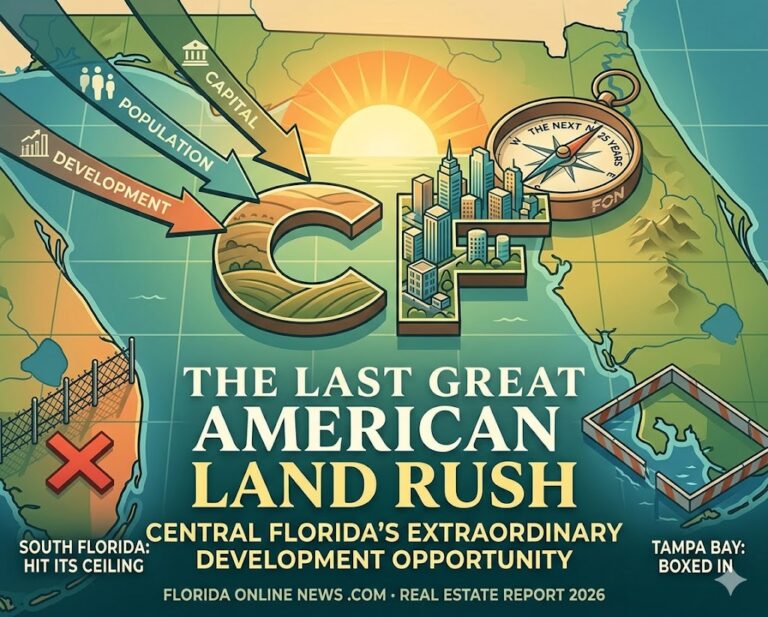
- Central Florida: The Last American Land Rush: Your piece touches on the tokenization of real estate; this article provides the ground-level context. It analyzes the massive capital migration into Florida’s interior, offering a look at the physical assets that are increasingly being moved onto the blockchain.
- The Last Inning: Why Baseball Cards and Comics Are Headed for a Crash: To understand the “productive” vs. “speculative” distinction Stanley Druckenmiller makes, read this analysis of the cooling collectibles market. It serves as a cautionary counterpoint to the rise of regulated utility tokens like USDC.
Florida Business Newsroom — Brandon, Florida — Finance, Technology & Markets
This article is for informational purposes only and does not constitute financial or investment advice. Tokenized assets, stablecoins, and prediction market contracts involve risk. Past performance does not guarantee future results. Stanley Druckenmiller’s comments are sourced from a March 2026 Morgan Stanley interview as reported by CoinDesk. Consult a licensed financial advisor before making investment decisions.
About the Author