Why Baseball Cards & Comics Are Headed for a Crash
By Brian French
Opinion · Collecting · Sports March 29, 2026
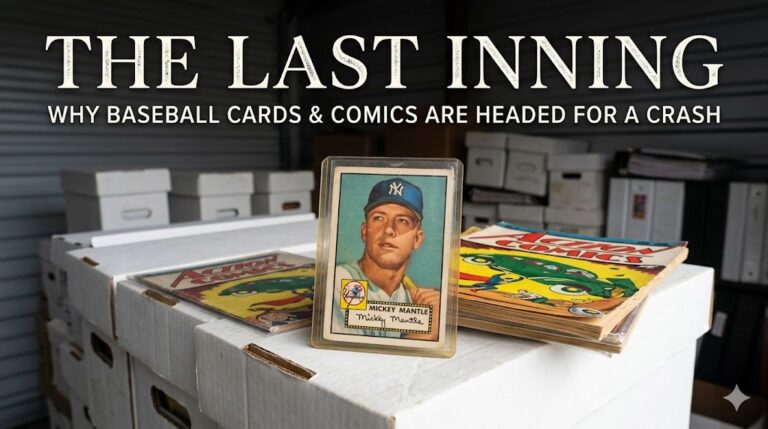
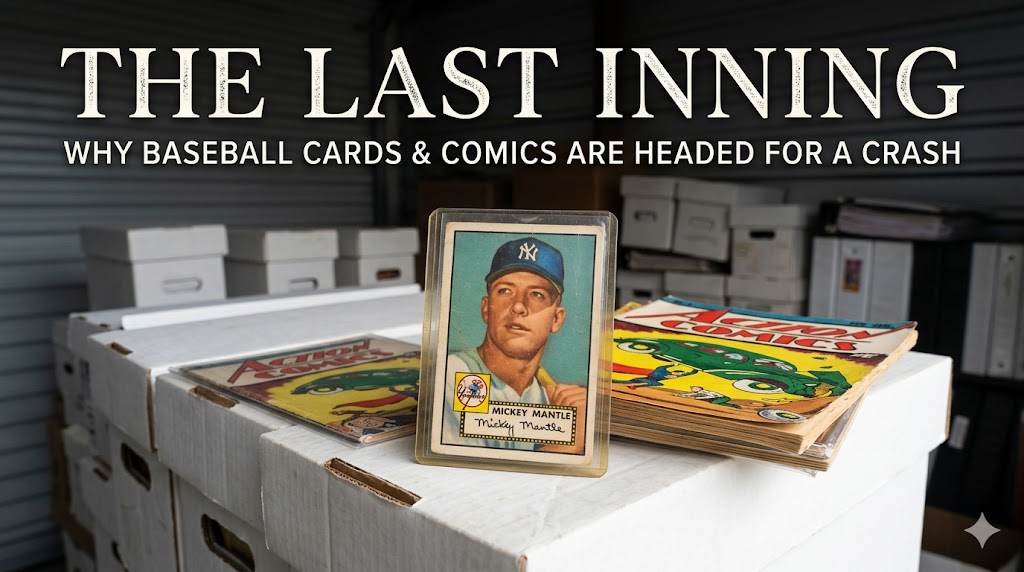
There is a storage unit somewhere in suburban America — probably in Florida, probably climate-controlled — packed floor to ceiling with long white boxes of comic books and binders of baseball cards in plastic sleeves. The man who filled it spent thirty years hunting down issues, tracking grades, negotiating trades at shows on weekends. He knows where every key issue is. He can tell you the print run of a 1952 Topps Mickey Mantle without looking it up. He is also seventy-two years old. And sooner or later, his family is going to have to figure out what to do with all of it.
Multiply that storage unit by tens of thousands. That is the quiet crisis building inside the hobby worlds of baseball card collecting and vintage comics — two markets that boomed on the backs of Baby Boomers and Generation X, and that now face a demographic cliff unlike anything they have seen before. The next decade is not going to be kind. The math simply does not work, and no amount of nostalgia or graded-slab hype is going to change it.
The Generation That Built the Hobby
To understand what is coming, you have to understand what happened. The postwar generation grew up in an era when baseball was America’s game — unchallenged, ubiquitous, woven into the fabric of everyday childhood. A pack of Topps cards was a rite of passage. Comics were dime-store entertainment that boys stashed under mattresses and traded on schoolyard steps. These were not investments. They were joy. And joy has a powerful grip on memory.
Those boys became men with disposable income. By the late 1970s and through the 1980s, they started going back — hunting the cards they’d thrown away, the comics their mothers had pitched. The hobby industrialized around them. Price guides appeared. Grading services emerged. Auction houses moved in. What had been attic junk became a legitimized alternative asset class. By the pandemic boom of 2020 and 2021, a single PSA-graded Honus Wagner card sold for over six million dollars. A copy of Action Comics #1 had cracked three million. The market looked invincible.
It was not invincible. It was aging.
A Demographic Cliff Hiding in Plain Sight
The core collector base for vintage baseball cards and Silver and Golden Age comics skews heavily toward men between the ages of 55 and 80. This is not a secret — it is openly discussed at shows, in forums, by dealers themselves. What is less openly discussed is what that age distribution means for the next ten years.
Collectors do not live forever. As they enter their late sixties and seventies, several things happen in sequence. First, they begin downsizing — moving from homes to condominiums, from condominiums to assisted living. Storage becomes a burden. Collections that once filled a basement become logistical problems. Second, health and estate planning forces the conversation: what happens to all of this? Third, death arrives, and suddenly a collection assembled over fifty years lands in the hands of heirs who have no idea what it is worth, no passion for the hobby, and every incentive to liquidate quickly.
“A collection assembled over fifty years lands in the hands of heirs who have no idea what it is worth, no passion for the hobby, and every incentive to liquidate quickly.”
This wave is not hypothetical. It is already beginning. Anyone who has attended a major card show in the past five years has noticed the gray hair. Anyone who has watched estate auction results has seen collections selling below expectation when the buyer pool simply is not there. The tsunami is still forming offshore, but the water is already pulling back from the shore.
Where Are the Young Collectors?
Optimists will point to the pandemic boom as proof of the hobby’s youth appeal. And it is true — social media, YouTube breakers, and the speculative frenzy of 2020 and 2021 brought in younger participants. But look closely at what they were buying: modern cards, short-print parallels, graded rookies of active players. They were not buying 1969 Topps sets or runs of Amazing Fantasy. They were gambling on player performance futures, not preserving cultural artifacts. That is a different hobby wearing the same clothes.
The hard truth is that genuine love for vintage baseball cards requires genuine love for baseball — and baseball has been hemorrhaging young fans for two decades. League-wide attendance has declined. The average age of a televised MLB viewer now sits well above fifty. Youth participation in the sport itself has plummeted as soccer, basketball, and flag football compete for kids’ time and attention. You cannot collect what you do not love, and you cannot love what you do not know.
The Problem No One Talks About: You Can’t Even Display the Stuff
Here is something that separates card and comic collecting from nearly every other serious collecting hobby: the collection is essentially invisible in your own home.
A person who collects fine art hangs it on the wall. It becomes part of the living environment — guests see it, admire it, ask about it. An antique collector arranges pieces on shelves and mantlepieces. A wine collector displays bottles in a rack that signals taste and knowledge the moment someone walks through the door. Even a serious watch collector can wear the collection — it travels with them, starts conversations, exists in the world.
A baseball card collection lives in a binder in a closet. A comic collection lives in acid-free boxes in the basement. A graded slab in a screwdown case can sit on a shelf, technically, but a wall of plastic slabs looks less like a curated collection and more like a warehouse inventory. There is no elegant way to live with these things. You cannot hang a PSA 9 rookie card above the fireplace. You cannot arrange vintage comics on a coffee table without risking damage. The hobby demands that its most prized possessions be hidden away for their own protection.
This is not a trivial problem. The inability to display a collection publicly removes one of the most powerful psychological rewards of collecting — and more critically, it eliminates the single most effective mechanism for recruiting the next generation: daily exposure. Children fall in love with things they encounter. A kid who grows up surrounded by art develops an eye for art. A kid whose parent’s card collection is locked in binders in a spare bedroom never really encounters the hobby at all.
Compare this to the natural intergenerational transfer of other collecting passions. The child of a serious art collector absorbs the aesthetic from birth, hears the stories, develops emotional attachment to specific pieces long before understanding monetary value. When the parent dies, the heir receives not just objects — but a relationship with those objects. Card and comic collectors have almost no mechanism for passing the passion on through daily lived experience. The collection stays hidden. And what stays hidden stays unloved by everyone except the person who assembled it.
The Screen Has Won
The children who should be tomorrow’s collectors are, statistically speaking, spending their leisure hours on mobile devices — gaming, streaming, scrolling. The tactile pleasure of holding a card, reading a comic page by page, organizing a collection in binders — these experiences compete poorly with the dopamine loop of a smartphone. They require patience, physical space, and a tolerance for delayed gratification that the digital age has spent twenty years systematically eroding.
This is not moralizing. It is market analysis. Every collecting hobby requires an on-ramp — a moment when a young person falls in love with the thing being collected. Baseball cards need kids who love baseball. Comics need kids who encounter them at an impressionable age. Both on-ramps have been washed out. Baseball games are four hours long in a world of ten-second clips. Comics now cost five dollars per issue in a world where entire narrative universes stream for twelve dollars a month. The economics of the on-ramp have inverted.
The Wealth Gap
Even among younger people who develop genuine interest in vintage collecting, there is a wall they hit almost immediately: price. The pandemic boom inflated valuations across every tier of the market. Entry-level key issues in comics — Amazing Spider-Man #1, Fantastic Four #1, X-Men #1 — now start in the tens of thousands of dollars in any presentable grade. Rookie cards of Hall of Famers from the 1950s and 1960s are simply inaccessible to anyone under forty without generational wealth.
The collectors who built these markets did so at a time when a working-class man could buy a key issue for the price of a movie ticket, because nobody yet understood what it was worth. That window is permanently closed. A person paying down student loans while renting a one-bedroom apartment is not buying a five-figure baseball card — at any discount.
The Hoarder’s Paradox
Serious collectors rarely sell at peak. They accumulate. The very psychology that drives great collecting — obsessive completionism, emotional attachment, the belief that prices always go higher — also ensures that supply stays off the market until death or crisis forces a sale. When that forced sale happens simultaneously across thousands of estates, the result is a flood of supply meeting a shrinking pool of demand.
“The hoarder, in the end, always becomes the seller. The only question is whether the market is ready to absorb what they held.”
Based on every demographic and cultural indicator available, the market of the next ten to fifteen years will not be.
The Crash Will Be Quiet, Then Sudden
Markets rarely collapse all at once. What is more likely is a long, grinding deflation punctuated by moments of sharp panic. The first phase is already underway: post-pandemic normalization has knocked 30 to 50 percent off the peak valuations of many modern and semi-modern cards. The vintage market has held better, propped up by the remaining active collector base. But as that base ages and begins to liquidate, the props come out one by one.
The second phase will accelerate when major collectors begin dying in volume — a wave that demography tells us is approximately ten to fifteen years from its peak. Estates will hit the market simultaneously. Auction houses will have more supply than they can responsibly absorb. Prices for mid-grade material — the bread and butter of most collections — will suffer most. True high-grade rarities may hold value because the ultra-wealthy always need somewhere to park money, but the average collector’s lifetime accumulation? It will be worth a fraction of what they believed.
A Hobby in Its Late Innings
None of this means that baseball cards and comics will disappear. Markets built on genuine scarcity and cultural history do not vanish — they contract. What is coming is not oblivion but correction: a painful reckoning between the prices collectors believe their holdings are worth and the prices a diminished, aging market will actually pay.
A collection is only worth what the next buyer will pay. And the next generation of buyers — outnumbered, economically squeezed, digitally distracted, largely indifferent to America’s pastime, and never even exposed to their parents’ hidden binders — is simply not going to be there in the numbers the market requires. The storage units will eventually be emptied. The binders will eventually be opened. The long, slow liquidation of the Baby Boomer collecting generation is the defining market event of the next decade in this hobby, and almost no one in the industry wants to say so out loud.
Consider this the announcement.
About the Author