“Why I Gave Up Everything (Except My Ring Light and Patreon Account)”
A Celebration of the Noble Art of Downgrading Your Life While Upselling It to Others
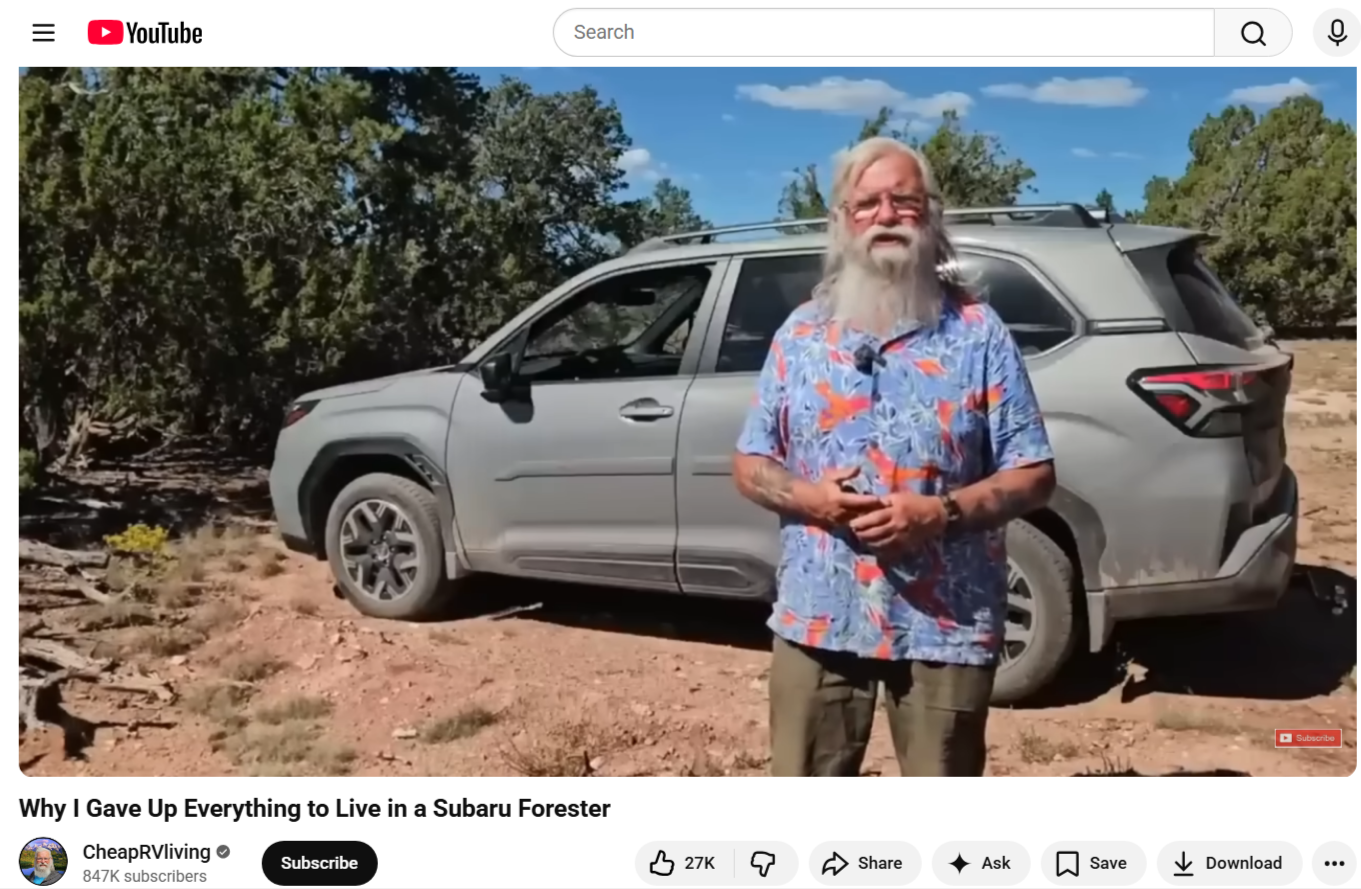
Somewhere in a Walmart parking lot in Flagstaff, Arizona, a 70 year-old named Bob Wells is filming his fourth video this week about the radical freedom he discovered when he traded his hastily constructed 400-square-foot Ambulance Van Conversion — which he described on camera as his “golden cage” — for a 2009 Subaru Forester with a sleeping platform made from a repurposed IKEA shelf and what he calls, without irony, a “bathroom solution.” The bathroom solution is a Home Depot bucket. It has a pool noodle on the rim. He is charging $12 a month on Patreon for access to the extended tutorial.
Welcome to the Van Life Industrial Complex, where the less you own, the more content you produce, and where “freedom” is a word that has been so thoroughly laundered through a ring-lit lens that it now means something roughly equivalent to “not paying rent while definitely still using everyone else’s infrastructure.”
The Great Downgrade: A Spiritual Journey Measured in Square Footage and Abandoning Responsibility
The timeline of the modern minimalist nomad influencer follows a remarkably consistent arc, which philosophers might one day call the Parabola of Voluntary Destitution.
It begins with The Awakening — typically a moment in a cubicle, or perhaps a Starbucks, where our hero suddenly perceives with crystalline clarity that society is a trap, mortgages are chains, and that the Babylonians, despite inventing writing, mathematics, astronomy, and functioning sewage systems, were clearly doing something deeply wrong. The Babylonians, bless their cuneiform-scribbling hearts, had indoor plumbing. Clearly, they lacked vision.
Stage Two is The “Get Away” Vehicle. This is where the mythology gets rich. The progression among the influencer class runs something like this: House → Apartment → RV → Cargo Van → Camper Van → Ambulance → Minivan → Subaru Forester → Bicycle with a tarp → and eventually, one presumes, a philosophy degree and a bus stop bench.
Each downgrade is presented not as what a clinical social worker might describe as “concerning” but as an ascension. Living in a full-sized RV is for sellouts. A converted school bus shows genuine commitment, but it’s awfully bourgeois with all that headroom. A Sprinter van is practically a penthouse. A Subaru Forester, however — now there is a man who has truly shed the shackles of civilization. He cannot stand upright. He cannot extend his legs. He relieves himself in a bucket that, when he describes it in his thumbnail, he calls a “composting system” with the same breathless reverence a Viking would reserve for Valhalla.
Freedom: A Redefinition for the Modern Age
The word “freedom” is doing extraordinary heavy lifting in this genre, and it deserves our full admiration for its endurance under such strain.
In the traditional, more pedestrian understanding — the kind that animated, say, Enlightenment political philosophy, or that guy at the DMV who complains about regulations — freedom implied the capacity to do things. To act, to create, to participate, to build something. To, at minimum, stand up straight without hitting your head on a ceiling.
In Van Life Freedom™, however, the definition has been quietly and ingeniously inverted. Freedom now means the systematic elimination of all obligations, responsibilities, and yes, apparently, ceiling clearance. Each thing surrendered is a chain broken. Your lease: gone. Your commute: gone. Your fixed address, your voter registration, your sense of where your mail goes, your dignity, your ability to have someone over for dinner without one of you sitting on the steering wheel: all of it, liberating gone.
The CheapRVLiving school of thought — a philosophical tradition that has produced more podcast episodes about bucket toilets than Shakespeare produced sonnets — holds that living in an ambulance is, ultimately, too constraining. One must wonder what exactly was being ambulanced here: the body, or the soul? And why did the ambulance, with its dramatic rear double doors and its noble heritage of literally saving human lives, fail to deliver sufficient liberty? Was it the disable siren? The extra foot of headroom? We may never know. The Forester awaits.
The Content Industrial Complex Hidden Inside the Simplicity
Here is the part that deserves a slow, appreciative golf clap: the minimalist influencer has discovered that the best way to make money is to film yourself not making money.
The average successful Van Life YouTube channel is, at its operational core, a small media production company. There is the primary camera — typically something from Sony that costs more than three months of the “soul-crushing” rent they left behind. There is the drone, because nothing communicates the lonesome freedom of solitary desert existence like aerial cinematography requiring a $1,200 DJI Mavic and an FAA registration. There is the editing suite, which is a laptop, sure, but a very nice laptop. There is the ring light. There is always a ring light.
And then there is the monetization stack: YouTube ad revenue, Patreon tiers (“For $25 a month, get access to my ‘Bathroom Solutions Masterclass'”), Amazon affiliate links for the exact bucket they use, merchandise, a self-published eBook titled something like Unshackled: How Owning Less Gave Me Everything, speaking engagements at RV shows, and, for the truly enlightened, a paid online course teaching others how to do what they did — which is, technically, create a business teaching people to create a business teaching people to simplify.
This is, and there is no other word for it, a hustle. It is a remarkably well-packaged hustle, gift-wrapped in linen and golden-hour desert light, but it is a hustle that would make a Phoenician merchant nod in grudging professional admiration.
What the Ancients Would Think
Let us pause and consider the cross-cultural perspective here, because it is illuminating.
The ancient Babylonians, operating around 1800 BCE, had already figured out that a roof was good. They had laws about roofs — the Code of Hammurabi stipulated that a builder whose house collapses and kills the owner shall be put to death, which is admittedly a stern building code, but at least indicates that permanence in shelter was considered a baseline of civilized life rather than a lifestyle choice to be monetized.
The Romans built roads and aqueducts because they understood, with a pragmatism that would make a Forester-dwelling influencer deeply uncomfortable, that infrastructure enables freedom rather than negating it. Flowing water into a city was not a cage. It was what allowed people to do interesting things other than locate water.
The ancient Egyptians built monuments intended to last ten thousand years. Whatever their spiritual motivation, there is something to be said for a civilization that looks at a rock and thinks “I’d like that to still be here in fifty centuries” versus a civilization that produces a YouTube thumbnail reading “I Lived in a BUCKET for 60 Days (And Found MYSELF).”
It is reasonable to suspect that a Sumerian farmer, having invented surplus grain storage and therefore civilization itself, would look at a man filming himself sleeping diagonally in a Subaru in a Cracker Barrel parking lot and experience a headache that no amount of early agricultural surplus could cure.
The Dropout Aesthetic and Its Cheerful Contradictions
What is most remarkable about the Van Life influencer ecosystem is how thoroughly it has aestheticized the act of opting out while simultaneously opting deeply back in — to attention, to audience, to the monetization of personal identity that is the most exhausting form of work ever devised.
The traditional dropout — your Thoreau, your genuine hermit, your person who actually went off-grid — was notable for, crucially, not telling anyone about it. Thoreau did write Walden, yes, but he also walked back to his mother’s house regularly for dinner, a biographical detail that the Van Life community would recognize immediately as highly relatable content.
The modern influencer dropout is distinctive because opting out of civilization is now a content vertical. Every mundane challenge is a video. “How I shower in a parking lot” (three million views). “My honest Walmart overnight review” (sponsored by the very civilization being rejected). “What I eat in a day living in my car” (Amazon affiliate links in description). The lonesome frontier spirit has discovered that the frontier has excellent cell service and a surprisingly robust CPM rate for outdoor lifestyle content.
Freedom, it turns out, requires excellent Wi-Fi. The nomad life requires Verizon. The off-grid existence requires a 200-watt solar panel, two lithium batteries, an inverter, and a Ring doorbell on your Forester’s hatchback because apparently some freedoms are worth protecting.
In Conclusion: Thoreau Was Right, Sort Of
None of this is to say that the desire to simplify, to step off the hedonic treadmill, to reject the soul-grinding machinery of modern consumer debt-slavery, is anything other than a completely understandable human impulse. It is. It is a good impulse. The examined life and all that.
But there is a meaningful difference between Diogenes living in his jar because he genuinely did not care what anyone thought, and someone living in a Subaru Forester who posts daily updates about not caring what anyone thinks to an audience of 340,000 subscribers whom they care about enormously.
More Florida News and Press Releases:
• Orlando Central Florida Construction Surety Bond Provider Guignard Company
• 1-Tom-Plumber Arrives: 24/7 Plumbing Rescue in Lakeland
• Miami Leads the Nation in Home Inventory, Reports RE/MAX: A Boon for Buyers
• Publishers Battle Florida’s Book Ban
Real freedom, the philosophers tell us, is internal. It is not contingent on whether your toilet has a lid or whether your sleeping platform clears your shoulder by two inches. It does not require a drone shot. It does not have a Patreon tier.
And it almost certainly does not need a pool noodle on a bucket.
Though, if it did — and here is where the genre’s mad genius reveals itself — that pool noodle would be available through an Amazon affiliate link in the description below. Don’t forget to like, subscribe, and hit the notification bell to find out what truly living with nothing looks like.
(The eBook is $19.99.)
About the Author