By Brian French
A nation that once ruled the world now can’t decide which pronoun to use
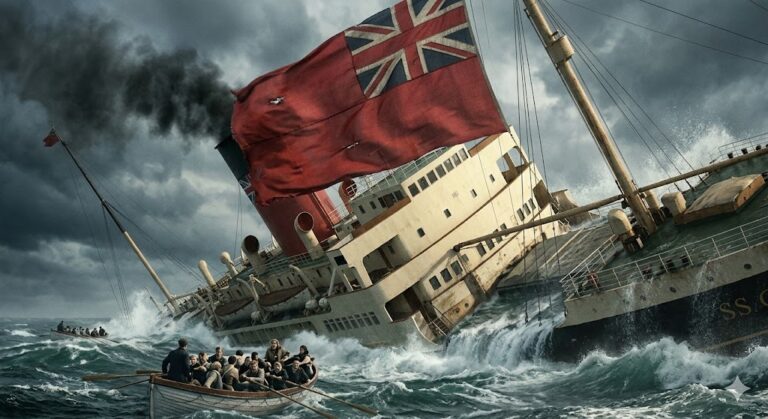
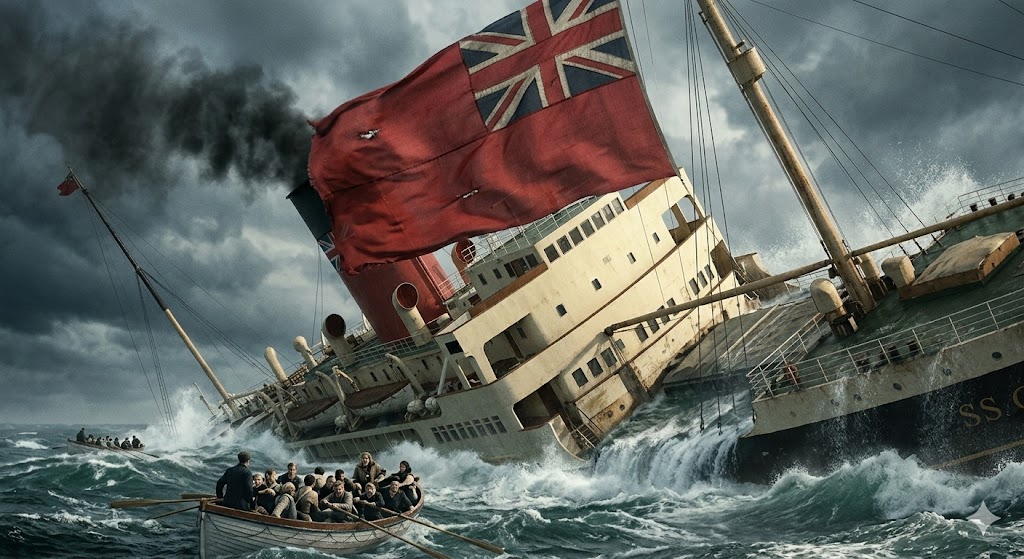
There was a time when Britain was the most feared and admired civilization on Earth. An island nation that conquered continents, industrialized the world, defeated Napoleon, and built an empire on which the sun famously never set. A people forged by cold weather, hard seas, and the unshakeable belief that if something needed doing, a Briton could damn well do it. That Britain is gone. In its place stands a nation paralyzed by politeness, besotted with victimhood, and so terrified of causing offence that it has lost the ability — or the will — to function.
What follows is not a hate letter. It is a eulogy for a spine.
The Army That Couldn’t Frighten a Parish Council
Let us begin with the military — or what remains of it. The British Army technically fields around 73,000 regular soldiers, a figure already embarrassingly small for a G7 nation. But the headline number flatters to deceive. Strip out support staff, logistics, training establishments, and the various desk-bound bureaucracies that modern armies inexplicably require, and Britain is left with approximately 19,000 troops genuinely ready for combat. Nineteen thousand.
Military analysts have run the numbers against the intensity of fighting seen in Ukraine — the rate of casualties, equipment consumption, and rotational demand that modern high-intensity warfare requires — and the conclusion is as stark as it is humiliating: Britain’s combat-ready force would be effectively expended in under five days. Five days. In the First World War, British forces suffered 57,000 casualties on the first day of the Somme alone and kept fighting for four more years. Today’s army couldn’t sustain a single week of serious combat before running out of soldiers.
The Royal Navy, which once patrolled every ocean on Earth and kept global trade arteries open through sheer intimidating presence, now struggles to keep both aircraft carriers simultaneously operational. The RAF has fewer combat aircraft than several medium-sized European nations that haven’t won a war since 1918. And yet the budget for diversity training, pronouns-in-the-workplace seminars, and recruitment campaigns featuring soldiers discussing their anxiety disorders appears entirely unaffected by austerity.
Recent British Army recruitment campaigns — rather than depicting elite warriors hardened by discipline and sacrifice — featured soldiers weeping, discussing their feelings, and “finding belonging.” When you market a fighting force as a therapy group with guns, don’t be surprised when warriors stop applying.
Winston Churchill would not recognise it. Neither would the men who stormed the beaches at Normandy. Speaking of which…
Who Actually Won World War II? (Hint: It Wasn’t You)
Nothing illustrates British self-delusion quite like the national obsession with World War II. It is the cultural load-bearing wall of British identity — the one thing, above all else, that Britons invoke when they need to feel significant. Every pub argument, every political speech, every tabloid front page about Europe somehow circles back to 1940 and “the Blitz spirit.” In the British retelling, Britain practically won the war single-handedly, Churchill’s jaw jutting heroically into a storm of German bombers.
The facts are inconvenient and therefore largely ignored. The Soviet Union suffered approximately 27 million dead — soldiers and civilians — grinding the Wehrmacht to dust on the Eastern Front. The Battle of Stalingrad alone cost more lives than the entire British war effort. By the time the Western Allies landed at Normandy in June 1944, Nazi Germany’s military had already been broken by three years of catastrophic losses in the East. Operation Overlord was the killing blow on a body that Soviet steel had already bled nearly dry.
Britain’s contribution was real and should not be trivialised — Dunkirk, the Battle of Britain, North Africa, the Atlantic convoys were genuine achievements of genuine courage. But “we survived and contributed meaningfully to an Allied coalition victory” is a rather different story from “we won the war.” One is historically accurate. The other is a national myth so deeply embedded that pointing it out at a dinner party in Surrey will get you treated as though you’ve suggested cancelling Christmas.
A nation comfortable with mythology over reality is a nation comfortable with decline.
The Church of Political Correctness
Britain has found a new religion. It has no God, no afterlife, and no forgiveness — but it has dogma in industrial quantities. Political correctness has moved from the fringes of academia to the commanding heights of British institutional life with a speed that would have seemed hallucinatory twenty years ago. The BBC, the Civil Service, the NHS, the police, the universities, the major corporations — all have been thoroughly colonised by an ideological framework that prioritises the management of feelings over the pursuit of truth or effectiveness.
Police forces that failed for years to investigate industrial-scale grooming gangs — partly, their own internal reports concede, out of fear of appearing racist — embody the lethal consequences of this ideology. Social workers who saw abuse and looked away. Councils that knew and filed the paperwork in the correct drawer. The victims were overwhelmingly working-class girls, failed by every institution designed to protect them. They were sacrificed on the altar of not wanting to be called a bad name. That is not politeness. That is cowardice dressed in the language of compassion.
Britain has become a society where being accused of an -ism is treated as more catastrophic than the actual harm the -ism is supposed to describe. The accusation has become the verdict. And so everyone from politicians to police officers to teachers has learned the same institutional survival skill: say nothing, do nothing, offend no one, and let someone else deal with the problem — ideally someone who has already retired.
Open Borders and Closed Eyes
Net migration to the United Kingdom hit 906,000 in the year to June 2023 — a figure so large it strains comprehension. Britain is absorbing a city the size of Birmingham every single year. Housing cannot keep pace. GP surgeries are overwhelmed. Schools bulge. Infrastructure built for 55 million is being asked to serve 68 million, with the number climbing relentlessly.
The political class, for decades, refused to discuss this with anything approaching honesty. To raise the subject was to invite immediate accusations of racism — and so the subject was not raised, not properly, not by anyone who wanted to keep their career intact. The British public consistently ranked immigration as a top concern in every poll taken since the early 2000s. The political class consistently responded by calling the public xenophobic and changing the subject. This is not democracy. It is managed contempt.
Brexit was, among other things, the revenge of a population that had been told for twenty years that their concerns were illegitimate. The establishment’s baffled horror at the result told you everything about how profoundly it had lost touch with the country it claimed to govern.
The Sick Note Economy
Britain now has the highest rate of economic inactivity due to long-term sickness of any comparable developed economy. Approximately 2.8 million working-age people are out of the labour market citing long-term illness or disability — a number that has surged dramatically since 2020 and shows no sign of reversing. The welfare bill has become a structural fixture of public finances, consuming ever-larger portions of a tax base that is itself shrinking as fewer people work.
The elephant in the room — which British commentators approach with the caution of a man defusing unexploded ordnance — is that a significant portion of this explosion in disability claims reflects a cultural and systemic shift rather than a genuine deterioration in national health. Mental health claims have rocketed. “Anxiety” and “depression” — real conditions, genuinely debilitating when severe — have become catch-all categories that a sympathetic GP system, terrified of seeming unsupportive, certifies with minimal scrutiny.
Previous generations survived the Blitz, the Great Depression, and the Black Death with rather fewer therapists and considerably less access to state support. The current generation — materially the most comfortable in human history — is apparently too unwell to work. Something does not add up.
Green Dreams and Economic Nightmares
Britain declared itself a world leader in climate policy and committed to net zero with the enthusiasm of a nation that has found a new cause to feel morally superior about. The result has been some of the highest domestic energy prices in the developed world, the systematic destruction of energy-intensive industry, and the extraordinary spectacle of a G7 nation burning wood pellets shipped from American forests in former coal power stations — and calling it “renewable.”
While Britain congratulates itself on closing its last coal mine, China opens a new coal power station every two weeks. Britain’s share of global CO₂ emissions is approximately one percent. The sacrifice of British industrial capacity, British jobs, and British energy security in pursuit of a target that cannot move the global needle without Chinese and Indian participation is not environmentalism. It is performance art. It is the international equivalent of recycling your yogurt containers while your neighbor burns tires in the back garden.
But it feels virtuous. And in modern Britain, feeling virtuous has become the primary output of national ambition.
Missing the Future: Britain and the AI Revolution
The great technological revolutions of our time — artificial intelligence, large language models, autonomous systems, genomics, advanced energy technology — are being driven from the United States and, increasingly, China. Britain, which invented the computer (Turing), cracked the structure of DNA (Crick, Watson, and the under-credited Franklin), and developed the World Wide Web (Berners-Lee), has managed to gift the world the intellectual foundations of the modern age while failing to commercialise any of it at scale.
DeepMind — Britain’s most celebrated AI company — was sold to Google in 2014 for £400 million. It is now worth hundreds of billions of dollars. Britain produced the talent, did the research, and then sold the future to California at a discount. The venture capital ecosystem remains shallow. The regulatory instinct runs to caution rather than enablement. Universities produce world-class research that gets commercialised elsewhere. The pattern is depressingly consistent: invent it, fail to back it, watch others get rich from it, then commission a government review.
While San Francisco debates the ethics of superintelligence and Beijing pours state billions into AI dominance, Britain’s contribution to the revolution largely consists of worried op-eds and a parliamentary select committee that meets quarterly and produces non-binding recommendations. The country that gave the world Alan Turing is now a spectator at the technological event of the century.
Is There a Way Back?
None of this is inevitable. Nations have pulled themselves back from worse. The British character — stubborn, pragmatic, darkly funny, and occasionally capable of extraordinary collective effort — has not been destroyed. It has been buried under decades of institutional timidity, political cowardice, and a cultural elite more interested in managing the nation’s feelings than confronting its problems.
The medicine is not pleasant. It requires telling people hard truths about welfare, immigration, energy, military readiness, and the yawning gap between national mythology and national reality. It requires politicians willing to be called names in the service of actual solutions. It requires a culture that values effectiveness over optics, results over intentions, and honesty over comfort.
In short, it requires exactly the qualities that modern Britain has spent thirty years systematically discouraging.
The sun set on the British Empire a long time ago. The question now is whether it is setting on Britain itself — or whether somewhere in this damp, grey, over-regulated, therapy-saturated island, the old fire still burns. The author, with diminishing optimism, would like to believe it does.
About the Author

Brian French is the CEO of Florida Website Marketing and Florida AI Agency. For over 15 years, Brian served as an Internet Marketing Professional for BoardroomPR, one of Florida’s largest public relations firms. He is a specialist in local SEO, AEO, and AI-driven marketing strategies tailored for the Florida business landscape. He has written over 1,600 article on Florida business, technology and economics. Connect with Brian on LinkedIn Visit his websites FloridaWebsiteMarketing.com and FloridaAIAgency.com or text him at 813 409-4683 for a consultation.
About the Author