Brian French | April 5, 2026 | CENTRAL FLORIDA REAL ESTATE DEVELOPMENT REPORT · 2026
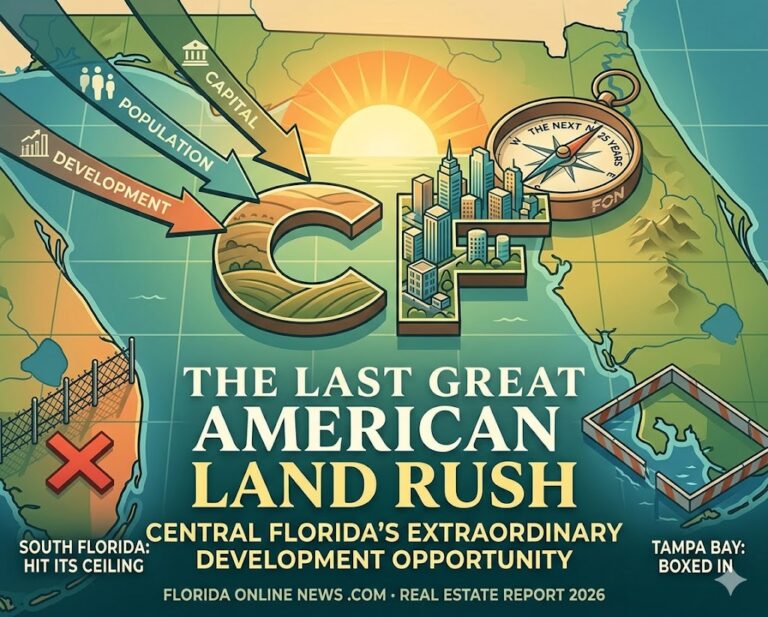
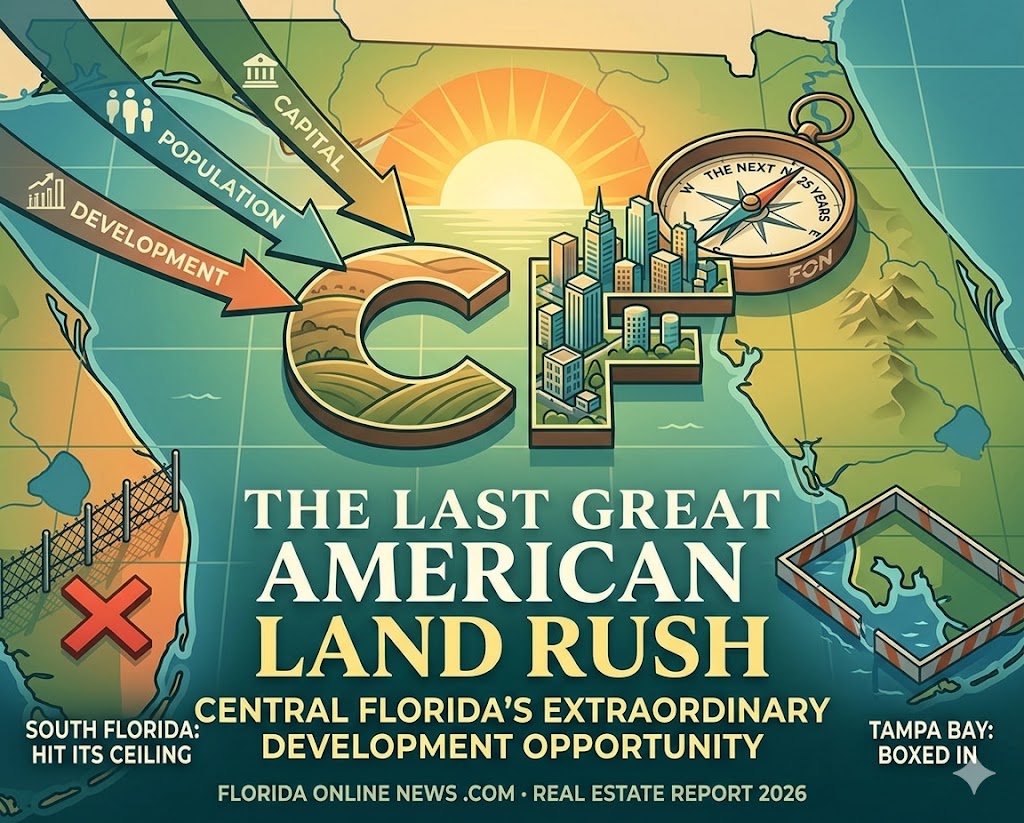
The Last Great American Land Rush: Central Florida’s Extraordinary Real Estate Development Opportunity for the Next 25 Years
Why South Florida Has Hit Its Ceiling, Why Tampa Bay Is Boxed In — and Why the Orlando Corridor Is Building the Future on Hundreds of Square Miles of Open Land
There is a moment in the lifecycle of every great real estate market when the most important question shifts. It is no longer “how much is it worth?” The question becomes: “Is there any left?”
In South Florida, that question has already been answered — and the answer is no. Drive west from Miami on the Tamiami Trail or Kendall Drive and you will eventually reach the Urban Development Boundary, an 80-mile legal line established in 1983 that separates the westward march of Miami’s urban grid from the Everglades. The line is stark and absolute: on one side, neighborhoods, strip malls, warehouses, and pavement; on the other, sawgrass marshes, subtropical wetlands, and the River of Grass that supplies drinking water for 9 million South Floridians. Courts have repeatedly blocked attempts to move that boundary. Environmental laws protect it. The Everglades themselves — irreplaceable, ecologically essential, politically defended at every level — make further westward expansion an environmental impossibility.
In Tampa Bay, the constraint is different but equally real. Pinellas County — home to St. Petersburg, Clearwater, and the peninsula communities of the bay’s western shore — is the most densely developed county in Florida. There is simply no undeveloped land left in Pinellas at meaningful scale. The small lot sizes that characterize St. Petersburg’s historic neighborhoods, the barrier islands already at capacity, and the geographic reality of a peninsula surrounded on three sides by water mean that Pinellas County’s growth story is largely written. Tampa proper, across the bay in Hillsborough County, has more room to work with — but the most desirable areas are already built, and the remaining developable parcels are scattered, constrained, and expensive to assemble.
The question of where Florida grows next has a clear answer. It is not south. It is not west of Tampa Bay. It is straight up the spine of the Florida peninsula, into a region of rolling hills, pristine lakes, open agricultural land, and vast undeveloped corridors that stretch for hundreds of square miles in every direction from Orlando. Central Florida — Orange County, Lake County, Osceola County, Polk County, and the expanding rings of growth that radiate outward from the I-4 corridor — is the last great American land rush. And the developers, homebuilders, institutional investors, and master planners who understand this are already moving with extraordinary speed and conviction.
THE SOUTH FLORIDA CEILING: WHY DEVELOPMENT HAS RUN OUT OF ROOM
To understand Central Florida’s opportunity, you must first understand South Florida’s constraint — not as a policy debate, but as a geographic and economic reality that shapes the entire state’s development trajectory.
The Urban Development Boundary in Miami-Dade County represents one of the most consequential planning decisions in American urban history. Established in the early 1980s by a county commission that understood both the environmental necessity and the fiscal logic of limiting sprawl, the UDB has effectively frozen the westward boundary of Miami for more than four decades. When you fly over Miami-Dade, the pattern is unmistakable: urban development gallops west from Biscayne Bay until it hits an invisible wall, then stops. Beyond the wall — the Everglades, the aquifer recharge zones, the wetlands that clean the region’s water and absorb its storm surge.
Every few years, developers and commissioners push to move the line. Courts have consistently blocked those attempts. In 2025 alone, a First District Court of Appeal ruling — overturning an attempted boundary expansion — was hailed as a decisive win by environmental organizations and acknowledged, even by many in the development community, as a necessary protection. The 2026 Florida legislative session brought new pressure, with House Bill 399 calling for the possible elimination of the UDB, but even prominent South Florida developers — including billionaires Jorge Perez and Armando Codina — publicly opposed the move as a threat to the region’s water supply and long-term planning integrity.
Codina put it plainly: the boundary “is not an obstacle to progress; it is a guardrail protecting Florida’s future.” Regardless of how the legislative debate ultimately resolves, the fundamental reality of the Everglades — its irreplaceability, its role in supplying drinking water to Miami-Dade and Monroe counties, and its centrality to the $13.5 billion federal and state Comprehensive Everglades Restoration Plan — means that large-scale land development to the west of Miami is not a viable strategic option for the next generation of master-planned community development.
Broward County faces similar constraints from different directions: the Everglades to the west, the Atlantic to the east, Miami-Dade to the south, and Palm Beach County to the north. The buildable land within Broward is not gone, but the opportunity for the kind of large-scale, multi-decade, master-planned community development that defines the great real estate opportunities of a generation does not exist in Broward any more than it does in Miami-Dade. The sites available are scattered, small relative to what master planning requires, and extraordinarily expensive.
Pinellas County — the Florida equivalent of Manhattan in its development saturation — is the most densely developed county in the state. The Homes.com director of analytics said it directly in the context of the 2025 master-planned community report: “Many areas along the coast are largely built out, especially in areas like Pinellas County in the Tampa Bay region.” The historic small lot sizes of St. Petersburg and Clearwater’s residential neighborhoods cannot be easily consolidated into the large-parcel assemblages that master planning requires. The geography of the peninsula, surrounded on three sides by water, means there is simply no direction for meaningful outward expansion.
Hillsborough County — home to Tampa — has more room, and indeed the eastern portions of the county and adjacent Pasco County are seeing genuine growth activity. But the most desirable Tampa locations are priced accordingly, and the assembly of the kind of contiguous acreage that supports true master-planned development at generational scale remains difficult, expensive, and limited compared to the opportunity that exists an hour up the I-4 corridor.
THE CENTRAL FLORIDA OPPORTUNITY: HUNDREDS OF SQUARE MILES OF OPEN LAND
Now consider what exists 60 to 90 miles north and northwest of Miami — or an hour east of Tampa — in Central Florida.
Orange County, the metropolitan core of the Orlando region, still contains thousands of acres of developable land in its southern and eastern reaches. Lake County, immediately to the west of Orange County, contains vast agricultural and rural land — currently in the process of a land rush that is producing some of the largest acreage transactions in Florida’s recent history. Osceola County, south of Orlando, has significant developable land adjacent to the tourism corridor and the expanding Lake Nona employment cluster. Polk County, to the southwest, contains large tracts of land along the I-4 corridor connecting Orlando to Tampa. And in the spaces between — in the rolling hills east of the Florida Turnpike, in the agricultural corridors south of SR-50 and north of US-192, in the lake-studded countryside that stretches for dozens of miles in every direction from downtown Orlando — there exist the raw material for a generation of master-planned community development that South Florida can no longer offer.
The numbers from 2025 tell the story with unmistakable clarity. In the national ranking of top-selling master-planned communities, Florida had 10 of the top communities on the list. The Villages in Central Florida ranked first nationally with 3,611 sales — more than twice the next-largest community in the country. Lakewood Ranch in Sarasota ranked second with 2,085 sales. Babcock Ranch in Punta Gorda ranked fourth with 1,066 sales — a 34% increase over 2024. These are not small, incremental developments. They are cities in the making, generating thousands of real estate transactions per year, and they share a common characteristic: they are all built on the kind of large-scale, contiguous, accessible, affordable Central and Southwest Florida land that is simply unavailable in the built-out coastal markets.
The research firm RCLCO, which has tracked master-planned community performance for a decade, identified the common traits of the communities that consistently dominate national rankings: scale, strategic segmentation, regional concentration, amenity-rich planning, and disciplined execution. Every one of those traits is more achievable in Central Florida than anywhere else in the state.
THE CORRIDORS OF OPPORTUNITY: WHERE THE NEXT GENERATION OF DEVELOPMENT IS HAPPENING NOW
Horizon West and the West Orange County Corridor
Horizon West — a master-planned community in western Orange County adjacent to Walt Disney World — has become one of the most significant real estate success stories in Florida over the past decade. What began as agricultural land in the shadow of the theme parks is now a community of tens of thousands of residents, with town centers, A-rated schools, resort-style amenities, and property values that have appreciated dramatically from their early entry points. Properties in Horizon West are now regularly transacting at $800,000 and above. The community did not happen by accident — it was the product of deliberate master planning at a scale that required hundreds of acres of contiguous undeveloped land, precisely the kind of land that Central Florida had and South Florida and Tampa Bay did not.
The Horizon West model has proven so successful that the industry is now actively replicating it in adjacent corridors, racing to capture the next wave of growth before land prices escalate to the point where the development economics become more difficult.
The Wellness Way Corridor — Lake County’s 15,000-Acre Next Frontier
The single most exciting development corridor in Central Florida for the next decade — and arguably in all of Florida for the next 25 years — is the Wellness Way Sector Plan in Lake County, a nearly 15,000-acre swath of land southeast of Clermont that is positioned to become the region’s next Horizon West.
The Wellness Way plan — established in 2016 and only now entering its major land rush phase — encompasses approximately 15,500 acres east of US-27 and south of State Road 50, just west of Orange County’s Horizon West boundary. The vision is deliberately comprehensive: high-tech and high-wage industry, healthcare innovation, residential development at scale, retail and mixed-use centers, and connections to Horizon West and the broader Orlando metropolitan area through new road infrastructure including the planned SR-516 connector expressway.
The land transactions that have closed in Wellness Way over the past two years signal the extraordinary conviction of institutional developers:
GT USA, a development partnership backed by Canadian homebuilders, closed on over 2,400 acres in Wellness Way for $166.5 million — one of the largest single land transactions in Central Florida history. Pulte Homes acquired 840 acres, the Schofield Community, for a record-breaking $90 million — the largest land sale ever recorded in Lake County at the time. Richland Communities paid $60 million for 406 acres known as the Hickory Groves property, slated for approximately 1,200 homes plus retail and office space. Multiple additional large transactions by national builders including Beazer, Lennar, Ashton Woods, David Weekley, and Toll Brothers are reshaping 15,000 acres of what were, just a decade ago, orange groves and cattle farms.
The Olympus Master Development — a healthcare, sports, and wellness-focused mixed-use project anchoring the eastern portion of Wellness Way — plans more than one million square feet of office, medical, retail, restaurant, and industrial space alongside over 1,000 residential units, all built around the athletic heritage of Clermont, long known as the “Choice of Champions” for the Olympic and elite athletes who train at the National Training Center.
Analysts who track the Wellness Way corridor compare its potential to Lake Nona in 2010 — before Lake Nona’s Medical City attracted major employers, drove extraordinary appreciation, and established itself as one of the most successful master-planned developments in American history. Horizon West properties are now at $800,000 and above. Wellness Way is currently transacting around $600,000. That gap is closing, and the developers writing $90 million and $166 million checks are betting that it closes dramatically over the next decade.
Lake Nona and the Eastern Expansion
Lake Nona — built on open land in southeastern Orange County that was, in the early 2000s, largely undeveloped scrub and agricultural property — is the defining proof of concept for Central Florida’s master-planned development model. Today it hosts the UCF College of Medicine, the Nemours Children’s Hospital, the VA Medical Center, the United States Tennis Association national campus, a Hyatt Regency, dozens of corporate offices, miles of trails, and tens of thousands of residents in communities ranging from starter homes to multi-million dollar estates.
The appreciation trajectory of Lake Nona since 2010 has been extraordinary by any measure — and the model it established is now being replicated across multiple Central Florida corridors simultaneously. The Sunbridge master plan in eastern Orange County and western Osceola County is one of the most significant: a large-scale development spanning the county line, with communities including Weslyn Park and Bridgewalk being built by multiple national builders simultaneously. Weslyn Park’s architectural diversity — Ashton Woods, David Weekley, and Toll Brothers all building in the same community — creates the visual character and long-term resale value dynamics that the best master plans deliver.
Osceola County itself represents one of the most significant land development opportunities in Florida. It had Florida’s second-largest growth in population from 2010 to 2020 according to the U.S. Census Bureau. With developable land becoming scarce in Orange and Seminole counties, the Urban Land Institute has projected that much of the region’s residential growth for the next decade will take place in and around Kissimmee and greater Osceola County. The county contains large tracts of developable land adjacent to the tourism corridor, the Florida Turnpike, and the expanding Lake Nona employment cluster — accessible, high and dry, and increasingly connected by new road infrastructure.
Polk County and the I-4 Corridor
Between Orlando and Tampa lies one of the most consequential and underappreciated development corridors in Florida: the I-4 corridor through Polk County. Connecting the two fastest-growing major metropolitan areas in the Southeast United States, with interchange access at multiple points and land values that remain substantially below what equivalent locations in either metro command, Polk County represents a development opportunity that is beginning to attract serious institutional attention.
The cities of Lakeland, Davenport, Haines City, Kissimmee, and the surrounding unincorporated areas along the I-4 spine are experiencing a wave of new residential and commercial development driven by the fundamental logic of positioning: equidistant between two major job markets, connected by a major interstate, affordable relative to the urban cores, and sitting on land that can be assembled at scale. For the master-planned community developer with a 15-to-25-year horizon, this corridor offers a strategic position that will look, in retrospect, extraordinarily foresighted.
Apopka and the Northern Orange County Frontier
North of Orlando proper, Apopka has emerged as one of the most rapidly transforming cities in Orange County — a municipality that is leveraging its land availability, highway access, and proximity to the metro’s employment centers to attract a wave of mixed-use, residential, and commercial development that is reshaping its character entirely.
Apopka currently has more than 15,000 new residential units and 14 million square feet of industrial and commercial space in the works. Major projects include the 500-million-dollar Floridian Town Center, a 65-acre mixed-use development including 600 apartments, retail, and a hotel; the 202-acre Crossroads at Kelly Park, where national homebuilder Dream Finders has begun construction; and the 255-acre Wyld Oaks development planned for 4,000 residences. The Daryl Carter Parkway Interchange at I-4 and Apopka Vineland Road, now open, has connected Apopka more directly to the region’s highway infrastructure and made its development economics more compelling.
WHY THE NEXT 25 YEARS BELONG TO CENTRAL FLORIDA
The fundamental drivers of Central Florida’s development opportunity are not cyclical — they are structural, demographic, and geographic. They will not be diminished by interest rate cycles or the ebbs and flows of the national housing market. They will persist for the same reason that the best real estate opportunities always persist: they are based on the irreversible logic of human movement toward opportunity.
Population growth is structural and sustained. Florida replaced New York as the third most populous state in the United States. Hundreds of thousands of people migrate to Florida every year, and they are not coming from other Florida markets — they are coming from the Northeast, the Midwest, the Mid-Atlantic, and California, drawn by no state income tax, affordable land relative to their origin markets, and a quality of life that the climate, the economy, and the environment of Central Florida consistently delivers. That migration is accelerating, not decelerating.
Land availability is the decisive geographic advantage. There are hundreds of square miles of developable land in the Central Florida corridor that are already entitlement-ready or in the entitlement process, accessible by existing and planned highway infrastructure, and priced in a range that makes the development economics genuinely compelling at today’s margins. This is not speculation — it is the conclusion of every major homebuilder, institutional land fund, and master-plan developer that has looked seriously at the Florida market. The Pulte Homes, Lennar, Toll Brothers, DR Horton, and David Weekley operations that are pouring capital into Central Florida land are not doing so on the basis of short-term market timing. They are doing so on the basis of a 20-to-30-year land strategy that recognizes Central Florida as the primary growth corridor of one of the fastest-growing states in the country.
Infrastructure investment is following development at scale. The new SR-516 connector in the Wellness Way corridor. The Daryl Carter Parkway interchange in Apopka. The Schofield Road extension linking Wellness Way communities to the SR-429 beltway. New schools, hospital campuses, retail centers, and employment destinations are following the residential growth at a pace that reinforces the long-term case. Unlike speculative land development in isolated markets, Central Florida’s growth is anchored by genuine employment — healthcare, technology, aerospace, defense, tourism, and logistics — that creates the stable economic foundation for residential growth to sustain itself across cycles.
The master-planned community model has proven itself in this market. The Villages is the most successful master-planned community in the history of American real estate. Lakewood Ranch is the fastest-selling multigenerational community in the country. Lake Nona is the model that every medical-and-wellness-anchored planned community in the nation aspires to replicate. Horizon West has produced appreciation that has transformed the financial lives of the families who bought early. These are not scattered success stories — they are a coherent pattern of repeatable outcomes driven by the structural advantages of Central Florida land.
THE INVESTMENT THESIS IN PLAIN LANGUAGE
For the real estate investor, developer, landowner, or institutional capital allocator trying to understand where to position for the next 25 years, the thesis is straightforward.
South Florida is built out. The Everglades will not be paved. The Urban Development Boundary, whatever its legal future, reflects a physical reality that cannot be argued away: there is not meaningful large-scale undeveloped land available in Miami-Dade, Broward, or Palm Beach County for the kind of master-planned development that captures generational appreciation.
Tampa Bay’s most constrained market — Pinellas County — is at capacity. The city of Tampa has growth opportunity in its eastern and northern reaches, but the intimate scale of the city’s historic neighborhoods and the existing development patterns of the market make large-scale master-planned development difficult.
Central Florida has hundreds of square miles of open, accessible, entitled or entitle-able land within 30 to 60 minutes of one of the world’s most visited metropolitan areas, connected to a major interstate highway system, served by a world-class international airport, anchored by major employment centers in healthcare, technology, and aerospace, and already proven at scale by the most successful master-planned communities in American history.
The developers who are writing $90 million and $166 million checks for Central Florida land in 2025 and 2026 understand this. The national homebuilders who are opening new communities in Wellness Way, Sunbridge, Apopka, Osceola County, and Polk County understand this. The institutional land funds that are banking thousands of acres in the I-4 corridor understand this.
The Central Florida land opportunity is not a secret. But it is, for the developer, investor, or long-term landowner who acts with the kind of conviction that great real estate opportunities always require, still early in a story that will unfold over the next 25 years and shape the residential landscape of the American South for generations beyond that.
KEY CENTRAL FLORIDA DEVELOPMENT CORRIDORS AT A GLANCE
- Wellness Way, Lake County — 15,000+ acres; $166.5M and $90M landmark land transactions; 16,500 planned residential units; Olympus sports/wellness campus; the next Horizon West | Clermont, FL
- Horizon West, Orange County — Already Florida’s premier master-planned success story; still expanding; new Del Webb active adult communities; $800K+ property values | Winter Garden / Orlando, FL
- Lake Nona / Sunbridge, Orange-Osceola County — Medical City model; UCF Medicine, Nemours, USTA campus; Sunbridge expanding eastward with Weslyn Park and Bridgewalk | Southeast Orlando, FL
- Osceola County / Kissimmee — Florida’s #2 growth county 2010–2020; significant developable land adjacent to tourism corridor and Lake Nona; Urban Land Institute projects next decade of growth here
- Polk County / I-4 Corridor — Between Orlando and Tampa; interstate access; affordable land; emerging as the connective corridor for the state’s two fastest-growing metros
- Apopka / North Orange County — 15,000+ residential units in the pipeline; 14M sq ft commercial/industrial; $500M Floridian Town Center; direct I-4 access via new Daryl Carter Parkway interchange
Central Florida Real Estate Development Report · Orange County · Lake County · Osceola County · Polk County · 2026 Edition The Last Great American Land Rush — and Why the Next 25 Years Belong to Central Florida
About the Author