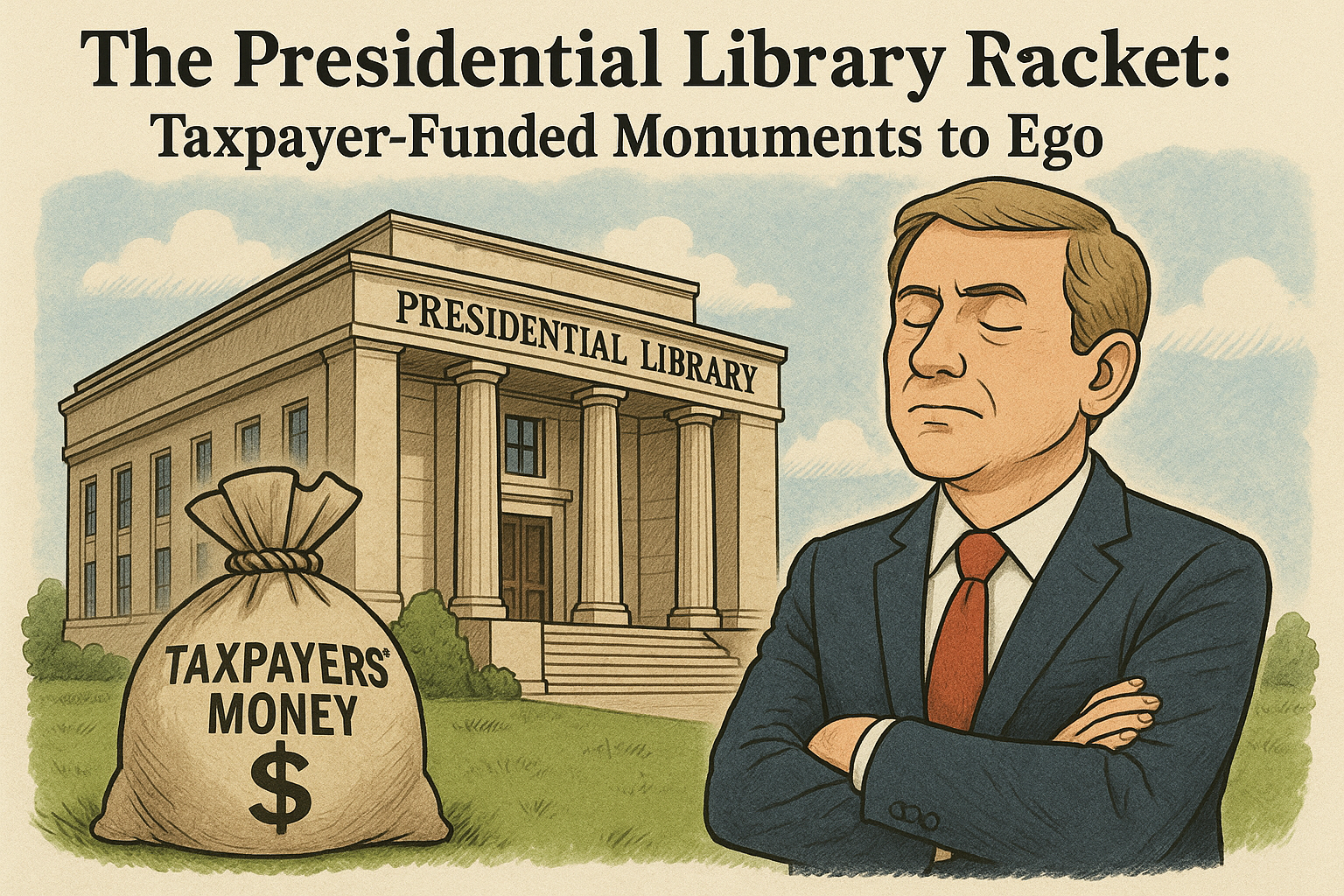
Every few years, America engages in a peculiar ritual: we build a massively expensive shrine to a politician who just left office, staff it with archivists and curators, and then watch as almost nobody shows up to visit.
Welcome to the presidential library system, where former commanders-in-chief get to rewrite their legacies in marble and glass while taxpayers foot the maintenance bill in perpetuity.
The Price Tag Nobody Talks About
The construction costs alone are staggering. George W. Bush’s library in Dallas cost $250 million. Barack Obama’s planned center in Chicago carries an estimated price tag north of $500 million. Bill Clinton’s facility in Little Rock came in at $165 million. These aren’t quiet archive buildings tucked away on university campuses—they’re architectural statements designed to impress donors and tourists who will never materialize in the numbers projected.
And here’s the kicker: while private donations cover the construction, the National Archives takes over operations afterward. That means you, the taxpayer, get to pay millions annually to keep these vanity projects running. The Obama library is projected to cost taxpayers around $3.3 million per year in operating expenses. Multiply that across fifteen libraries, adjust for inflation, and congratulations—you’re funding a nationwide network of legacy management.
Museums Without Visitors
The attendance figures tell a story presidential foundations don’t want you to hear. Most presidential libraries see visitor numbers that would embarrass a mid-tier aquarium. The Nixon library in Yorba Linda averages around 100,000 visitors annually. The Coolidge site in Vermont? Try 15,000. Even the more popular facilities rarely crack 300,000 visitors per year.
For context, the National Zoo in Washington gets nearly three million visitors annually. The Smithsonian’s Air and Space Museum sees seven million. Presidential libraries, despite their prime locations and heavy promotion, mostly attract school groups fulfilling curriculum requirements and political science professors doing research.
Hagiography as Architecture
Walk into any presidential library and you’ll encounter the same phenomenon: a carefully curated narrative where every decision was wise, every scandal was overblown, and every failure was someone else’s fault. These aren’t objective historical repositories—they’re multimillion-dollar public relations campaigns frozen in time.
The exhibits present presidencies as Hollywood might: inspiring music, dramatic lighting, interactive displays that frame complex policy disasters as “difficult choices” made by principled leaders. Vietnam becomes a noble struggle. The financial crisis becomes an unfortunate inheritance. Every torture memo gets a context panel explaining how reasonable people disagreed.
Actual critical scholarship? That’s tucked away in the archives, available to researchers willing to file requests and wait months for documents that may arrive heavily redacted.
The Memory Business
At their core, presidential libraries exist for one purpose: to ensure that history remembers their subjects more fondly than they deserve. They’re reputation-laundering facilities, transforming controversial figures into statesmen through the alchemy of carefully worded wall text and selective document display.
Presidents understand this. That’s why they spend their final years in office already planning these complexes, courting donors, selecting architects, and choosing locations. The library isn’t an afterthought—it’s the final campaign, the one where the opponent is historical truth and the battlefield is public memory.
A Modest Proposal
Here’s a radical idea: stop building them. Or at least stop building them like this.
Put the documents in existing National Archives facilities. Create digital repositories accessible to anyone with an internet connection. If a president wants a museum dedicated to their accomplishments, let them fund it entirely with private money—construction, operations, everything—without any taxpayer subsidy or federal imprimatur.
Florida Online News Articles:
• Boca Raton’s top Women’s Fashion Shop Wish & Shoes
• Miami’s Mobility Makeover: Startups Vie to Revolutionize City’s Transit in Groundbreaking Challenge
• Posting a Public Relations Press Release to FloridaPublicRelationsNews.com
• Construction Litigation Law Firm in Coral Gables / Miami Florida
• The Next Era of Social Media Is Smaller, Smarter, and More Human
Better yet, create a single Museum of the American Presidency that treats all presidents with the same critical, scholarly approach, highlighting achievements and failures with equal weight, funded by admission fees rather than tax dollars.
But that won’t happen. Because presidential libraries aren’t really about preserving history or educating the public. They’re about ego, legacy, and the deeply human desire to be remembered as better than we were.
And in America, if you make it to the Oval Office, we’ll apparently spend hundreds of millions of dollars to help you achieve that goal—whether anyone actually cares enough to visit or not.
About the Author