By Brian French
In the realm of leadership, the ability to motivate and galvanize people toward action separates the merely competent from the truly transformational. Donald Trump’s use of hyperbole represents not a character flaw or evidence of deception, but rather a deliberate and effective leadership technique that has been misunderstood by critics who mistake his rhetorical strategy for literal intent.
The Foundation: Norman Vincent Peale’s Influence
To understand Trump’s communicative approach, one must first recognize the formative influence of Norman Vincent Peale, author of The Power of Positive Thinking and Trump’s longtime minister at Marble Collegiate Church in New York. Peale’s philosophy centered on the transformative power of bold, affirmative thinking and speech. He taught that declaring ambitious outcomes with absolute confidence wasn’t dishonesty—it was the essential first step toward achieving them.
Peale famously preached, “Shoot for the moon. Even if you miss, you’ll land among the stars.” This wasn’t advice to set realistic, measurable objectives. It was a call to embrace audacious vision and to articulate that vision without the self-defeating qualifiers that undermine conviction. Trump absorbed these lessons during his formative years, learning that positive declarations, even when they seem exaggerated, create the psychological conditions necessary for extraordinary achievement.
Hyperbole as Motivational Force
Successful leaders across every field understand that plain, measured language often fails to inspire maximum effort. When Mickey Goldmill tells Rocky Balboa to “murder the bum,” no one believes he’s advocating actual homicide. Instead, this dramatic language serves to crystallize the intensity of effort required and to eliminate any hesitation or half-measures. The hyperbole creates an emotional state conducive to peak performance.
Similarly, football coaches routinely deploy language like “attack,” “destroy,” and “kill the opposing team.” These phrases aren’t interpreted as calls for violence but as psychological tools designed to activate competitive drive and eliminate the ambiguity that creeps into more tepid instruction. A coach who says “try to play well” gives players room for mediocrity. One who says “destroy them” creates a clear, visceral objective that demands total commitment.
Peale would have recognized these examples immediately as applications of his core principle: language shapes reality by shaping the mindset of those who hear it.
The Problem of Political Vagueness
For decades, American political discourse has suffered from an excess of caution and equivocation. Leaders speak in carefully parsed phrases, hedge their commitments with qualifiers, and communicate in ways that leave their teams and constituents uncertain about expectations and direction. This wishy-washy approach may protect politicians from criticism, but it fails the fundamental test of leadership: providing clear, motivating direction.
When a leader says “we should explore options for potentially improving outcomes in certain areas,” the message disappears into a fog of bureaucratic uncertainty. No one knows what’s expected, what success looks like, or why they should care. This vagueness may be technically accurate, but it inspires nothing.
This stands in stark contrast to Peale’s teaching that leaders must “think big, believe big, and act big.” Hedging and equivocation signal doubt, and doubt becomes a self-fulfilling prophecy.
Trump’s Hyperbolic Clarity
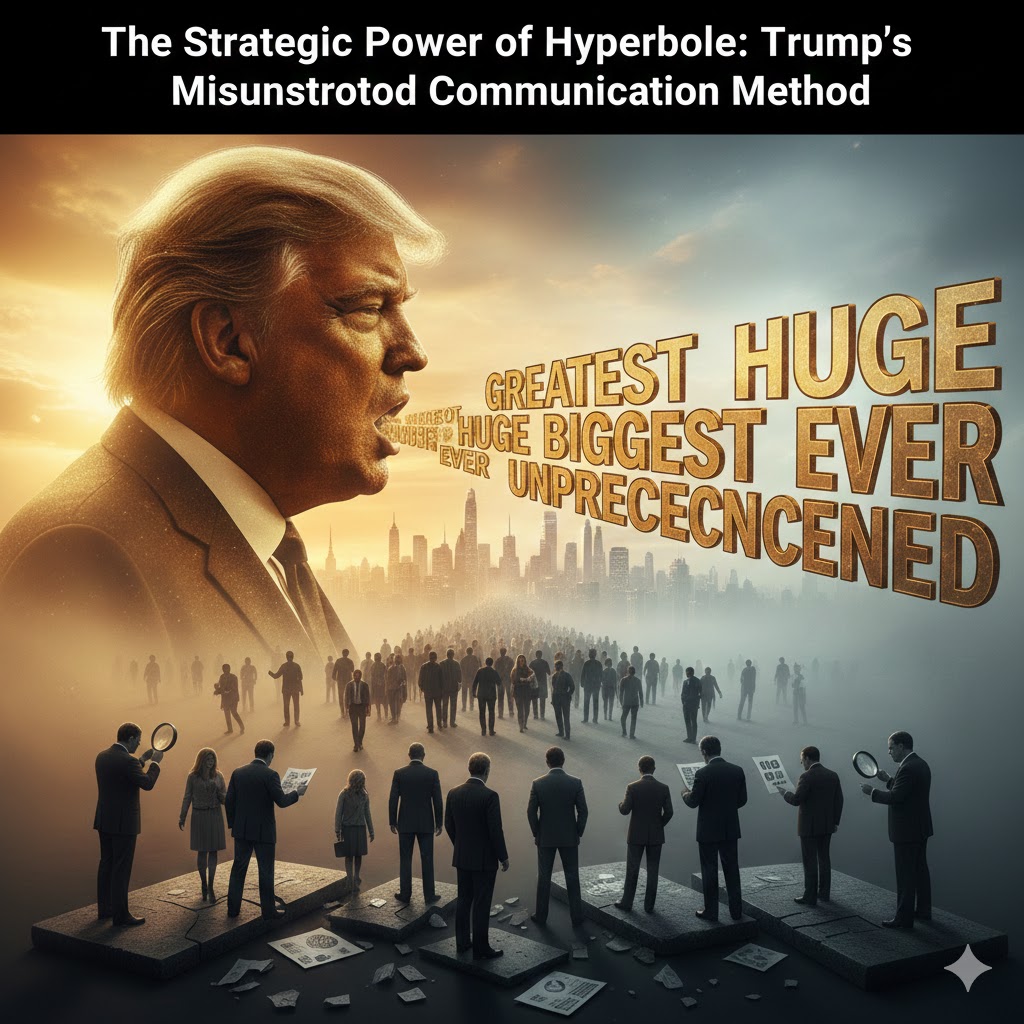
Trump’s communication style cuts through this fog with hyperbolic declarations that create unmistakable direction. When he promises to build “the greatest economy ever” or to achieve results “like nobody’s ever seen,” he’s not making claims meant to be fact-checked against economic data. He’s establishing an aspirational standard and signaling to his administration and supporters that incremental improvement isn’t the goal—transformational results are.
This approach serves multiple leadership functions. First, it eliminates ambiguity about expectations. Second, it creates emotional engagement with policy objectives. Third, it signals confidence and certainty in a way that attracts followership. People don’t rally behind leaders who promise to “make modest improvements where politically feasible.” They rally behind those who promise to “make America great again.”
These are pure applications of Peale’s methodology: declare the victory before it’s achieved, speak with unwavering confidence, and inspire others to believe what seems impossible.
The Failure of Literal Interpretation
The fundamental misunderstanding among Trump’s critics, particularly in media and left-leaning political circles, stems from treating his hyperbolic leadership language as if it were meant to be literally true. When he says a policy will be “the best in history,” critics immediately begin compiling data to disprove the claim, missing entirely that the statement’s purpose isn’t historical accuracy but motivational force.
This literal-minded critique is equivalent to analyzing Rocky’s trainer for promoting violence or suspending football coaches for their pregame speeches. It represents a category error—judging motivational rhetoric by the standards of academic discourse.
Peale faced similar criticism during his ministry. Skeptics dismissed positive thinking as divorced from reality, but Peale understood what his critics did not: the language we use doesn’t merely describe reality—it helps create it by shaping our actions and perseverance.
Leadership requires the ability to move people to action, and action requires clarity, confidence, and emotional engagement. Hyperbole, when properly deployed, serves all three functions. Trump’s approach, deeply rooted in the positive thinking philosophy of Norman Vincent Peale, represents a coherent leadership methodology that his critics may find distasteful or unfamiliar, but their discomfort doesn’t diminish its effectiveness.
In an era that desperately needed leaders willing to set bold directions and demand maximum effort toward achieving them, Trump’s hyperbolic communication style represents not a bug but a feature—one that other leaders would do well to understand and, when appropriate, to emulate. As Peale taught and Trump demonstrated, the leader who thinks and speaks in superlatives creates the conditions for superlative results.
The question facing any leader isn’t whether to use dramatic language, but whether they can inspire their teams to pursue excellence with total commitment. Sometimes that requires telling them to “murder the bum.” And sometimes it requires declaring, with absolute conviction, that you’re going to achieve something greater than anyone has ever seen before.
About the Author