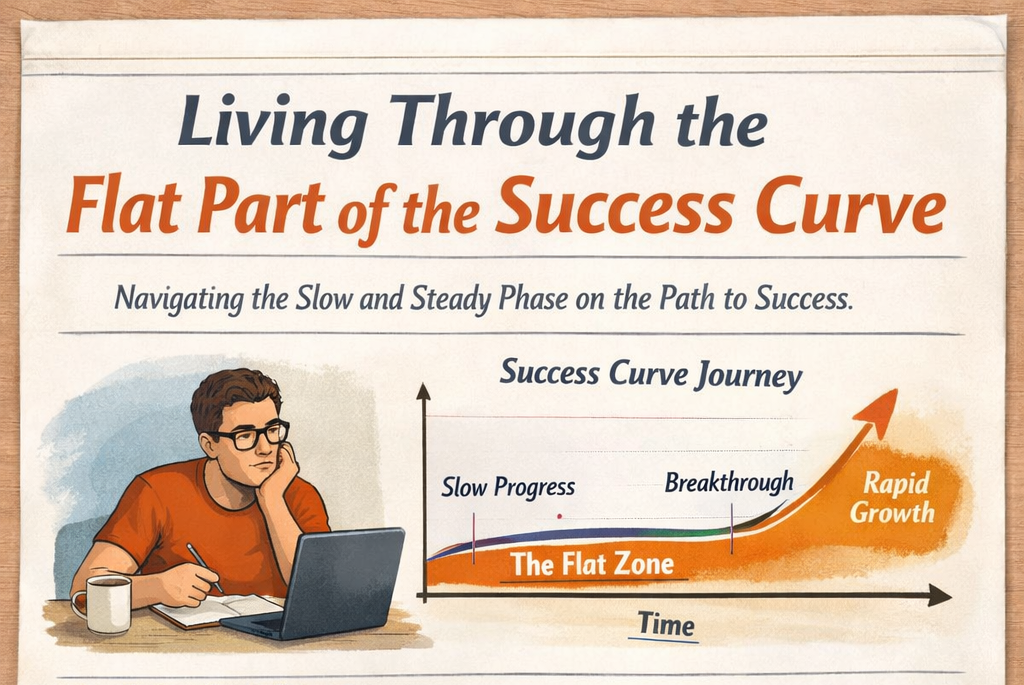
Every success story, when viewed in retrospect, appears as an elegant arc—a smooth ascent from obscurity to triumph. We see the peak and assume the path was clear, the outcome inevitable. But this is the cruelest optical illusion of achievement. What we fail to see, what survivors rarely emphasize, is the interminable flat part of the curve: that brutal, soul-testing plateau where effort produces no visible results, where talent generates no recognition, and where conviction must sustain itself on nothing but its own fumes.
This is not the dramatic valley of failure, where at least you know you’re failing. The flat part is more insidious—it’s the purgatory of ambiguity, where you cannot tell if you’re on the verge of breakthrough or simply deluding yourself. It is here, in this featureless landscape, that most dreams die quietly, not from lack of merit but from exhaustion of spirit.
The Entrepreneur’s Gauntlet
Jeff Bezos, now synonymous with transformative business success, has described raising Amazon’s first million dollars as “the hardest thing I’ve ever done.” The image of Bezos we carry today—the billionaire who reshaped commerce—makes it difficult to imagine him sweating through sixty investor meetings, hearing “no” forty times. But more revealing than the rejections themselves was the process: each “no” required multiple meetings, presentations, follow-ups. Hours of preparation for conversations that led nowhere. The psychological toll of explaining your vision again and again to people who cannot or will not see it is extraordinary.
Twenty investors eventually said yes, contributing roughly $50,000 each. But focus on what this means: Bezos needed to find and convince twenty people willing to bet on an online bookstore when most investors didn’t understand why anyone would buy books without touching them first. The idea that would seem “obvious” in hindsight was nearly un-fundable in reality. The flat part of Amazon’s curve wasn’t a few weeks of struggle—it was months upon months of grinding repetition, of defending a vision that existed only in Bezos’s mind, of maintaining conviction when the external world offered no validation whatsoever.
FL Press Releases and News:
• Florida AI Agency Introduces Microsoft Copilot The AI Game Changer
• Training Programs for Florida Construction
• Cloud vs. Local Computing: Transforming Florida Businesses Through AI-Powered Solutions
• Florida Website Marketing Delivers Marketing Results for Florida Commercial Real Estate
• Top Universities Caught in Fossil Fuel Funding Scandal: $100M in Donations Unveiled
The Decade of Nothing Working
Mustafa Suleyman, now Microsoft’s AI chief, offers an even more stark testimony. He spent a decade at DeepMind, one of the most influential AI research organizations in history, “grinding through the flat part of the curve where basically nothing worked.” A decade. Ten years of brilliant minds attacking problems that refused to yield, of algorithms that failed, of approaches that led to dead ends.
This is the reality obscured by the current AI revolution. We see the breakthrough—the moment when systems suddenly perform tasks we thought impossible. We don’t see the years of researchers staring at screens, tweaking parameters, running experiments that produce nothing but incremental noise. Suleyman’s decade wasn’t wasted time; it was necessary time. The breakthroughs that eventually came were built on the foundation of a thousand failures, each failure teaching something that couldn’t be learned any other way.
The flat part of the curve in cutting-edge research is particularly cruel because you’re navigating unknown territory. There’s no roadmap, no guarantee that your approach will ever work. You’re sustained only by the belief that the problem is solvable and you might be the one to solve it—or at least contribute a piece that someone else will use.
The Artist’s Lifetime of Obscurity
Vincent van Gogh painted approximately 860 oil paintings and more than 1,300 watercolors, drawings, and sketches. During his lifetime, he sold exactly one painting to someone other than family or friends. One. He lived in poverty, struggled with mental illness, and died at 37, convinced he was a failure. Today, his works sell for over $100 million and are considered among the most influential in Western art history.
Van Gogh’s flat part of the curve was his entire life. There was no ascending slope for him to experience, no validation that he was on the right path. He painted because he had to, because the work itself was the only reward he would ever receive. His brother Theo supported him financially, but even that came with the weight of being a burden, of feeling he was wasting someone else’s resources on a dream no one else could see.
What’s remarkable about van Gogh isn’t just that he persisted—it’s that he developed his voice, refined his technique, and produced his most innovative work during years when he had every rational reason to quit. The flat part of his curve required not just persistence but continued growth and experimentation in the absence of any external confirmation that growth mattered.
Even Michelangelo and Leonardo da Vinci, who achieved recognition during their lifetimes, experienced only a fraction of their posthumous glory. Michelangelo was famous, yes, but as a craftsman serving patrons, taking commissions, navigating political intrigue. The reverence we hold for him now—as one of the supreme artistic geniuses in human history—is a modern construction. His lived experience was of a talented professional doing demanding work, not a demigod reshaping culture.
Leonardo died with many of his grandest visions unrealized, his scientific notebooks unappreciated, his engineering designs unbuilt. The Renaissance polymath we celebrate existed more in his private notebooks than in the world’s acknowledgment during his lifetime. He lived on a slowly ascending curve, recognized but not understood, appreciated but not fully valued.
The Psychology of the Plateau
Why is the flat part of the curve so difficult? Because human beings are narrative creatures who need progress as psychological fuel. We can endure hardship if we see we’re moving forward. We can accept slow progress if there’s progress. But the flat part offers neither hardship that feels meaningful nor progress that feels real.
The flat part is characterized by:
Ambiguous feedback: You’re working hard, but you can’t tell if you’re getting better or just spinning your wheels. The entrepreneur takes meetings that feel promising but yield nothing. The researcher runs experiments that produce unclear results. The artist creates work that no one sees.
Social isolation: People pursuing something on the flat part of the curve often can’t explain what they’re doing to others. The vision is too nascent, too weird, too unproven. Friends and family grow concerned. Peers don’t understand. The world moves on while you stay focused on something that doesn’t yet exist.
Resource depletion: The flat part drains time, money, energy, and goodwill. Savings accounts empty. Relationships strain. Opportunities pass by. Every day on the plateau is a day of investment with no return.
Doubt amplification: Without external validation, internal doubt grows louder. Maybe the investors are right. Maybe the experiments are failing because the approach is wrong. Maybe you lack talent. The voice that questions your path has no counterargument except your own increasingly uncertain conviction.
Why the Flat Part Is Where Greatness Begins
Some might argue that accepting life on a flat curve is settling, a loss of ambition or perspective. This misunderstands what the flat part represents. The flat part isn’t where mediocre ideas languish—it’s where every great idea, business, or achievement starts.
The flat part serves several crucial functions:
Selection for genuine belief: Only those who truly believe in what they’re doing will persist through the plateau. The opportunists leave. The dilettantes give up. What remains are people whose commitment is independent of external validation. This selection process is brutal but necessary—most breakthrough achievements require years of work before they produce results, and only those with deep conviction will last.
Time for skill development: Bezos needed those sixty meetings not just to find investors but to refine his pitch, understand objections, and sharpen his vision. Suleyman’s decade of “nothing working” built the expertise that eventually recognized what would work. Van Gogh’s years of painting without recognition allowed him to develop a unique visual language. The flat part is where you accumulate the capabilities you’ll need when opportunity arrives.
Immunity to premature success: Early, easy success often proves poisonous. It creates expectations, attracts the wrong attention, and prevents the deep learning that comes from struggle. The flat part, by withholding rewards, forces you to focus on the work itself rather than the fruits of the work.
Discovery of what matters: When nothing is working and no one is watching, you discover what you actually care about. The elements of your vision that are merely fashionable or ego-driven fall away. What remains is the core—the thing you’d do even if no one ever noticed.
Living Through the Flat Part
How does one survive the plateau? Not with tricks or hacks, but with fundamental reorientations:
Redefine progress: If you measure progress only by external outcomes, the flat part will destroy you. You must find ways to measure progress intrinsically—skills developed, problems understood, work completed. The marathon runner doesn’t experience every training run as thrilling, but measures progress in split times, endurance, form improvements.
Build support structures: Bezos had his wife MacKenzie, who believed in him and supported the risk. Van Gogh had his brother Theo. Suleyman had colleagues at DeepMind who shared the struggle. The flat part is survivable with others who understand what you’re attempting, even if the wider world doesn’t.
Accept the illegibility of your journey: You cannot explain the flat part to those who haven’t experienced it. Stop trying. Your journey won’t make sense to others until it’s over, and by then it will seem inevitable. This illegibility is lonely but liberating—you can stop performing for an audience that isn’t watching anyway.
Practice active patience: This isn’t passive waiting but engaged persistence. You’re not waiting for success; you’re building toward it, even when the building shows no visible progress. The sculptor who chips away at marble for months sees no statue until suddenly, all at once, it emerges.
The Retrospective Illusion
Here’s what makes the flat part so invisible: once you’re past it, even you will struggle to remember how hard it was. Bezos can describe the sixty meetings, but he cannot fully recreate the psychological state of being in them, of not knowing Amazon would work, of wondering if he was wasting everyone’s time. Success retrospectively justifies all the struggle, making it seem meaningful, purposeful, even obvious.
This creates a vicious cycle. New entrepreneurs, artists, and researchers look at successful people and see the arc, not the plateau. They assume their own flat part means they’re failing, not that they’re on the necessary path. They quit at precisely the moment persistence matters most.
The curve of success that we see plotted in biographies and business school case studies is a lie—not because it’s inaccurate, but because it’s incomplete. It shows the data points of achievement but hides the daily experience between those points. The flat part isn’t a feature on the curve; it’s the texture of life that the curve abstracts away.
Every great achievement begins on the flat part of the curve, in that featureless expanse where effort seems to produce nothing, where talent goes unrecognized, where vision appears as delusion. This isn’t the exception—it’s the rule. The peak we see, the moment of recognition or breakthrough, is simply the point at which the external world’s perception catches up to what was being built in obscurity.
Jeff Bezos taking sixty meetings, Mustafa Suleyman grinding through a decade of failed experiments, Vincent van Gogh painting hundreds of masterpieces that no one wanted—these aren’t stories of suffering that preceded success. They’re stories of what success actually looks like while it’s happening. The flat part of the curve isn’t the prelude to greatness; it’s the substance of it.
The hardest truth about achievement is this: you will spend most of your time on the flat part of the curve, and you will never know for certain whether you’re on the verge of breakthrough or simply persisting in a delusion. The curve reveals itself only in retrospect. While you’re living it, there is only the work, the doubt, and the choice to continue.
Those who make it to the peak aren’t necessarily more talented or lucky—they’re simply the ones who kept going when the curve was flat, when nothing worked, when no one was watching. They’re the ones who understood that the flat part isn’t where you wait for greatness to begin. It’s where greatness is forged.
About the Author