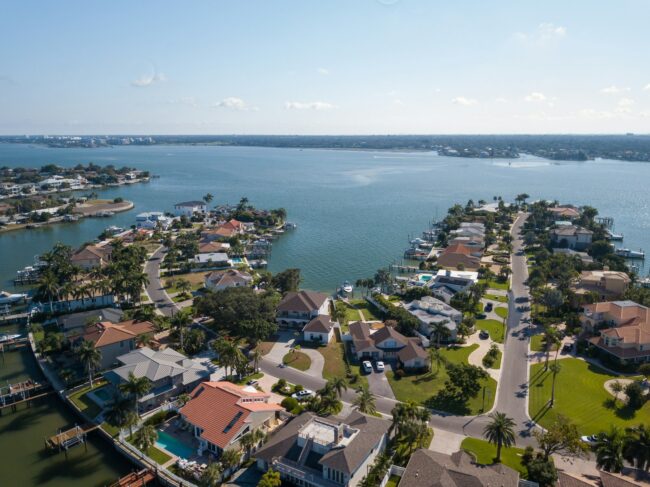
Aerial view of a waterfront residential neighborhood. Photo: Matt Paul via Unsplash, used under the Unsplash License.
Quick Answer: Florida’s population reached an estimated 23,708,635 on April 1, 2026, up 329,374 people, or 1.41%, from a year earlier, according to the state’s Demographic Estimating Conference. Growth is still strong but slowing, because net domestic migration has dropped sharply and deaths continue to outnumber births, leaving all of Florida’s growth dependent on people moving in.
Florida’s population forecast shapes nearly every major public and private decision in the state, from school construction and road funding to housing starts, retail site selection and hospital expansion. Twice a year, the Legislature’s Office of Economic and Demographic Research convenes the Demographic Estimating Conference to update the official numbers.
The conference that met on June 22, 2026, kept Florida on a growth path but lowered its outlook. The materials released with that forecast show a state that is still adding hundreds of thousands of residents a year, but one where the sources of that growth have shifted. This article breaks down the numbers and what they mean for Florida businesses.
How many people live in Florida in 2026?
The conference estimated Florida’s population at 23,708,635 as of April 1, 2026. That is an increase of 329,374 residents, or 1.41%, from the April 1, 2025, estimate of 23,379,261.
Growth slowed from the prior year, when the state added 364,710 people, or 1.58%. The conference summary noted that Florida’s annual growth is roughly the size of a city larger than St. Petersburg but smaller than Orlando. Based on a five-year average, the state is adding about 814 residents per day.
| Date | Florida population | Annual increase | Growth rate |
|---|---|---|---|
| April 1, 2025 | 23,379,261 | 364,710 | 1.58% |
| April 1, 2026 | 23,708,635 | 329,374 | 1.41% |
Source: Florida Demographic Estimating Conference, June 22, 2026.
The U.S. Census Bureau publishes its own estimates on a different date and method. Its July 1, 2025, estimate for Florida was 23,462,518, with growth of 196,680, or 0.85%, according to the conference handouts. State and federal estimates often differ, and Florida’s official planning uses the state conference figures.
Why do Florida and Census population estimates differ?
Florida’s official estimates are produced by the University of Florida’s Bureau of Economic and Business Research (BEBR) and adopted by the state conference. The Census Bureau uses its own methods. The handouts show how much the two can diverge.
Through April 1, 2025, the BEBR estimate of 23,379,261 was 34,087 lower than an adjusted Census figure of 23,413,348, a gap of about 0.15%. For 2020 through 2025, BEBR estimated net migration of 1,942,163, while the Census Bureau estimated 2,023,675. The handouts also note that the 2020 Census undercounted Florida by about 3.48%, or roughly 750,000 people, which affects how later estimates are built.
BEBR’s track record supports the state’s approach. According to the handouts, its 2020 state estimate came within 0.3% of the Census count, and its county estimates for 2010 to 2020 had a mean absolute percentage error of 2.8%.
The next major federal update is due soon. The handouts list December 2026 for the Census Bureau’s Vintage 2026 estimates, which will offer a new federal view of Florida’s 2026 growth.
How fast will Florida grow through 2036?
The new forecast calls for steady but gradually slowing growth. From April 2026 to April 2030, the conference expects an average of about 297,200 net new residents a year, a compound annual growth rate of 1.24%. Annual growth is projected to fall below 1% for the first time in 2032.
| April 1 | Forecast population | Annual growth | Net change | Change from prior forecast |
|---|---|---|---|---|
| 2027 | 24,018,133 | 1.31% | 309,498 | -25,436 |
| 2028 | 24,314,412 | 1.23% | 296,279 | -31,453 |
| 2029 | 24,596,952 | 1.16% | 282,540 | -37,684 |
| 2030 | 24,865,263 | 1.09% | 268,311 | -43,765 |
| 2031 | 25,119,490 | 1.02% | 254,227 | -49,787 |
| 2032 | 25,359,482 | 0.96% | 239,992 | -55,864 |
| 2033 | 25,585,044 | 0.89% | 225,562 | -61,808 |
| 2034 | 25,798,101 | 0.83% | 213,057 | -67,648 |
| 2035 | 26,001,185 | 0.79% | 203,084 | -73,426 |
| 2036 | 26,194,402 | 0.74% | 193,217 | -79,137 |
Source: Florida Demographic Estimating Conference, June 22, 2026.
By 2030, the forecast puts Florida at about 24.9 million people, roughly 1.16 million more than in 2026. By 2036, the state is expected to pass 26.1 million, about 2.49 million more than today. Each year in the new forecast is lower than in the previous forecast, and the gap widens over time, reaching 79,137 fewer residents by 2036.
Why is Florida’s population growth slowing?
The conference materials point to two forces: a natural decrease and a sharp drop in domestic migration.
More deaths than births
Florida has recorded more deaths than births every year since fiscal year 2020-21, according to the conference summary. The conference concluded that “all of Florida’s population growth is due to positive net migration.”
Florida Department of Health data included in the conference handouts show the gap has narrowed but not closed. Provisional 2025 figures show 223,378 births and 227,180 deaths, a natural decrease of 3,802.
| Year | Births | Deaths | Natural change |
|---|---|---|---|
| 2020 | 209,645 | 239,381 | -29,736 |
| 2021 | 216,189 | 261,246 | -45,057 |
| 2022 | 224,403 | 238,953 | -14,550 |
| 2023 | 221,413 | 229,045 | -7,632 |
| 2024 | 224,423 | 228,537 | -4,114 |
| 2025 (provisional) | 223,378 | 227,180 | -3,802 |
Source: Florida Department of Health data as presented in the Demographic Estimating Conference handouts, June 22, 2026.
Domestic migration has fallen
The bigger change is in migration from other states. Census Bureau Vintage 2025 data presented to the conference show net domestic migration to Florida peaked at 310,892 in 2022, then fell to 183,646 in 2023, 58,411 in 2024 and 22,517 in 2025. That is a decline of about 93% in three years.
Net international migration also fell from its 2023 peak of 333,449 to 178,674 in 2025, a decline of about 46%. Even so, international migration accounted for most of Florida’s net migration in 2025.
| Year | Net international migration | Net domestic migration | Total net migration | Natural change |
|---|---|---|---|---|
| 2021 | 46,857 | 253,220 | 300,077 | -42,010 |
| 2022 | 287,845 | 310,892 | 598,737 | -38,062 |
| 2023 | 333,449 | 183,646 | 517,095 | -7,571 |
| 2024 | 283,664 | 58,411 | 342,075 | -8,039 |
| 2025 | 178,674 | 22,517 | 201,191 | -1,333 |
Source: U.S. Census Bureau Vintage 2025 estimates as presented in the Demographic Estimating Conference handouts. Total net migration is the sum of the two migration columns.
The conference summary said the April 2026 estimate for net domestic migration was lowered, erasing part of an increase in the prior forecast, and that the forecast assumes the lower baseline continues. The forecast for net international migration was unchanged.
Who is moving to Florida?
American Community Survey data in the handouts show which age groups drive domestic net migration. In 2024, Florida gained the most residents in their 50s, 60s and 70s, while it lost residents in their 20s and 30s.
| Age group | Net migration to Florida, 2024 |
|---|---|
| 0 to 9 | 2,111 |
| 10 to 19 | 2,140 |
| 20 to 29 | -7,458 |
| 30 to 39 | -5,488 |
| 40 to 49 | 5,808 |
| 50 to 59 | 21,469 |
| 60 to 69 | 28,043 |
| 70 to 79 | 16,126 |
| 80 to 89 | 5,369 |
| 90 and older | -323 |
Source: American Community Survey data as presented in the Demographic Estimating Conference handouts.
Residents 50 and older accounted for net gains of more than 70,000 in that year’s ACS data, while Floridians in their 20s and 30s left on net. The same ACS series shows about 578,429 people moving into Florida from other states in 2024 and about 510,632 moving out, a far smaller gap than in 2022.
How important is international migration to Florida?
International migration has become the largest single source of Florida’s growth. The conference handouts show cumulative net international migration of 1,133,327 from 2020 to 2025. Florida’s foreign-born population was 5,392,412 in 2024, or 23.1% of residents, and 2,958,705 foreign-born residents were naturalized citizens.
The handouts estimate that Florida typically receives about 14% of net international migration to the United States, within a range of 10% to 17%. They also show U.S. Customs and Border Protection encounters attributed to Florida fell from 289,413 in fiscal 2024 to an annualized pace of about 31,455 in fiscal 2025, a decline of about 89%.
The conference presented several rough scenarios for future international migration based on national projections, but the adopted Florida forecast kept its international migration assumption unchanged. Because international migration now carries more of the state’s growth, changes in national immigration levels can have an outsized effect on Florida’s future population.
Which Florida areas are growing and shrinking?
The handouts include a few local highlights from the Census Bureau’s 2025 estimates. The Ocala metro area was the fastest-growing metro area in the nation, at 3.4%. Clewiston ranked as the second-fastest-growing micropolitan area, at 2.9%.
Some coastal counties lost population. Pinellas County’s decline of 11,834 residents was the second-largest numeric drop among U.S. counties, and Taylor County’s 2.2% decline was the largest percentage drop among Florida counties with at least 20,000 people on the national list. Miami-Dade County, the state’s largest, had 2,802,029 residents as of July 1, 2025.
| Area highlight (Census 2025) | Figure |
|---|---|
| Ocala metro growth rate | 3.4%, fastest-growing U.S. metro |
| Clewiston micro area growth rate | 2.9%, second-fastest U.S. micro area |
| Pinellas County change | -11,834, second-largest U.S. county numeric decline |
| Taylor County change | -2.2% |
| Miami-Dade County population | 2,802,029 |
Source: Demographic Estimating Conference handouts, June 22, 2026.
What do housing, utility and school data show?
The conference uses other indicators to check its estimates, and several of them point in the same direction as the migration data.
| Indicator | Earlier figure | Later figure | Change |
|---|---|---|---|
| Census housing units (July 1) | 10,627,805 (2024) | 10,789,047 (2025) | About +1.5% |
| Residential building permits | 210,189 (2024) | 198,529 (2025) | -5.5% |
| Residential electric customers (March) | 10,332,652 (2024) | 10,545,825 (2025) | +2.06% |
| Public K-12 enrollment | 2,806,576 (2024) | 2,798,157 (2025) | -8,419 |
| Private K-12 enrollment | 416,942 (2024) | 446,339 (2025) | +29,397 |
| Home education enrollment | 155,532 (2024) | 152,871 (2025) | -2,661 |
| Total K-12 enrollment | 3,379,050 (2024) | 3,397,367 (2025) | +18,317 |
Source: Demographic Estimating Conference handouts, June 22, 2026.
Housing permits fell in 2025 even as the number of housing units and electric customers kept growing. Total K-12 enrollment rose slightly, but all of the gain came from private schools, while public school enrollment declined.
What do the population numbers mean for Florida businesses?
Population growth is one of Florida’s most important economic engines, and the new forecast changes the outlook in several ways.
- Growth continues, but at a lower level. The state is still expected to add about 300,000 residents a year through 2030, a large market by national standards.
- Demand is shifting inland. Fast growth in places like Ocala and declines in some coastal counties suggest housing and retail demand is spreading to more affordable areas.
- Labor supply depends on migration. With deaths exceeding births, new workers must come from other states and countries. Florida’s labor force was 11,121,794 in 2025, according to the conference handouts, and domestic net migration among people in their 20s and 30s was negative in 2024.
- Older newcomers shape demand. Net gains are concentrated among residents 50 and older, which supports demand for health care, leisure and age-friendly housing.
- Education demand is shifting. Private school enrollment grew by nearly 30,000 students in 2025 while public enrollment declined.
- International ties matter more. With international migration now the largest source of net migration, Florida’s economy is closely linked to national immigration levels.
- Long-term plans need revisiting. Businesses that used older forecasts for site selection, staffing or capital planning may need to adjust for a smaller future population.
The conference also noted that the end of the decade marks the entry of the final baby boomer groups into retirement, which it described as an inflection point. For a state with a large retiree base, that shift may affect health care, housing and services demand in the years ahead.
Frequently Asked Questions
What is Florida’s population in 2026?
Florida’s official estimate is 23,708,635 as of April 1, 2026, according to the state’s Demographic Estimating Conference.
How many people move to Florida per day?
Florida’s population grew by about 814 residents per day based on a five-year average. Net growth includes all arrivals, departures, births and deaths, so it is not the same as the number of people moving in.
Why is Florida’s growth slowing?
Net domestic migration fell from 310,892 in 2022 to 22,517 in 2025, according to Census data presented to the conference, and deaths have exceeded births every year since fiscal 2020-21.
What will Florida’s population be in 2030?
The June 2026 forecast projects 24,865,263 residents on April 1, 2030, about 43,765 fewer than the previous forecast.
Which age groups are moving to Florida?
In 2024 ACS data, Florida’s largest net gains came from residents ages 50 to 79, while it saw net losses among people in their 20s and 30s.
Where is Florida growing fastest?
The Ocala metro area was the fastest-growing metro in the United States in the Census Bureau’s 2025 estimates, at 3.4%.
Sources and Further Reading
- Florida Demographic Estimating Conference Executive Summary, June 22, 2026 — Florida Office of Economic and Demographic Research
- Demographic Estimating Conference Handouts, June 22, 2026 — Florida Office of Economic and Demographic Research
About the Author