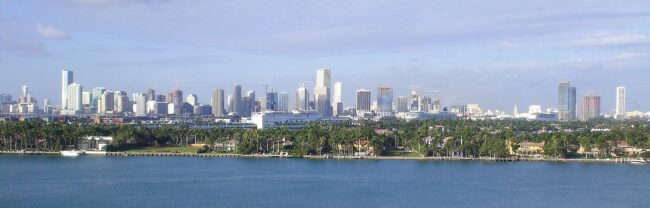
Miami skyline as seen from Miami Beach. Photo by Marc Averette, via Wikimedia Commons (public domain).
Quick Answer: Florida’s inflation-adjusted economy grew at about a 3.0% annual rate in the second quarter of 2026, reaching $1.41 trillion in chained 2017 dollars, according to U.S. Bureau of Economic Analysis data released September 30, 2026. That beat the national rate of 2.2%. Information, wholesale trade and finance led growth, while construction, retail and transportation were flat to down, and state economists expect growth to slow to about 2.0% in fiscal 2026-27.
Florida’s economy picked up speed in the spring of 2026. New state-level gross domestic product figures from the U.S. Bureau of Economic Analysis (BEA), published September 30 alongside the agency’s annual revision of state accounts, show Florida’s real output rising faster in the second quarter than in the first, and faster than the nation as a whole. The details also show an economy whose growth is shifting away from the construction and real estate engines that powered the post-pandemic boom. This report uses BEA data as published by the Federal Reserve Bank of St. Louis, the BEA’s national release, and the Florida Legislature’s Office of Economic and Demographic Research (EDR).
How fast did Florida’s economy grow in 2026?
Florida’s real GDP was $1,411.3 billion at a seasonally adjusted annual rate in the second quarter of 2026, measured in chained 2017 dollars, up from $1,400.9 billion in the first quarter. That works out to annualized growth of about 3.0%. Compared with the second quarter of 2025, when real GDP was $1,369.9 billion, Florida’s economy was about 3.0% larger, an increase of roughly $41 billion in inflation-adjusted output in one year.
For comparison, U.S. real GDP grew at a 2.2% annual rate in the second quarter of 2026, according to BEA’s third estimate. Nationally, real GDP increased in 44 states and the District of Columbia, with growth ranging from 4.0% in New York to a decline of 2.3% in West Virginia.
| Quarter | Florida real GDP (chained 2017 $, billions, SAAR) | Annualized growth |
|---|---|---|
| Q3 2024 | $1,346.7 | n/a |
| Q4 2024 | $1,355.7 | 2.7% |
| Q1 2025 | $1,362.2 | 1.9% |
| Q2 2025 | $1,369.9 | 2.3% |
| Q3 2025 | $1,381.9 | 3.5% |
| Q4 2025 | $1,392.7 | 3.1% |
| Q1 2026 | $1,400.9 | 2.4% |
| Q2 2026 | $1,411.3 | 3.0% |
Source: U.S. Bureau of Economic Analysis, Real GDP: All Industry Total in Florida, via Federal Reserve Economic Data (FRED), vintage updated September 30, 2026. Annualized growth rates calculated from quarterly levels.
Why do the Q1 2026 numbers look different from earlier reports?
Because BEA revised them. EDR’s August 24, 2026 economic overview, based on the data available before the annual update, reported Florida’s first-quarter 2026 real growth at a 1.6% annualized rate, ranked 22nd in the nation, versus 2.1% for the United States. The September 30 vintage now puts Florida’s first-quarter growth at about 2.4% annualized. BEA’s annual update revised several years of state data, so comparisons should use figures from a single vintage. Florida’s Q2 2026 rank among states was not stated in BEA’s release text.
How big is Florida’s economy compared with prior years?
In the September 2026 vintage of BEA’s annual series, Florida’s real GDP was $1,376.7 billion in 2025, up about 2.8% from $1,338.8 billion in 2024. Florida’s real output grew about 17.5% from 2021 to 2025, with growth slowing each year after the 2022 surge.
| Year | Florida real GDP (chained 2017 $, billions) | Annual growth |
|---|---|---|
| 2021 | $1,171.7 | n/a |
| 2022 | $1,246.9 | 6.4% |
| 2023 | $1,300.0 | 4.3% |
| 2024 | $1,338.8 | 3.0% |
| 2025 | $1,376.7 | 2.8% |
Source: BEA via FRED, annual series updated September 30, 2026. Growth calculated from annual levels.
The earlier vintage told a slightly stronger story for 2025. The National Association of Home Builders, analyzing BEA’s April 2026 state release, reported that Florida and South Carolina tied for the fastest real GDP growth in the nation in 2025 at 3.1%, compared with 2.1% nationally. After the annual revision, Florida’s 2025 growth calculates to about 2.8%, still well above the national pace reported in April.
Which industries are driving Florida’s growth?
The industry breakdown for the second quarter of 2026 shows growth concentrated in information, wholesale trade, finance and real estate, with retail, transportation and construction flat or down.
| Florida industry | Q2 2026 real GDP ($B) | Q2 2025 real GDP ($B) | Change ($B) | Change (%) |
|---|---|---|---|---|
| Real estate, rental and leasing | $297.1 | $289.1 | +$8.0 | +2.8% |
| Information | $79.4 | $70.7 | +$8.7 | +12.4% |
| Wholesale trade | $83.4 | $79.6 | +$3.7 | +4.7% |
| Finance and insurance | $86.0 | $82.3 | +$3.7 | +4.5% |
| Retail trade | $99.0 | $99.3 | -$0.2 | -0.2% |
| Transportation and warehousing | $46.7 | $46.8 | -$0.1 | -0.3% |
| Construction (Q1 2026 vs. Q1 2025) | $64.7 | $65.2 | -$0.6 | -0.8% |
Chained 2017 dollars, seasonally adjusted annual rates. Construction data shown from the June 2026 vintage, the latest available on the series page reviewed. Source: BEA via FRED; changes calculated.
Why is the information sector growing so fast in Florida?
Florida’s information sector, which includes software publishing, data processing, telecommunications and media, added about $8.7 billion in real output over the year, the largest dollar gain of any industry in the table and a 12.4% increase. That growth came even as the sector shed workers. The Florida Chamber’s 2026 mid-year report said information and finance and insurance, both of which pay average wages above $130,000, had the largest percentage job losses of any Florida industries. Output rising while employment falls means each remaining worker is producing more, consistent with automation and productivity gains in high-wage sectors.
Nationally, BEA said real estate, information, durable goods manufacturing, and finance and insurance were the leading contributors to second-quarter growth, while transportation and warehousing, retail trade and nondurable goods manufacturing were the leading offsets. Florida’s industry pattern closely tracks that national mix.
Is Florida’s construction and real estate boom fading?
Construction output was down slightly year over year in the latest data, and EDR’s August forecast cited “continued deceleration in construction and real estate,” along with slowing tourism, as factors in its revenue outlook. Real estate, rental and leasing remains Florida’s largest single industry by output at $297.1 billion and still grew 2.8%, but that is slower than the economy’s 3.0% overall pace.
What was the national economy doing in the second quarter?
BEA’s third estimate revised U.S. second-quarter growth up to 2.2% from 1.5% in the earlier estimates, and revised first-quarter growth to 2.5%. Real final sales to private domestic purchasers, a measure of underlying private demand, grew at a 4.6% rate. Inflation remained elevated: the PCE price index rose at a 5.0% annual rate and 3.3% excluding food and energy. Corporate profits from current production increased $384.0 billion in the quarter. Florida’s 3.0% pace came against that backdrop of solid demand and high inflation, which is why the real, inflation-adjusted figures in this report matter more than current-dollar totals.
What about Florida personal income and consumer spending?
BEA’s September 30 release reported that personal income increased in 49 states and the District of Columbia in the second quarter of 2026, with rates ranging from 6.4% in Wisconsin to a decline of 4.2% in North Dakota. The release text did not state Florida’s second-quarter personal income growth. EDR reported that Florida’s first-quarter 2026 personal income grew at a 3.4% annualized rate, ranked 25th and matching the U.S. rate.
Florida stood out on consumer spending. BEA reported that current-dollar personal consumption expenditures grew 5.3% nationally in 2025, and Florida had the fastest growth of any state at 7.0%. California had the slowest at 4.2%. Health care and housing and utilities were the leading contributors to spending growth in most states, including Florida.
What do Florida’s state economists forecast?
EDR’s August 24, 2026 overview summarized the state’s official forecasts. They predate the September GDP revision.
| Florida indicator | Figure | Period |
|---|---|---|
| Real GDP growth | 3.3% | FY2024-25 (actual) |
| Real GDP growth | 2.5% | FY2025-26 (projected) |
| Real GDP growth | 2.0% | FY2026-27 (forecast) |
| Real GDP growth | 2.7% | FY2027-28 (forecast) |
| Personal income growth | 5.6% | FY2024-25 |
| Personal income growth | 4.5% | FY2025-26 (preliminary) |
| Nonfarm job growth, year over year | 0.4% (U.S. 0.2%) | July 2026 |
| Unemployment rate | 4.6% (U.S. 4.1%) | July 2026 |
| Average wage as share of U.S. | 92.4% (87.3% in 2020) | 2025 |
| General Revenue forecast | $52,339.9 million | FY2026-27 (August 2026) |
| Population growth forecast | 1.20% per year (U.S. 0.41%) | 2026 to 2030 |
Source: Florida Legislature Office of Economic and Demographic Research, Florida Economic Overview, August 24, 2026. Fiscal years run July through June.
After fiscal 2027-28, EDR expects real growth to settle at about 2.2% a year. Personal income growth is forecast to rise to 6.3% in fiscal 2027-28 before settling at 4.6% to 4.8% a year. The August General Revenue forecast of $52,339.9 million for fiscal 2026-27 was up 0.9% from the January 2026 estimate of $51,864.8 million.
Is Florida’s job market keeping up with GDP?
Not entirely. Florida’s unemployment rate was 4.6% in July 2026, half a point above the national 4.1%, representing 514,500 people, and EDR expects 4.9% for the current fiscal year before easing to 4.7% in fiscal 2027-28. The Florida Chamber reported five months of year-over-year job losses from November 2025 through April 2026, followed by gains in April, May and June. Florida’s GDP growth in the same period suggests output is growing faster than employment.
How is Florida’s economic output distributed across the state?
Unevenly. EDR reported Florida’s per capita real GDP at $58,757 in 2024. Orange County, home to Orlando, had the highest per capita GDP at $83,168, while Dixie County had the lowest at $18,023. Thirteen counties saw per capita GDP decline between 2023 and 2024.
What role do population and tourism play?
Population growth remains Florida’s structural advantage. EDR reported that Florida has added more than 2.1 million net residents since the 2020 Census count of 21,538,187 and expects the state to pass 24 million residents in 2027 and 25 million by 2031. The Florida Chamber estimated that about 551 people move to Florida per day, down from the 2020 to 2023 peak, and that 89% of 2025 net migration came from other countries.
Tourism is growing more slowly. EDR’s forecast calls for 145.8 million visitors in fiscal 2026-27, growth of 1.8%, after just 0.7% growth in fiscal 2025-26, with 2.7% growth expected in fiscal 2027-28. Slower tourism growth was one of the factors EDR cited in its revenue outlook.
Brian’s Take
The headline is good: Florida grew about 3.0% in the second quarter against 2.2% for the country, and the economy added roughly $41 billion in real output in a year. But the line that stands out to me is the information sector. It added about $8.7 billion of output, up 12.4%, during a period when the Florida Chamber says information was among the industries losing the largest share of jobs. That is what productivity growth looks like at the industry level, and it means Florida can post strong GDP while unemployment sits above the national rate.
The second thing I watch is the mix. Construction is slightly down, retail and transportation are flat, and the state’s own economists flagged deceleration in construction and real estate. For two decades, Florida’s growth leaned on building and selling homes to new residents. The current numbers show growth coming more from finance, wholesale distribution and information. That is a healthier long-run mix, but it rewards a different kind of worker and business.
Finally, I would not lean too hard on any single quarter. BEA’s annual revision moved Florida’s first-quarter growth from 1.6% to about 2.4% and trimmed 2025. The state’s forecasters still expect growth to slow to 2.0% in fiscal 2026-27. Florida businesses should plan around solid but slower growth, not a return to the 2022 pace.
Frequently Asked Questions
How fast is Florida’s economy growing?
Florida’s real GDP grew at about a 3.0% annualized rate in the second quarter of 2026 and was about 3.0% larger than a year earlier, based on BEA data released September 30, 2026.
How big is Florida’s economy?
Florida’s real GDP was $1,411.3 billion at an annual rate in the second quarter of 2026, measured in chained 2017 dollars.
Is Florida growing faster than the U.S.?
Yes, in the second quarter of 2026. Florida grew about 3.0% annualized compared with 2.2% for U.S. real GDP.
Which Florida industries grew the most?
Information grew 12.4% year over year, wholesale trade 4.7%, finance and insurance 4.5%, and real estate 2.8%. Retail, transportation and construction were flat to slightly down.
What is Florida’s GDP forecast for 2026-27?
The state’s Office of Economic and Demographic Research forecast real GDP growth of 2.0% for fiscal 2026-27, rising to 2.7% in fiscal 2027-28.
When is the next state GDP release?
BEA lists its next GDP by state release for December 23, 2026.
Sources and Further Reading
- GDP (Third Estimate), Industries, Corporate Profits, State GDP, and State Personal Income, 2nd Quarter 2026; State PCE, 2025. U.S. Bureau of Economic Analysis.
- GDP by State. U.S. Bureau of Economic Analysis.
- Real Gross Domestic Product: All Industry Total in Florida, quarterly and annual series, plus industry series. Federal Reserve Bank of St. Louis, FRED and ALFRED.
- Florida Economic Overview, August 24, 2026. Florida Legislature Office of Economic and Demographic Research.
- 2026 Florida Economic and Business Mid-Year Report. Florida Chamber of Commerce.
- 2025 Regional and State-Level GDP Data. National Association of Home Builders, Eye on Housing.
About the Author